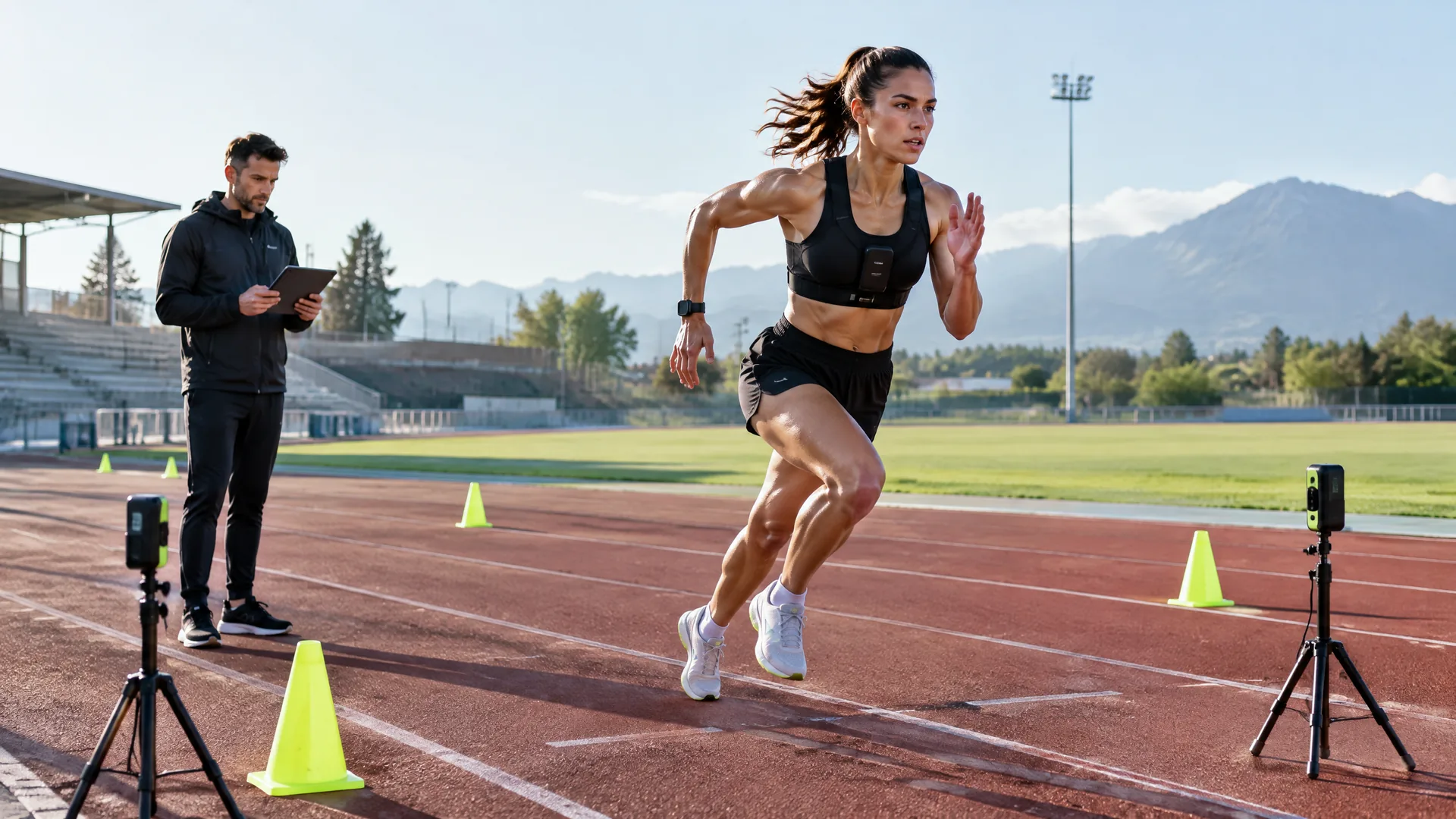
What counts as wearable technology in sports
Wearable technology in sports is equipment worn on or attached close to an athlete that records, transmits or presents information about movement, location, physiological response or the surrounding environment. A wrist device, chest strap, sensor unit in a garment, instrumented insole, optical sensor and ear-worn unit can all be wearables when they collect a signal during sport or recovery. The label does not make an output useful. Its value depends on what the device actually detects, how the signal is processed and whether the resulting measure fits the decision at hand.
It helps to separate a direct signal from a derived metric. An accelerometer detects acceleration; a positioning receiver estimates location; an optical sensor detects changes in reflected light related to blood volume. Distance, top speed, workload score and readiness indicator are derived metrics: software combines raw signals, assumptions and rules to produce them. Coaches and athletes should ask what has been measured, over what time window, and what uncertainty enters before treating a displayed number as evidence.
Device and signal families
Positioning systems estimate where an athlete is and how that position changes. Outdoors, satellite-based location can support estimates of distance, speed and route; its usefulness can fall where signals are blocked or reflected. In indoor settings, local positioning systems may estimate position from installed reference points. Inertial measurement units combine accelerometers and gyroscopes to describe acceleration and rotation. They can identify repeated movement patterns or impacts, but estimates of distance, orientation and events depend on algorithms, sensor placement and the movement being studied.
Physiological wearables commonly use electrical, optical, temperature or pressure signals. A chest-based electrical signal can identify heart beats; an optical sensor estimates pulse-related changes near the skin. Insoles and force-sensitive systems may measure pressure distribution, while muscle or respiration sensors may capture a narrower response. Each family answers a different question and has different error sources, including motion artefact, poor contact, sweat, skin characteristics, garment fit, battery condition and signal loss. A single dashboard can hide those differences, so outputs should not be treated as interchangeable.
From measurement to a decision
The practical chain is measurement, interpretation, decision and review. Start with a decision that a staff member or athlete can actually change, such as adapting a session, checking a return-to-training plan or reviewing a tactical drill. Then select a measure with a plausible connection to that decision, define a comparison point and set out who will review it. A baseline is an athlete's own reference range gathered under comparable conditions; it is usually more informative than a generic target because bodies, roles and training histories differ.
A wearable output should be one input, not an automatic instruction. For example, an unexpected change in movement output may lead to a conversation about drill design, fatigue, equipment, illness, travel, motivation or a sensor problem. The next step might be to repeat the measure, compare video or session records, or monitor the pattern over time. Record the decision and its rationale. This makes later review possible and prevents a number from acquiring authority merely because it is precise-looking.
Context changes the meaning
The same distance, heart-rate pattern or acceleration count can mean different things in a match, a conditioning session and a rehabilitation drill. Surface, heat, altitude, travel, footwear, opposition, role, tactical instructions, session duration and prior work all alter the interpretation. Sampling rate is the number of sensor observations taken each second; a higher rate does not by itself guarantee a better answer. Data processing choices, filtering and the device's ability to track the relevant movement also shape the output.
Context matters especially in India, where training can occur across high heat, monsoon conditions, uneven facilities, variable connectivity and multiple languages. A measurement protocol should state the setting, device placement, activity type and any interrupted or missing recording. It should also be accessible: athletes need an explanation they can understand, not only a colour-coded score. Ask whether the workflow works for athletes with different communication needs, devices, body sizes and access to support. A useful system adapts to the sporting environment rather than asking every athlete to adapt to the system.
Validation before use
Validation asks whether an output is sufficiently accurate for a defined purpose when compared with an appropriate reference method. Reliability asks whether repeated measurements under similar conditions are consistent. A device can be reliable but consistently wrong, or accurate in a controlled test but unreliable in a fast, contact-heavy sport. Both properties matter, along with sensitivity to meaningful change: the ability to distinguish a genuine athlete change from ordinary measurement noise.
Before an output affects workload, selection or rehabilitation discussions, test it in the intended setting. Use a short protocol with consistent placement, documented firmware and processing settings, repeated trials and a sensible comparison reference where available. Check missing data, implausible values and agreement across sessions. Define in advance what result would trigger a review rather than a decision. The specialist guide wearable technology validation examines this process in greater depth; this hub's point is that a polished interface is not validation.
Athlete data rights and safeguards
Wearable records can reveal routines, location, performance patterns and information that an athlete may regard as sensitive. Data governance is the set of rules that determines what is collected, why it is collected, who can see it, how long it is kept and how it is deleted. Informed consent means an athlete receives a clear explanation of those points and has a meaningful chance to ask questions. In settings with unequal bargaining power, consent should not become a formality or a condition that silently removes an athlete's voice.
A sound programme uses data minimisation: collect only what is needed for the stated purpose. It assigns access by role, protects accounts and devices, keeps an audit trail of exports or changes, and establishes retention and deletion rules. Athletes should know how to view or correct their record, who receives summaries, and what happens if they stop participating. Parents or guardians require particular care when athletes are minors. Data should not be reused for unrelated profiling, public comparison or commercial purposes without a separate, understandable basis and appropriate safeguards.
Limits of wearable outputs
Wearables observe proxies, not the whole athlete. A proxy is a measurable signal used as an indirect stand-in for something harder to observe, such as effort, fatigue or readiness. A heart-rate response may reflect temperature, hydration, emotion or device contact as well as training load. Movement counts cannot establish skill quality, tactical intent, pain, recovery status or risk on their own. Algorithms may also embed assumptions drawn from populations or conditions that do not match the athlete using the device.
False precision is the impression that a decimal or ranking is more certain than the underlying measurement supports. Treat thresholds, readiness scores and single-session changes cautiously, particularly when placement, conditions or software versions change. Staff should retain the option to say that the data are insufficient, conflicting or not applicable. Wearables can support observation and dialogue, but they do not replace coaching judgement, athlete self-report, qualified clinical assessment where needed, or fair processes for selection and participation.
Choose the next specialist guide
Use this hub as a map rather than a device manual. When the question is how to turn outdoor movement records into a training conversation, continue with GPS tracking for training decisions. For indoor movement measurement and the uncertainty behind apparently exact outputs, see indoor inertial sensors. If a metric could influence opportunity, workload or a high-stakes discussion, use wearable technology validation to structure the checks before it carries that weight.
Sport-specific decisions also need sport-specific context. For bowling workload, movement signals, session records and the athlete's account should be reviewed together; wearable sensors for cricket fast bowlers provides that focused route. Across every guide, keep the same discipline: identify the decision, understand the measure, document conditions, test the output, protect the athlete's data and state the limits. That approach makes technology easier to scrutinise and less likely to displace the person it is meant to support.