What CAB announced
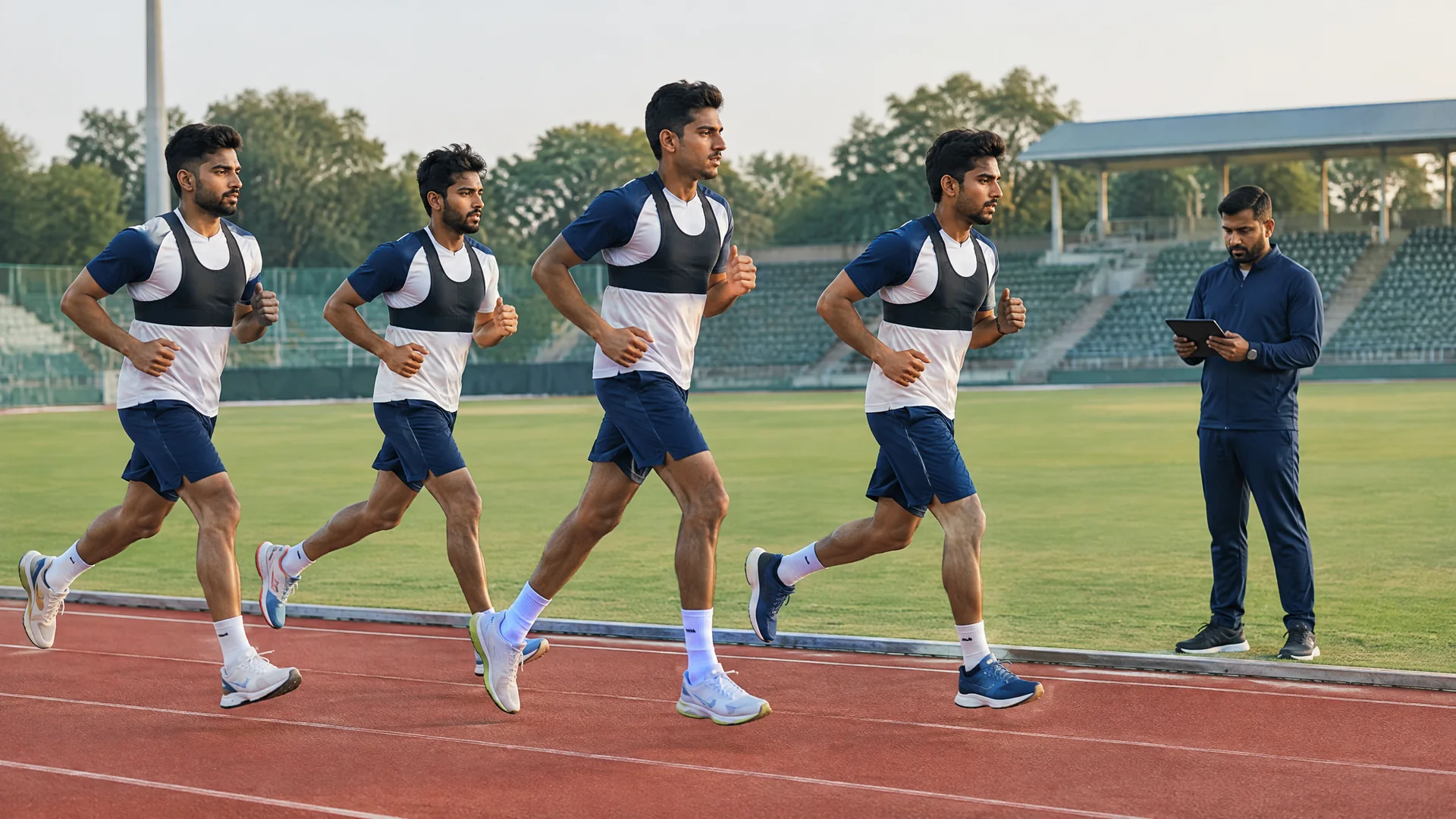
The Cricket Association of Bengal says it has introduced wearable GPS technology for Bengal senior and age-group players before the 2026–27 BCCI domestic season. In the documented session, Bengal senior men's players wore Catapult vests while training at the Synthetic Running Track at SAI Salt Lake under senior men's strength and conditioning coach Snjeeb Chowdhury. The official announcement makes this a specific association-level deployment rather than a general claim about wearable adoption across Indian cricket. It does not establish a BCCI-wide programme or use by every Bengal player.
The stated purpose is workload monitoring
CAB describes the intended use as monitoring fitness and workload, reviewing training loads, following player development and supporting rehabilitation and return-to-play processes. Those are intended operating uses stated by the association. They are not results. A vest can capture movement-related signals, but staff still need to decide what a session was meant to achieve, whether the recording is complete and how the output compares with the player's role and recent work. SportyTechs' guide to turning GPS tracks into training decisions explains that decision chain in more detail.
A vest does not measure the whole athlete
Player-tracking wearables can estimate external load through measures such as distance, speed zones, accelerations and time spent in defined movement bands. The CAB announcement does not publish the exact model, sampling settings, metrics, thresholds or dashboard used in this programme. It also does not show whether every output is GPS-derived or combined with other sensors. The correct page-level conclusion is therefore limited: players wore monitoring vests during the named session, and CAB states how it intends to use the system. The article cannot infer an unseen data configuration.
Cricket context changes the meaning of a number
A distance total or acceleration count needs cricket context. A fast bowler, wicketkeeper and batter can complete the same session with different movement demands, while drill design, surface, heat, prior training and recovery status alter interpretation. Data from a conditioning run should not be treated as interchangeable with match movement. The cricket bowling-load guide shows why sensor output, bowling records, session design and the player's own report need to be reviewed together before a coaching response is chosen.
Return to play remains a governed process
CAB says performance benchmarking can support rehabilitation and a return-to-play protocol. That wording does not show that the vest diagnoses injury, predicts recurrence or decides when a player is ready. A responsible process combines the recorded workload with the rehabilitation plan, symptom reports, clinical judgement where needed, coaching observations and staged sport-specific exposure. The wearable can add one comparable record. It should not replace the qualified people responsible for athlete health or turn a dashboard threshold into an automatic clearance decision.
Validation should precede high-stakes use
The source publishes no accuracy study, missing-data rate, repeatability test or comparison against a reference method in the CAB setting. Before a metric affects selection, workload or rehabilitation, staff should check device placement, signal quality, comparable drill conditions and the size of normal measurement variation. SportyTechs' guide to validating a wearable before it shapes selection separates reliability from accuracy and asks what evidence is strong enough for the decision at hand.
Athlete data governance is not disclosed
The announcement does not explain what personal data are collected, who can see them, how long records are kept, whether players can review or correct them, or how access changes for age-group athletes. Those questions matter because movement data can reveal routines, workloads and individual performance patterns. A clear programme should define purpose, access, retention, deletion, exports and the route for raising an error. The wearable data chain of custody provides a same-site framework for those controls without assuming CAB's undisclosed arrangements.
What would justify a follow-up
The next useful evidence would be a published implementation protocol, device and metric specification, player-data notice, validation record, season-level operating review or a clearly defined outcome with an appropriate comparison. Until then, the defensible finding is narrow. CAB has announced wearable GPS monitoring for specified Bengal player groups and has shown senior men's players using Catapult vests in one training session. The deployment is real enough to report, while claims about injury reduction, better performance, selection effects or successful return to play remain unsupported.