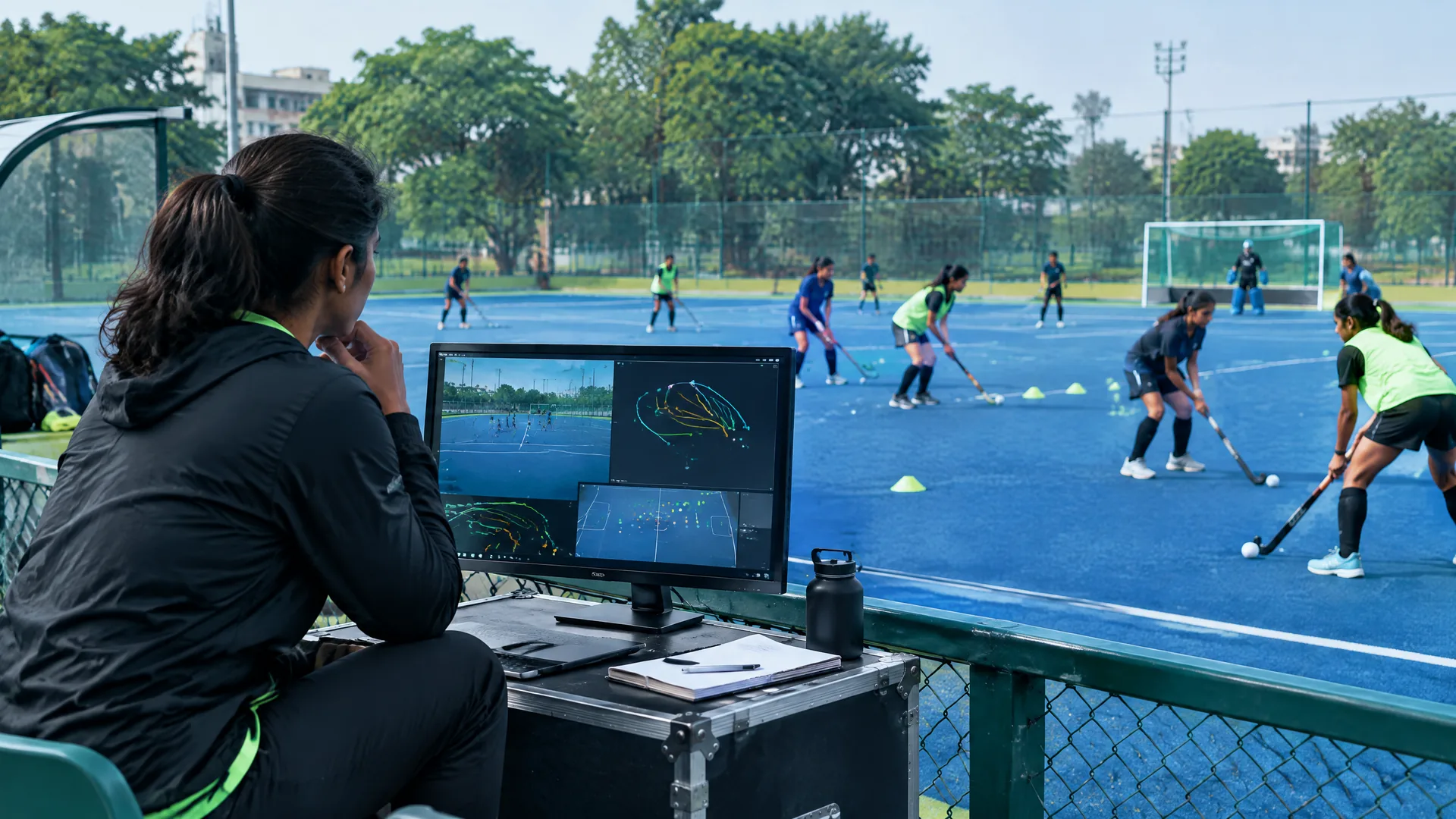
What AI in sports means—and what it does not mean
AI in sports is a set of computational methods that learn from examples or apply rules to data in order to recognise patterns, rank options, generate summaries, or make forecasts. Inputs can include video, event logs, wearable readings, training notes, schedules and scouting observations. A model may identify recurring movement shapes in footage, group similar passages of play, or flag clips that meet a defined condition. Its output is not knowledge in the human sense: it is a probability, classification, score, or generated description shaped by the data and objective it was given.
This distinction matters because sport decisions carry context that data may not contain. Selecting a player, changing a tactic, allocating minutes, or setting an access rule involves values, relationships, uncertainty and consequences. AI can make evidence easier to inspect; it cannot assume accountability for whether the evidence is appropriate, current or fairly interpreted. Treat it as decision support, not an autonomous coach, selector, referee or clinician. A useful starting question is therefore not whether the system is intelligent, but which narrow task it performs, for whom, and with what acceptable margin of error.
The main AI method families
Machine learning is the broad term for systems that infer a pattern from data rather than being given every rule. Supervised learning uses labelled examples—for example, clips already marked with an event—to predict the label for new material. Unsupervised learning looks for structure without a target label, such as clusters of comparable playing sequences. Forecasting models estimate a future value from past observations. These methods are only as suitable as their target: predicting a logged event is different from judging a player's long-term potential.
Computer vision converts images or video into information, such as detecting people, tracking positions, estimating a pose or finding a ball. Natural-language systems can search notes, transcribe speech, extract fields from reports, or draft a plainly marked first version of a summary. Generative systems produce new text, images or other material from patterns in their training. In all cases, a model needs evaluation on realistic data, including conditions unlike its training set. Rules-based automation is also useful and should not be overstated as AI: a reliable filter or alert may be the clearer, safer option.
From input to decision
A responsible workflow starts with a decision that genuinely needs support, then defines the smallest useful output. A video model, for instance, may receive footage that has been recorded consistently, time-aligned and checked for missing segments. Annotated examples become training data; held-out examples are reserved to test whether the model works beyond what it has already seen. Teams should specify what a positive result means, how false positives and false negatives will be reviewed, and whether an output is a prompt for review, a ranked shortlist, or a reportable fact. Data quality work—consistent labels, clear timestamps and documented provenance—is often more important than model complexity.
The output should enter a human review step with the original evidence available. A coach or analyst needs to see the relevant clip, event record or uncertainty flag, not just a dashboard colour. The reviewer can correct errors, add context and record the final rationale. Feedback is valuable only when it is checked; otherwise, a system can learn to reproduce earlier assumptions. Monitor performance after deployment because camera angle, lighting, competition level, tactics and data-collection habits change. A decision process should also have a fallback: when data are incomplete or the model is outside its tested conditions, pause automation and use ordinary professional judgement.
Where AI supports sports work
Appropriate uses are usually bounded, repeatable and reviewable. AI can help index long video archives, propose timestamps for analysts, organise large sets of observations, translate routine material for multilingual teams, or surface comparable sequences for discussion. It can reduce time spent on first-pass sorting so staff can inspect evidence and speak with athletes. In talent identification, it can structure a dossier around observations and comparable data points, but it cannot convert a limited record into a definitive judgement about character, development or future fit. In officiating contexts, any technical aid needs a published protocol, clear authority and a way to handle inconclusive evidence.
Use cases should reflect local conditions. In India, sports programmes can span languages, uneven connectivity, shared devices and highly varied access to video or sensors. A workflow that assumes stable high-bandwidth capture may exclude community or school settings. Interfaces should support plain language, accessible contrast and keyboard or screen-reader use where possible; reports should avoid unexplained technical labels. Systems intended for diverse athletes also need validation across relevant playing environments and groups. When those conditions cannot be met, modest tools—well-kept logs, searchable footage and human-led review—may offer more dependable value.
Failure modes and transfer limits
A model can appear accurate in a controlled sample yet fail elsewhere. This is called a transfer limit: an approach trained on one camera placement, league, age group or style of play may not carry over to another. Vision systems can struggle with occlusion, rain, low light, crowded scenes, inconsistent frame rates or players who look different from examples used in training. Historical data can encode selection bias, because past opportunities and labels may reflect unequal scouting, facilities or exposure. Generated text adds another risk: it may state an unsupported detail fluently, so it should never be treated as a source without checking the underlying record.
Metrics require interpretation. Accuracy alone can conceal whether a tool misses the cases that matter, behaves differently across groups, or merely repeats an obvious pattern. Examine error examples, not just averages, and test against realistic shifts in conditions. Avoid using a single score as a proxy for readiness, effort, tactical understanding or wellbeing. Correlation means two measures move together; it does not establish that one caused the other. If a result affects opportunity or reputation, make the evidence, uncertainty and route for correction visible to the person responsible for the decision.
Rights, safeguards and accountability
Sports data can be personal even when it appears routine. Video, movement patterns, voice, location-linked information and performance notes may identify or profile an athlete. Organisations should define a lawful and understandable purpose before collection, limit access to people who need it, retain data only for a stated period, and protect copies, exports and shared devices. Consent is not a cure-all where there is a power imbalance; participants should receive clear information about what is collected, who can see it, how it may be reused and how questions or corrections can be raised. Extra care is necessary for children and youth programmes.
Accountability should be assigned before a tool goes live. Name an owner for the sporting purpose, a person responsible for data governance, and a reviewer with authority to stop use when harms or errors emerge. Keep a simple record of the data source, model version, intended use, evaluation results, known limitations and material decisions. Secure procurement and access terms should address reuse, deletion, audit rights and what happens when a relationship ends. Human review must be meaningful: reviewers need time, training and the ability to disagree, rather than being expected to rubber-stamp an automated recommendation.
Questions to ask before deployment
Begin with the problem rather than the technology. What decision or workflow is being improved, and is an automated approach necessary? What data are needed, who has the right to provide them, and are they representative of the intended setting? Define the output in plain terms and decide which errors are tolerable. Ask how it will be tested before use, how often it will be rechecked, and whether the original evidence can be inspected. A small pilot with documented review may reveal that the task is poorly defined, the data are inadequate, or a simpler process meets the need.
Then examine practical governance. Who can access the inputs and outputs? Could the tool disadvantage athletes with less data, different communication needs or limited infrastructure? What explanation can be provided to an athlete, coach or administrator affected by it? Is there a correction route, an escalation route and a stop condition? Budget for staff time, accessibility, security, training and quality assurance—not only software. A system should be retired or redesigned when its purpose changes, performance deteriorates, rights cannot be protected, or human review is no longer realistic.
Choose the next specialist guide
This hub provides the frame: clear task definition, evidence review, limits on inference and accountable use. The next step depends on the work in front of you. For governance of player-facing decisions, use the internal guide responsible AI for player decision support. For the operational challenge of handling footage quickly without losing review standards, use AI-assisted sports video analysis. Each specialist topic should be assessed against the same basics: data purpose, evaluation in real conditions, a human decision owner and a route to challenge a material error.
For evidence-led recruitment materials, continue with evidence-led sports scouting; for the mechanics and limits of visual systems, continue with computer vision in sports. These guides narrow the question rather than offering a universal answer. Keep the final boundary clear: a model can organise and compare evidence, but people must decide how much weight it deserves, explain consequential choices and protect the rights of everyone whose data made the analysis possible.