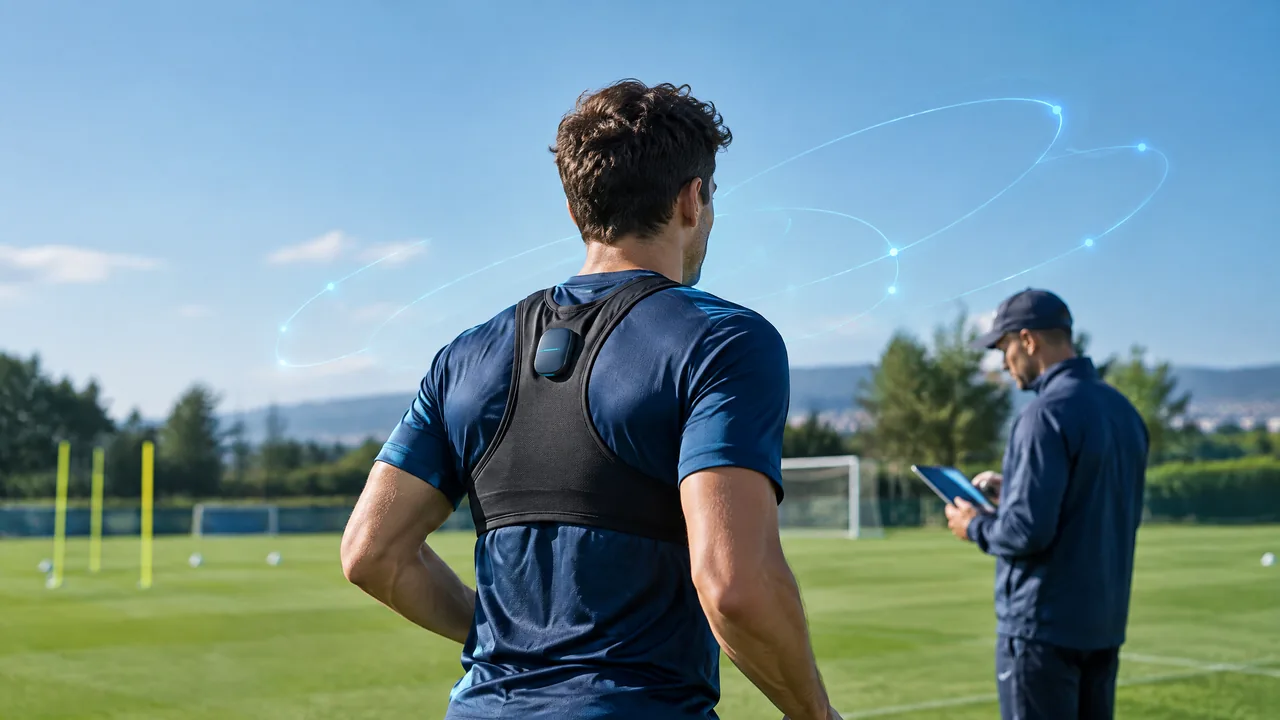
The short answer: how does a GPS sports vest work?
A receiver worn by an athlete estimates outdoor position from precisely timed satellite signals. Software turns a sequence of positions and timing information into a movement record, including distance and speed. A vest may also contain motion sensors, but those sensors aren't satellites. The resulting numbers need a signal-quality check and a defined question before a coach uses them.
If you see a player wearing a small unit between the shoulder blades at training, the vest itself isn't measuring effort or reading an athlete's thoughts. It holds a receiver and, depending on the product, other sensors. This guide follows the measurement from sky to screen. For the wider device family, start with wearable technology in sports. For match-use rules rather than measurement mechanics, see when football GPS vests are permitted.
GPS, GNSS and the signals a receiver hears
GPS is the US satellite-positioning system. GNSS is the wider family, which also includes Galileo, GLONASS and BeiDou. A modern athlete tracker may listen to more than one constellation, so a device sold as a “GPS vest” may actually be a multi-GNSS receiver. The European Union Agency for the Space Programme describes these systems as broadcasting ranging and timing information; it doesn't claim that every sports vest uses every constellation.
The receiver uses signals from several satellites to estimate position and time. The US Federal Aviation Administration explains the basic calculation: comparing when a satellite broadcast a signal with when the receiver got it yields a range estimate; information from a fourth satellite resolves the receiver's clock uncertainty. You don't need to solve the geometry on the sideline. You do need to know that a roof, an indoor hall or a blocked sky can damage the position estimate before any dashboard draws its neat route line.
From positions to distance, speed and running zones
Once the receiver has time-stamped measurements, software can estimate an outdoor route, add up distance and assign movement to speed bands. Some receivers derive speed from changes in satellite-signal frequency rather than simply dividing map-point distance by elapsed time. The precise processing and smoothing depend on the device, so don't assume two dashboards use the same method.
Consider a training report showing 900 metres of “high-speed running.” That figure is meaningless to a reader until the report states the speed threshold, when the player wore the unit, whether gaps were excluded and which drills were counted. The 900 metres is an illustration, not measured SportyTechs athlete data. A short session with many hard starts can look different from a steady run covering the same total distance. For decisions made after collection, turning GPS tracks into training decisions is the separate coaching-workflow guide.
Which readings come from motion sensors instead?
Many training units pair satellite positioning with an inertial measurement unit: commonly accelerometers and sometimes gyroscopes and magnetometers. Such sensors detect changes in the device's own movement and orientation. They can keep recording movement-related signals when satellite reception is poor; that does not mean they reconstruct an exact GPS route indoors.
Be careful with a single impressive-looking “load” score. It may be calculated from accelerometer signals by the vendor's own algorithm, not transmitted by a satellite or measured directly as fatigue. The published review of GPS and inertial devices distinguishes external movement measures from internal responses such as heart rate or perceived exertion. A position trace can't diagnose recovery, readiness or injury. See athlete performance tracking for the broader measurement categories and indoor inertial sensors for situations where satellite position is a poor fit.
Where does a sports GPS reading become unreliable?
The US GPS programme says receiver accuracy depends on geometry, signal blockage, atmosphere and receiver design; buildings and indoor settings can block or reflect signals. This is why a government figure for signal performance cannot be presented as the accuracy of a particular football vest. Weather or a stadium roof shouldn't be turned into a made-up error percentage for an unnamed device.
Research offers a useful warning, not a universal accuracy score. A 2020 scoping review of 48 validation studies found that test methods and reference systems differed enough to make study-to-study comparisons difficult. A 2018 outdoor football study found errors varied by system, movement and metric, with high-speed distance especially vulnerable in its setup. Neither study certifies today's unnamed hardware or says every 2026 training session has the same error. If a route jumps outside the pitch or has missing minutes, flag it before comparing players. More decimal places won't repair a missing signal.
A five-check reading of your session report
- Check whether the session was outdoors with a usable satellite view. Note any covered stand, indoor segment or apparent route jump.
- Check that the assigned unit, worn position and recording window match the session you meant to measure. A late start isn't a low-workload athlete.
- Check whether distance and speed are position-based, and whether an acceleration or “load” field comes from a separate motion sensor or a proprietary calculation.
- Check the definition of every speed band before comparing reports. Different thresholds can change a result without changing the athlete's actual work.
- Check the intended decision. Ask the athlete and staff what the drill involved before interpreting an outlier; keep the raw uncertainty visible.
These are questions to take to a vendor or a performance team, not a claim that SportyTechs tested a device. How to validate a wearable before it shapes selection goes into the separate purchasing and decision-evidence problem.
Sources, scope and what remains unverified
Checked 6 October 2026 against the European Union Agency for the Space Programme's GNSS explanation, the US Federal Aviation Administration's GPS explanation, GPS.gov's accuracy guidance, Luteberget and Gilgien's 2020 scoping review in BMJ Open Sport & Exercise Medicine, and Linke and colleagues' 2018 field-validation study in PLOS ONE. These sources explain the system and show why its measurements must be interpreted carefully. No SportyTechs field test, device model, firmware, match deployment, athlete data or accuracy benchmark was independently verified here. The first-party illustration shows a conceptual training scene, not a documented team or product.