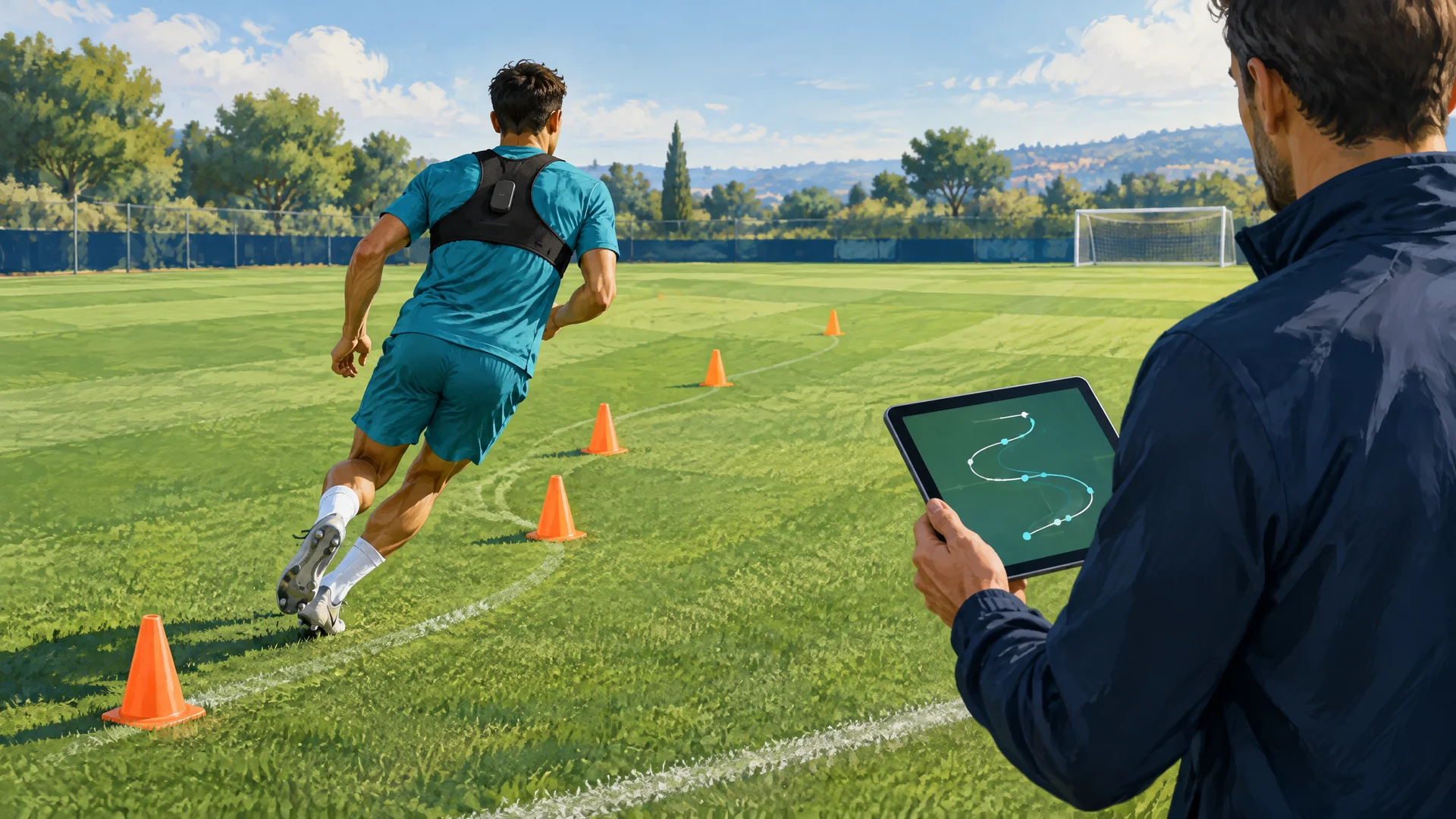
What is GPS tracking in sports?
GPS tracking in sports estimates an athlete's outdoor position and movement using satellite signals. A player-worn receiver records data that software turns into distance, speed and running patterns. Some units add motion sensors. These measurements describe parts of the work an athlete performed; they don't directly measure skill, fatigue or fitness.
A footballer's training vest holds the unit securely. After collection, ask what each number means and whether it's good enough for your decision.
How GPS player tracking gets from the pitch to a report
The receiver listens to timed satellite signals to estimate location. GPS is one satellite system; GNSS is the wider family. A device marketed as a football GPS tracker may use several constellations. Software processes time-stamped observations into a session report; speed estimation may use satellite-signal Doppler measurements, depending on the receiver.
Logging a route isn't the same as transmitting it to a coach. Live sideline delivery, cloud upload and storage are separate product features. Our satellite-to-session explanation covers the mechanics in detail. Here, the priority is reading the report correctly.
What does an athlete tracker actually measure?
Start with definitions, not dashboard colours. An acceleration count needs a threshold and event-duration rule; a sprint count needs a speed definition.
| Output | What it describes | What to check |
|---|---|---|
| Total distance | Estimated movement over the recording window | Missing segments and session start/stop times |
| Speed and peak speed | Estimated movement rate | Filtering and whether a brief spike is credible |
| High-speed running | Distance above a defined speed threshold | The threshold, units and individual comparison |
| Accelerations/decelerations | Changes in speed or sensor-derived events | Data source, threshold and duration rule |
| Route or heat map | Recorded locations and movement distribution | Pitch alignment, reception and drill context |
| Motion-sensor load score | An algorithm's summary of device movement | Vendor definition; not a direct fatigue reading |
Many athlete tracking systems combine GPS with accelerometers or gyroscopes. A vest-mounted sensor measures movement at that location, not every joint or the body's centre of mass. Heart rate needs a compatible sensor; perceived effort needs the athlete's report. Keep those separate from external movement load. Wearable technology in sports explains the wider sensor family.
A real training setting and a worked example
In its 29 September 2026 announcement, the Cricket Association of Bengal described senior men's players wearing Catapult vests during training at SAI Salt Lake's Synthetic Running Track. CAB stated workload monitoring as an intended use. It didn't publish the device settings or individual readings, so that session can't support a claimed improvement or injury-prevention result. Read the documented Bengal GPS deployment.
For a numerical illustration, imagine an outdoor football session divided into two recorded blocks. The following numbers are hypothetical, not CAB or SportyTechs athlete data. Assume usable reception and the same illustrative high-speed threshold of 20 km/h throughout; that threshold isn't a recommendation for every player.
| Recorded block | Duration | Total distance | Distance above 20 km/h |
|---|---|---|---|
| Small-sided game | 15 minutes | 1,200 m | 60 m |
| Longer running drill | 10 minutes | 1,000 m | 180 m |
| Combined recorded blocks | 25 minutes | 2,200 m | 240 m |
The second block averages 100 metres per minute versus 80 in the first. It also contains more high-speed distance despite a smaller total distance. That doesn't prove it was harder overall: the small-sided game could involve more braking, contact or technical work. Ask what the drill required before changing training. The illustration above is conceptual, not a photograph of this example. The GPS coaching-workflow guide explains the next decision step.
Where GPS numbers can mislead you
Indoor spaces, roofs and blocked or reflected satellite signals can weaken positioning. Sharp turns, rapid speed changes and processing settings can also affect estimates. Two systems needn't produce interchangeable numbers, even during the same run.
FIFA's EPTS programme publishes system-specific positioning and velocity test reports by speed bracket. Look for the relevant report, not a blanket claim that a vest is perfectly accurate. A test of positioning doesn't validate every proprietary load score.
A tracker also misses work it wasn't designed to capture. Holding a low stance or performing a strength exercise may be demanding without covering much ground. Low distance doesn't mean low effort. Check match-equipment rules separately; football GPS vest permission isn't decided by the measurement screen.
What affects the cost of a football GPS tracker?
There's no verified current price survey behind this guide. Compare the full programme cost rather than just the unit: receivers and spare vests, charging docks, software subscriptions, live-data equipment, replacement cover, support and staff time to review sessions. Ask whether exports remain accessible after cancellation and what storage or user limits apply.
For a grassroots squad, start by naming the question you need answered. A system that can't explain its thresholds or export your data is difficult to assess, whatever its price. Include athlete-data access and retention in the purchase discussion. Our wearable procurement questions offer a separate checklist.
GPS tracking in sports: common questions
Does GPS work indoors?
Satellite positioning is a poor fit where reception is blocked. Indoor tracking may use local positioning or cameras instead. An inertial sensor can record movement indoors without producing an accurate GPS route.
Can a tracker tell whether I'm recovered?
Not on its own. Movement data describe external work; recovery requires other context and, when appropriate, qualified assessment. A load score isn't a diagnosis.
Is a GPS watch equivalent to a team tracking vest?
Don't assume so. Wear position, processing, supported metrics and team-reporting features differ. Compare the intended use and relevant validation, not just the GPS label.
Which metric should a beginner read first?
Check the recording window and signal quality, then read distance alongside the drill. Add speed zones only after their definitions are clear. One headline number can't represent the whole session.
Sources and scope
Reviewed 12 October 2026 against FIFA's official EPTS programme, peer-reviewed GPS/inertial-device and tracking-quality papers, Catapult's technical explainer and CAB's original announcement. The supplier description isn't an independent product test. No device, firmware, price, personal training record or performance gain was tested by SportyTechs. The worked figures and cover are illustrations; the CAB training setting is documented.