How to use this sports technology guide
This sports technology guide maps the connected systems used to capture sporting activity, turn observations into evidence, support decisions and deliver events to participants and audiences. It helps you choose a specialist topic, test whether a tool fits the intended task and identify the people, safeguards and fallbacks needed before adoption.
Start here when you know the broad problem but not the correct technical layer. A coach reviewing training load, an official assessing replay evidence, a venue manager planning resilient entry and a broadcaster moving live pictures face different questions even when their systems share cameras, networks or data. The guide shows where those paths connect and where they must remain separate. If you first need a stable definition, main types and introductory examples, use what sports technology includes. This page owns the system map and learning routes rather than repeating that definition article.
The seven layers of a sports technology system
A useful sports-technology system can be understood in seven layers: physical equipment, capture, transport, data management, analysis, decision and review. Physical equipment includes the playing surface, protective gear, cameras and sensors. Capture turns an event into a signal. Transport moves that signal. Data management stores and labels it. Analysis produces an estimate or summary. A person or published rule then acts, and later review checks the result.
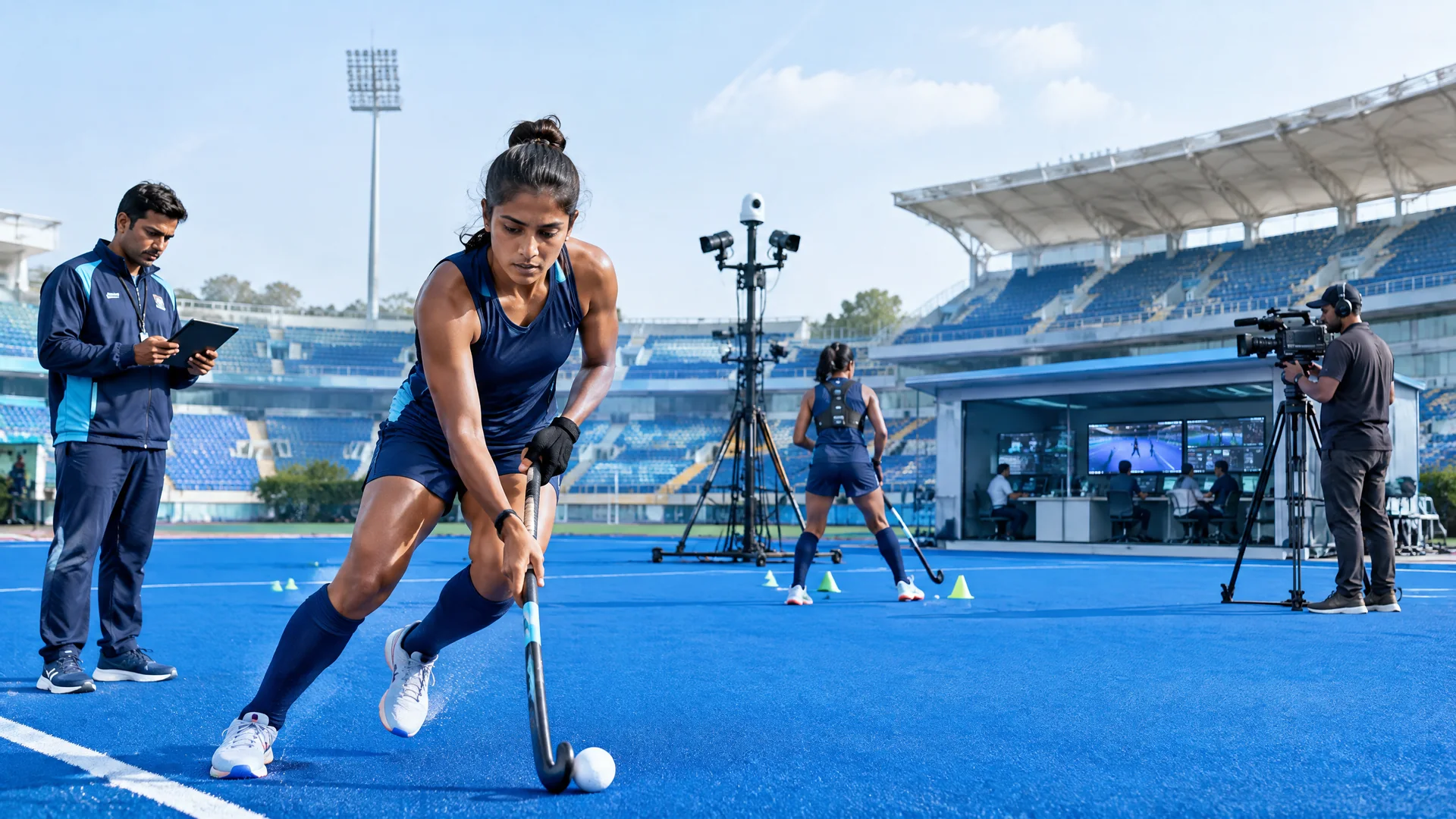
The layers prevent a common category error. A camera does not equal analysis, and a dashboard does not equal a decision. A field-hockey training system, for example, may use fixed cameras to capture movement, a network to transfer footage, a tagging process to identify sequences and a coach to judge whether a spacing pattern should shape the next session. Failure can occur at any handoff. The best place to improve may be camera positioning, naming conventions or review time rather than a more complex model.
Performance and training technology
Performance technology helps practitioners observe training and competition in a repeatable way. Timing gates, video review, force measurement, motion capture, instrumented equipment and session records can make specific actions easier to compare. The useful question is not whether a device produces many metrics. It is which decision the output can inform before the next drill, match, recovery block or development review.
A sprint time can describe an observed effort under stated conditions. It cannot explain motivation, diagnose an injury or determine selection by itself. Video can show where a movement occurred, while a coach still interprets task, technique and intent. Begin a monitoring programme with athlete performance tracking, which sets out decision ownership, athlete feedback, escalation boundaries and review points. Use the smallest set of measures that changes a real conversation, and keep the original evidence available when an output is challenged.
Wearables and sports sensors
Wearables and sports sensors detect physical signals near an athlete, a piece of equipment or the playing environment. Satellite positioning can estimate location outdoors. Inertial sensors detect acceleration and rotation. Electrical or optical sensors can describe heart-beat patterns. Pressure, temperature and force systems answer other narrow questions. Software then converts those raw signals into derived measures such as distance, speed, impact count or a workload summary.
A derived measure inherits every assumption in the chain. Device position, sampling, fit, surface, heat, software version and missing records can change the result. Comparison should normally use the same athlete, protocol and context rather than a universal target. wearable technology in sports explains sensor families, validation and athlete data rights in depth. Treat a surprising number as a reason to check the session, device and athlete account. Do not turn a wearable score into an automatic health, readiness or selection instruction.
Sports analytics and data operations
Sports analytics connects defined data to a defined decision. Event records, tracking positions, video tags, training logs, schedules and operational counts become useful only when their terms, timestamps, units and owners are clear. Descriptive analysis reports what happened. Diagnostic work explores plausible reasons. Predictive work estimates an outcome. None of those stages can decide how much risk, fairness or uncertainty an organisation should accept.
Data operations are the quiet foundation. Teams need stable identifiers, versioned definitions, freshness checks, access rules and a visible response when a feed is missing. A match model built on inconsistent event labels can be precise and still be wrong for the coaching question. sports analytics follows the full path from question to evidence, interpretation and review across coaching, scouting and venue work. Keep facts, inferences and recommendations distinct so a later reader can reconstruct why an action was taken.
AI and machine learning in sports
Artificial intelligence in sport includes models that classify, rank, forecast, search or generate material from data. Machine learning infers patterns from examples, while rules-based automation follows instructions written in advance. Both can save time when the task is bounded and reviewable. A model may suggest video timestamps or group comparable sequences; it does not understand a player's character, a coach's duty or the consequences of a selection decision.
The operating question is which errors matter. A missed clip creates a different risk from a false claim about an athlete. Test the model on the setting where it will be used, including different camera angles, competitions, age groups and environmental conditions. AI in sports explains method families, transfer limits, human review and accountability. Keep generated summaries tied to source evidence, label uncertainty and define a stop condition when the system moves outside its evaluated use.
Computer vision and video intelligence
Computer vision turns images or video into detections, tracks, poses, events or searchable segments. The chain begins with capture quality and camera calibration. A model then locates objects or body points, links identities through time and may project observations into a pitch coordinate system. Analysts or officials review the evidence according to the sporting task and the available decision window.
Crowding, occlusion, low light, rain, camera movement and similar uniforms can break that chain. Cricket ball tracking, football player tracking and kabaddi movement analysis require different views, labels and error responses. computer vision in sports covers calibration, player and ball tracking, pose estimation, real-time limits and one-camera constraints. Use confidence to route doubtful segments to review, not to decorate the screen. Preserve the source clip so a user can see what the system actually observed.
Officiating and competition technology
Officiating systems support decisions defined by a sport's rules. Electronic timing, line calling, ball tracking, replay and result systems may reduce uncertainty, but each needs a protocol for authority, evidence and communication. Technical accuracy alone is insufficient. The system must operate within the decision time, identify when evidence is inconclusive and preserve the official's assigned role.
A credible competition workflow documents camera coverage, calibration, synchronized clocks, operator steps and fallback procedures. Participants should know when technology may intervene and what happens after a component failure. A narrow graphic can appear more certain than the underlying image supports, so the review should expose the relevant frame and limitation. The vision pipeline in computer vision in sports is the best next route for understanding why capture and calibration are part of officiating quality rather than backstage engineering details.
Smart venues and event operations
A smart venue coordinates entry, movement, safety, connectivity, building systems, accessibility and incident response. Its value comes from shared operating information and clear handoffs, not from the number of connected devices. Ticket scans, queue observations, radios, cameras, network status and maintenance alerts may feed a common view, while named staff retain authority over opening routes, pausing access or switching to a manual process.
Peak demand exposes weak integration. A gate reader may work in isolation yet fail the event if its exception path is slow or unclear. Network capacity, power, weather protection, step-free routes and multilingual wayfinding belong in the same operating plan. smart stadium technology explains arrival, crowd movement, connectivity, energy, accessibility and resilience. Test the venue on a realistic event day, including device loss and staff changes, rather than judging it from a quiet demonstration.
Sports broadcasting and media systems
Sports broadcasting is an end-to-end production chain. Cameras and microphones capture the event; clocks keep sources aligned; transport carries signals; production teams select pictures and sound; graphics and replay add context; distribution systems deliver the programme. Remote production changes where people and equipment sit, but it does not remove the need for timing, monitoring, editorial control and recovery paths.
A delay or fault can move through several layers before viewers notice it. Operators therefore need route diversity, known quality thresholds, accessible audio and caption workflows, rights controls and a tested fallback. sports broadcasting technology follows the complete capture-to-viewer pathway and explains where IP networks, control rooms and streaming fit. Keep editorial decisions with authorised people, distinguish live status from confirmed outcomes and avoid treating lower latency as the only measure of a good service.
Equipment, materials and adaptive technology
Sports technology also includes the physical objects and materials that shape participation. Footwear, bats, rackets, balls, protective equipment, surfaces, wheelchairs, prostheses and adaptive interfaces can change grip, energy transfer, protection, fit or access. These designs may use sensing and software, but many important advances come from geometry, materials science, manufacturing and careful testing rather than a digital layer.
Equipment claims should be matched to the intended sport, user and rule set. A material that performs well in a laboratory may behave differently under heat, rain, dust, repeated impact or imperfect maintenance. Adaptive technology should be developed with the athlete, not simply fitted to an assumed need. The broad categories and definition boundaries in what sports technology includes provide the next starting point. Then assess safety evidence, classification or competition rules, repairability, replacement parts and whether the equipment remains usable outside a controlled trial.
Immersive training and fan experience
Virtual reality, augmented reality and interactive media can create repeatable scenarios, overlay context or provide new viewpoints. In training, an immersive system may rehearse visual search or decision sequences without reproducing the full physical load. During an event, overlays, alternate feeds and accessible interfaces can help an audience understand play. The value depends on the task, not on how dramatic the display appears.
Immersion has limits. Visual realism does not guarantee that perception, timing or movement will transfer to competition. Headsets may create discomfort or exclude users with particular access needs. Fan features can add cognitive load, collect unnecessary data or distract from the live event. Pilot one interaction, define what users should learn or complete and observe whether the system helps. Provide an equivalent route for people who cannot or do not wish to use the immersive layer.
A sports technology guide for India
Sports technology in India must work across professional leagues, national centres, schools, academies, district programmes, community grounds and individual practice. Cricket creates strong demand for tracking, replay and broadcast systems, while hockey, kabaddi, athletics and para-sport present different movement and venue conditions. Heat, monsoon weather, dust, travel, shared facilities and uneven connectivity can change whether a design remains reliable.
Local fit is an engineering and governance requirement. An academy may gain more from consistent video naming, an offline-first review process and clear staff ownership than from a cloud dashboard that depends on stable broadband. Interfaces may need local-language explanations, shared-device access and low-bandwidth synchronization. Procurement should check power, repair, recurring costs, data location, export rights and the staff who will operate the system after a pilot. India relevance must be shown through representative conditions rather than a generic case study with an India label.
A decision-first sports technology adoption framework
A sound adoption decision answers four questions. Would the promised information help a named decision? Can you trust the measurement and its interpretation for this setting? Can the organisation integrate, manage and analyse the data? Can athletes, staff and operators use the technology within normal practice? A no or unknown answer is a reason to narrow the pilot, gather evidence or stop.
Write the decision before reviewing products. Identify the user, deadline, available alternatives and consequence of a wrong output. Then inspect validity, reliability, data access, integration burden, training needs and the effect on working culture. Ask whether an existing camera, log or process can answer the question with less burden. A purchase is justified by a better decision process, not by feature count. The framework should also name the final owner, the challenge route and the condition that returns work to a manual method.
Measurement quality and transfer limits
Validity concerns whether evidence supports the interpretation and action being proposed. Reliability concerns consistency under comparable conditions. Responsiveness asks whether a measure can detect a meaningful change rather than ordinary noise. These properties belong to a stated use. A system can be reliable yet measure the wrong thing, or work in controlled tests while failing during crowded, wet or low-light competition.
Transfer is the step from evaluated conditions to real use. Camera angle, sport, athlete group, surface, climate, firmware and staff procedure can all shift. Test representative cases and retain examples near the decision threshold, because averages can hide the errors that matter. Report missing coverage and disagreements. Do not infer that a performance result proves causation, safety or future potential. When conditions leave the evaluated range, label the output provisional or suspend it until a suitable check is possible.
Data rights, security, fairness and accessibility
Sports data can identify, locate or profile a person. Video, voice, movement, heart-rate patterns, training notes and access records need a defined purpose, proportionate collection, role-based access, retention limits and a correction route. Consent requires special care where an athlete has less power than a team, school or governing body. Children and youth programmes need clear communication with the athlete and the appropriate guardian process.
Security and accessibility are part of system quality. Accounts, exports, shared devices, cameras and venue networks need ownership, updates and incident procedures. Interfaces should work with keyboard and assistive technology where relevant, use readable contrast and explain decisions without colour alone. Fairness review asks who is missing from the data, who bears extra effort and who can challenge an output. A technically successful system can still be unacceptable if it creates hidden surveillance, unequal access or an authority that users cannot question.
Procurement, pilot and rollout checklist
- State the sporting problem, decision owner and deadline.
- Define the smallest useful output and the errors that matter.
- Map the complete workflow from capture to review, action and fallback.
- Check evidence from a comparable sport, population and environment.
- Inspect raw-data access, exports, definitions, integration and version changes.
- Calculate staff time, training, maintenance, connectivity and replacement costs.
- Set purpose, access, retention, deletion, security and correction rules.
- Test language, disability access, shared-device use and low-connectivity operation.
- Run a bounded pilot with pre-agreed success and stop measures.
- Review outcomes, unintended effects and user feedback before any scale decision.
The pilot should exercise the whole service, not only the device. Include an ordinary day, a high-load day and a degraded case such as missing data or equipment failure. Record what staff did, how long it took and whether the output changed the intended decision. Give affected athletes or operators a way to report confusion or burden. At review, continue only the parts that produced useful, understandable evidence. Change weak definitions before adding more data, and retire a tool when the organisation cannot maintain its safeguards.
Common sports technology implementation mistakes
- Buying before defining the decision, which leaves staff with data but no agreed action.
- Treating a dashboard value as ground truth instead of checking the capture and definition.
- Assuming laboratory accuracy transfers unchanged to every athlete, venue or competition.
- Collecting more personal data than the stated sporting purpose requires.
- Hiding missing records, low confidence or operator disagreement behind one score.
- Ignoring integration, training, repair, accessibility and recurring staff burden.
- Running only ideal demonstrations and leaving failure recovery undocumented.
- Scaling a pilot before users can explain its benefit, limits and challenge route.
These mistakes share one pattern: attention stays on the product while responsibility disappears between handoffs. Correct that by assigning an owner at capture, analysis, decision and review; preserve a short record of what changed; and keep a simpler fallback ready. Measure whether the workflow improves the named decision under ordinary conditions. A smaller system that people understand and can stop is often more dependable than a feature-rich system whose output arrives too late or cannot be traced.
Frequently asked sports technology questions
What is included in sports technology?
Sports technology includes equipment, materials, sensors, cameras, software, data systems, officiating tools, venue infrastructure, broadcast production and accessible interfaces designed for a sporting purpose. The boundary depends on the task, user and decision rather than whether a product is digital or new.
Which sports technology should a club start with?
Start with the problem that staff can act on. A consistent camera workflow, session record or timing method may be more useful than a large platform. Choose the least complex tool that produces trustworthy evidence within the club's time, skills, budget and data-protection capacity.
Can sports technology prevent injuries?
No device can guarantee injury prevention. Measurements may help qualified staff notice workload or movement patterns and ask a better question, but they do not diagnose a condition or prove future risk. Health decisions require the appropriate professional process, athlete input and evidence beyond one score.
Is artificial intelligence required for sports analytics?
No. Many useful analyses use clear definitions, basic summaries, video review or rules-based calculations. AI is appropriate only when its method, training data, errors and review path fit the question better than a simpler approach. Complexity should earn its place through measured usefulness.
How should schools and academies handle athlete data?
Collect the minimum needed for a stated purpose, explain it in age-appropriate language, limit access, set retention and deletion rules, secure devices and provide a correction route. Do not reuse a training record for unrelated profiling or public comparison without a separate lawful and understandable basis.
What makes sports technology suitable for India?
A suitable system works under the local sport, climate, power, connectivity, language, staffing and repair conditions. It should support shared or low-cost workflows where needed and avoid assuming elite infrastructure. Evidence from representative Indian operation matters more than a generic regional label.
Choose the next path from this sports technology guide
Use what sports technology includes for the core definition and examples. Choose AI in sports when the problem involves model-assisted classification, forecasts or generated summaries. Choose sports analytics for the path from data definitions to coaching, scouting or operational decisions. Use wearable technology in sports for sensor signals, derived metrics, validation and athlete rights, and athlete performance tracking for the daily programme around those measurements.
For camera systems, calibration, tracking and video limits, continue with computer vision in sports. For access, connectivity, building systems and event resilience, use smart stadium technology. For cameras, sound, timing, control rooms, transport and accessible distribution, use sports broadcasting technology. Each route answers a narrower question. Return to this master map when a project crosses layers, because the quality of sports technology depends on the complete chain from purpose and capture to decision, review and accountable operation.