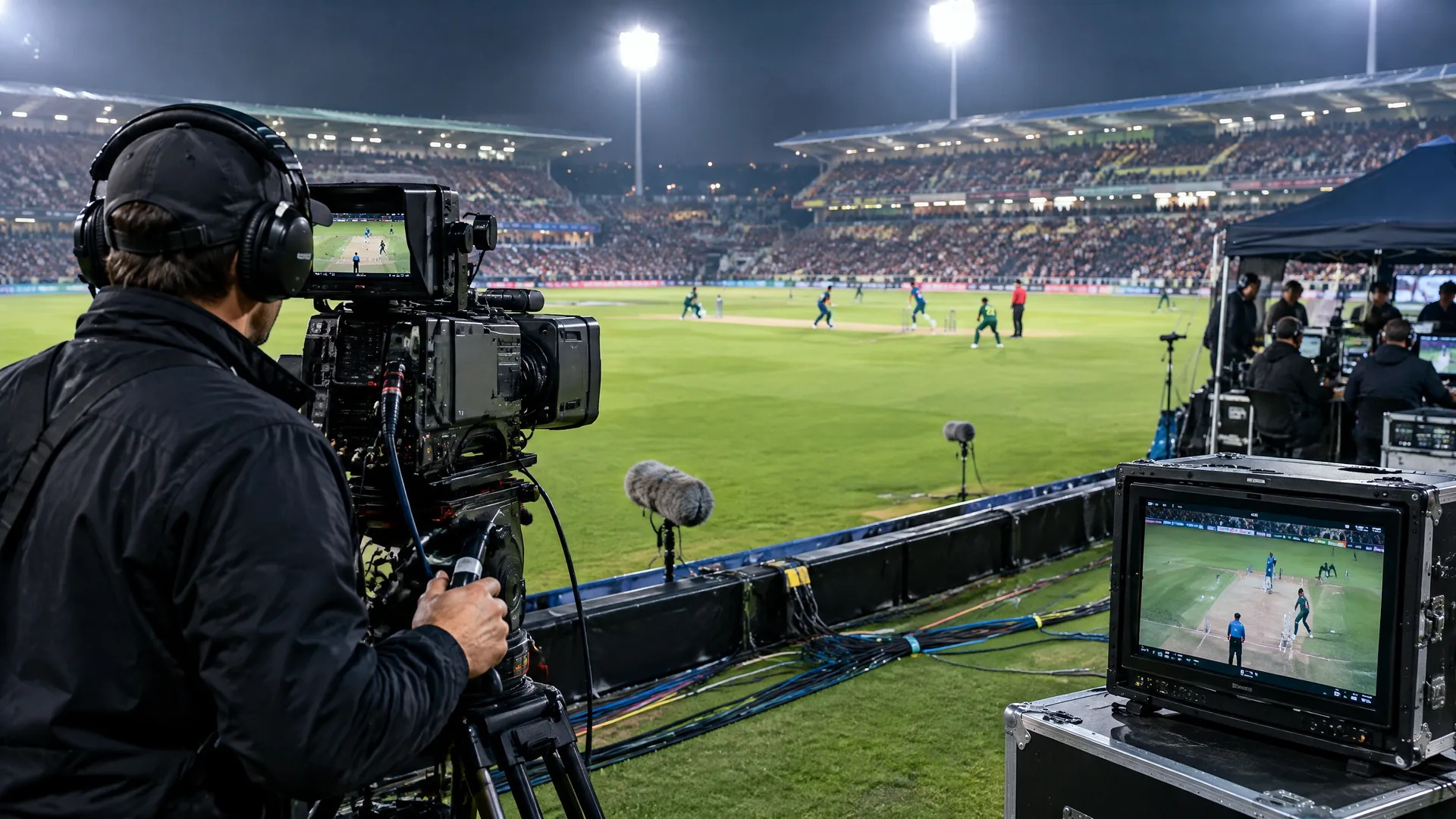
The capture-to-viewer pathway
Sports broadcasting technology is the connected chain that turns venue activity into a programme audiences can watch, hear or use with assistive tools. Acquisition records action through cameras, microphones, timing feeds and venue data. Contribution moves those signals into production; production combines them into a programme; distribution packages versions for television or internet delivery; playback adapts a stream to a device and connection. A weakness can travel through the chain: a late camera feed can undermine replay, while an inaccurate clock can make graphics misleading even if the pictures are clear.
Map the pathway before choosing equipment. For each signal, document its source, owner, format, timing reference, route, monitoring point, backup and permitted use. Contribution is high-quality transport into production; distribution is delivery to audiences; latency is the time between an action and its presentation. Reducing latency can leave less room for buffering and error recovery. The useful target is therefore an agreed delay and reliability level for the editorial format and audience, not simply the lowest possible delay.
Cameras, audio and synchronisation
A camera plan should serve storytelling and coverage continuity. A wide angle establishes play, tighter positions reveal detail, and specialist viewpoints can explain a decision or technique. Frame rate, resolution, dynamic range and lens choice affect appearance and downstream workload. Higher-resolution capture can permit reframing but increases storage, bandwidth and processing needs. Audio planning must separately consider commentary, crowd ambience, referee or field effects, public-address sound and interviews, which may have different permissions. Wind, crowd spill, cable routing and radio-frequency coordination remain practical constraints.
Synchronisation aligns pictures, sound, replay angles and data to a common time reference. A frame is one complete video image; feeds that are not frame-aligned can jump on a switch or make sound appear late. Genlock supplies a shared video timing reference, while timecode labels media with a common timeline for logging and editing. Packet-based workflows also need clock synchronisation. Test after format conversion, a wireless hop or delay process, because each can introduce variable delay that is not obvious on one monitor.
Transport and live production
Transport carries feeds between venue positions and the people or systems making the programme. It may use dedicated cabling, fibre, managed packet networks or wireless links. Packet transport sends media as small data units; it can make routing flexible, but makes network design central to quality. Engineers must plan for jitter, or variation in packet arrival time; packet loss; path diversity; and buffers that smooth short disruptions. Network segmentation can separate production traffic from public connectivity and venue operations, reducing interference from unrelated demand.
Live production selects and combines sources into an editorially coherent output. Picture selection, audio balance, graphics, replay, captions and recorded inserts must follow a running order and clear procedures for incidents or reviews. Retain clean feeds without graphics or commentary when contractual uses require them, and record isolated camera or audio sources where later review is expected. Confidence monitors should show what audiences receive, not only material before processing. For the network-migration question, see IP broadcast systems in stadiums.
Data, graphics and replay
Live data supplies context cameras cannot: score, clock, line-ups, results, rankings and event markers can drive graphics, commentary research and replay search. The key issue is provenance, meaning the documented origin and handling history of data. Each score field should identify an authorised source, timestamp, status and correction process. Reconcile it with the official match record rather than treating an interface feed as automatically correct. A schema is an agreed structure for fields and values; it prevents identifiers, labels or event times being interpreted differently by separate systems.
Graphics need editorial approval because they make a public data assertion. Templates should handle name spellings, local languages, units and late corrections without improvised edits. Replay systems index angles and event times for quick retrieval, but a replay remains an editorial construction. Slow motion, a selective angle or an on-screen line can clarify a moment yet imply certainty where timing or perspective is limited. Define who can trigger replay, which review material is restricted and how an official decision is labelled. For operating models, see remote sports production workflows.
Remote and distributed workflows
Remote production moves selected functions away from the venue while retaining capture and essential engineering on site. A distributed workflow may place directing, graphics, replay, commentary and technical control in different locations. It can reduce travel and let specialists support more than one event, but replaces proximity with dependence on transport, monitoring and communications. A remote operator needs an appropriate multiviewer, sufficiently responsive controls and reliable talkback. Talkback is the private two-way voice system for production staff; it needs separate resilience because coordination loss can disrupt the whole programme.
Decide which functions must remain local. Camera shading, wireless management, venue liaison, cable repair and safety response normally require personnel close to equipment. Remote teams need escalation paths, shared clocks, access controls and a fallback that works during degradation, not only total link failure. Monitor contribution quality separately from the final stream because encoding and packaging can add faults. In India, multi-language commentary, regional feeds, variable last-mile connectivity and mobile-first audiences may require a tiered delivery plan rather than one assumed viewing environment.
Distribution and accessible delivery
Distribution converts the finished programme into versions devices and networks can use. Encoding compresses video and audio; adaptive bitrate delivery offers several versions so a player can select one for current connection conditions. Packaging groups a stream into timed segments and manifests, which direct a player to those segments. Segment length, encoder settings and player buffering influence latency and stability. Test the complete path on representative televisions, browsers and mobiles, including constrained connections, rather than judging quality only from a production monitor.
Accessible delivery is a core output, not an add-on. Captions provide timed spoken content and relevant sound cues; subtitles may also translate dialogue; audio description narrates important visual information for people who benefit from it. Each service needs timing and quality control. Keyboard operation, screen-reader labels, readable contrast and clear track selection improve player usability. In multilingual markets, establish languages for commentary, captions and description, how names are represented, and how late editorial changes reach every version consistently.
Rights, provenance and editorial control
Rights management determines what may be captured, retained, edited and distributed, not merely where a finished feed is visible. Agreements can distinguish live, delayed, highlights, archive, social, territorial, language and platform rights. They can cover commentary, music, participant audio, statistics, tracking data and user-generated material. Maintain a rights matrix that maps every asset and intended use to a permission, geographic scope, time window and restriction. Access controls should then limit who can retrieve feeds, clips, credentials and raw data, especially where clean feeds or isolated recordings are reusable.
Provenance applies to media as well as data. Asset records should retain source, capture time, transformations, editor actions and rights status so a clip can be verified before reuse. Editorial control means accountable people govern framing, captions, corrections and sensitive footage even when automation assists logging, clipping or translation. Automation can accelerate routine work but may misidentify people, context or speech, so review thresholds are needed. Watermarks, audit logs and release procedures help trace unauthorised edits but cannot replace policy. Implementation examples belong in HDR sports broadcasting and stadium broadcast connectivity.
Resilience and the next specialist guide
Resilience is the ability to continue an acceptable service during faults, not an assumption that faults will never occur. It depends on risk analysis, redundant power and signal paths, spares, rehearsals, monitoring and decision authority. Redundancy must avoid common points of failure: two feeds sharing one router, power source or cable route are not fully independent. Define likely modes in advance, such as loss of a camera, corrupted timing, venue power interruption, an unavailable remote control room or a distribution outage. State the viewer-facing fallback, the person authorised to invoke it and return-to-normal criteria.
Post-event review should connect technical observations to editorial and accessibility outcomes: whether captions remained aligned, a lower-bitrate version was watchable, a correction reached every output and operators identified a fault quickly. Preserve logs and representative recordings for investigation while applying rights and privacy retention limits. Choose the next specialist guide by bottleneck: IP broadcast systems in stadiums for network architecture, remote sports production workflows for operating roles, HDR sports broadcasting for an implementation case, or stadium broadcast connectivity for connectivity context. These decisions keep sports broadcasting technology accountable from capture through accessible delivery.