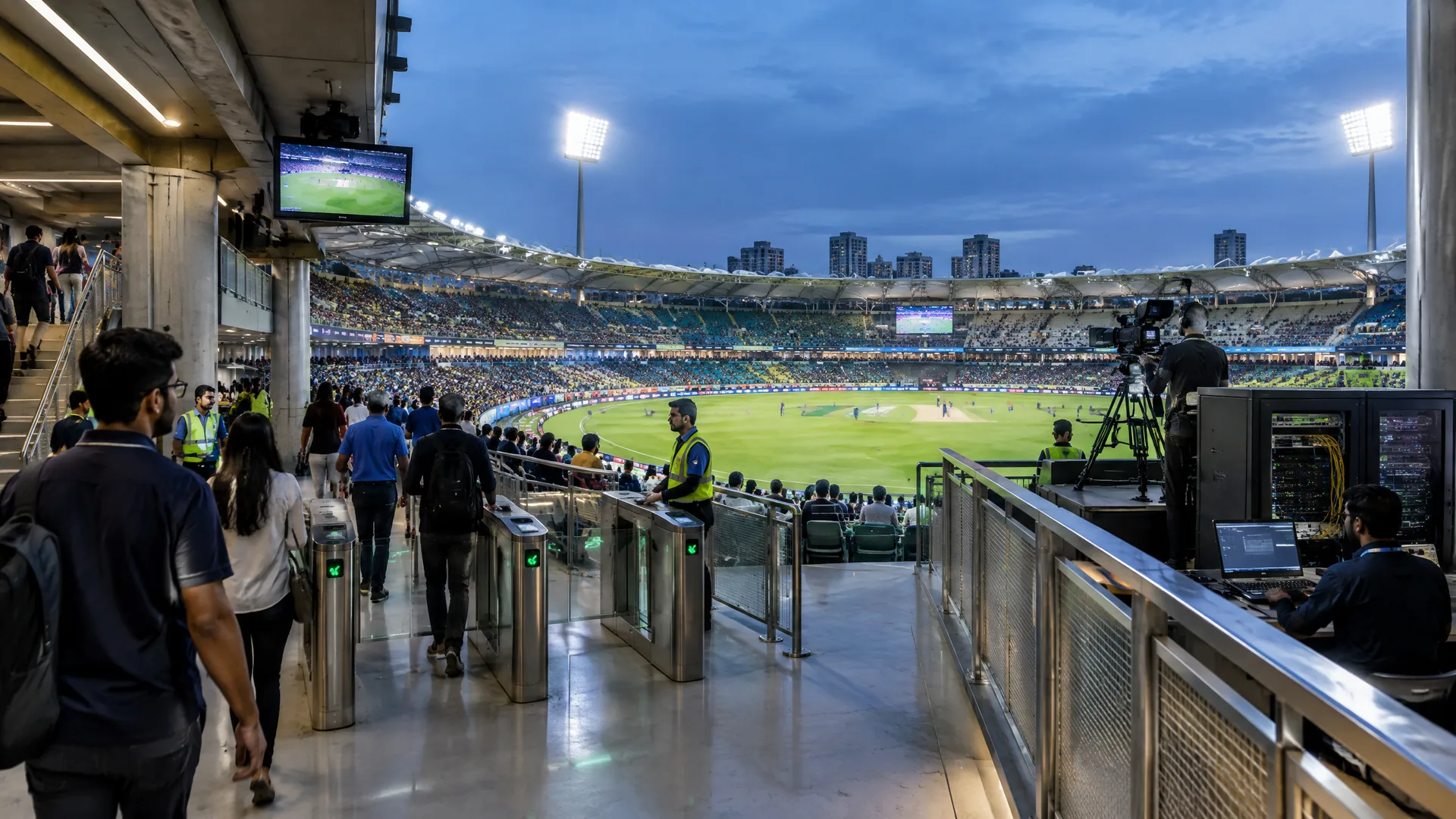
What makes a stadium smart
A smart stadium is not simply a venue with screens, apps or sensors. It is an operating model in which physical infrastructure and digital systems exchange timely, useful information so teams can make better decisions during an event. An integration layer, often called middleware, passes selected data between these systems without requiring every device to connect directly to every other device. The intended outcome is coordinated operations: a queue alert can reach a supervisor, an equipment fault can be routed to maintenance, and a crowd-management decision can be communicated through several channels.
The word smart should not imply autonomy or infallibility. Data is only valuable when its source, timing and meaning are understood. Operators should define which decisions may be automated, which require human confirmation and who owns the final call. A sensible design begins with service objectives such as reducing unsafe bottlenecks or restoring a failed gate quickly, then selects technology that supports those objectives. This avoids buying disconnected tools that create more dashboards than operational value.
Arrival and access
Arrival is a chain rather than a single turnstile moment. Smart stadium technology can join live gate status, ticket scans and staff reports to show where demand is building. A queue-management system normally uses simple indicators such as lane availability, processing time and visible queue length; it should not be treated as a precise count of every person. Signage and trained stewards remain essential because guests need clear direction before they reach a point of congestion.
Access design needs practical exception handling. Tickets can fail to scan, phones can lose power, a reader can go offline, or a guest may need step-free routing. The operating plan should state how staff verify entry, record overrides and prevent a short outage from becoming a long queue. In Indian venues, variable mobile coverage around large crowds, heat, monsoon conditions, mixed ticketing practices and complex transport arrivals can all shape the choice of equipment and sheltered fallback points. Gate capacity should be tested with realistic staffing, physical lane widths and arrival patterns, rather than inferred from a device specification alone.
Movement and safety
Once people enter, operations teams need a current picture of movement through concourses, stairs, toilets, food areas, lifts and exits. Sensors, camera views, access counts and steward observations can complement one another. A control room may display selected feeds on a common operating picture: a shared, time-stamped view of conditions and active tasks. This supports decisions such as opening a diversion route, pausing entry to a crowded zone or sending staff to an incident. It does not replace event commanders, safety officers or local emergency procedures, which must retain clear authority.
Safety systems work best when they are designed around actions, not detection alone. An alert needs an owner, priority, location, acknowledgement method and escalation path. It must also be possible to tell whether the condition has cleared. False alerts can desensitise staff, while overly aggressive automation can produce unnecessary disruption. Physical design still carries much of the safety burden: sightlines, protected egress routes, adequate lighting, wayfinding, barrier placement and maintained doors cannot be repaired by software. Rehearsals should include confused information, blocked routes and partial communications failures so teams practise judgement as well as procedure.
Connectivity and media
A connected venue needs a network designed as operational infrastructure, not as a guest amenity added at the end. Wireless access points, wired switches, fibre links and internet connections carry different types of traffic, including staff devices, point-of-sale terminals, broadcast production, building controls and public Wi-Fi. Network segmentation separates these uses into controlled zones so that a problem or compromise in one zone is less likely to reach another. Capacity planning considers where people gather, the materials that weaken radio signals, backhaul capacity and the number of devices attempting to connect at the same time.
Media systems add further timing and reliability demands. Scoreboards, ribbon displays, public-address, production feeds and event-control messages may need coordinated timing, but they should not all depend on one central path. Venue teams should map content approval, emergency-message priority and the safe behaviour of each screen or speaker if a link fails. Printed signs, trained staff, audible announcements and visible static information remain important for people without a suitable device, data plan or network connection.
Buildings, energy and maintenance
Building-management systems supervise equipment such as heating, ventilation and air conditioning, pumps, lighting, power distribution and sometimes water systems. Controls may adjust schedules or setpoints, which are target operating values, to match an event timetable. The useful question is not whether every room has a sensor; it is whether the system helps facility staff provide safe, comfortable conditions while recognising the venue's actual use. A cold, empty concourse, a sun-exposed stand and a packed hospitality area need different operational attention.
Condition-based maintenance uses patterns in equipment readings or inspections to decide when work is warranted, rather than relying only on a fixed calendar. It can help teams identify unusual vibration, repeated alarms or runtime that merits investigation, but it cannot establish the cause by itself. Sensors drift, labels can be wrong and an apparent anomaly may reflect event-day use. Maintainable systems therefore retain asset records, manual inspection routes, spare-parts plans and a way to document corrective work. Energy controls should have explicit comfort and safety boundaries; saving power is not a reason to disable essential ventilation, lighting or water monitoring.
Accessibility and data governance
Accessibility should be a design input for every connected service. Digital tickets, maps, queue notices and service requests should be usable with assistive technology and should not assume that all guests can read small text, hear an announcement, operate a touchscreen or navigate steps. In the physical venue, information systems need to reinforce step-free routes, accessible toilets, seating locations, companion arrangements and assistance points. Redundant formats matter: concise visual instructions, clear audio, staff support and tactile or high-contrast cues can each serve different needs. Testing with disabled users and venue staff reveals practical barriers that a technical compliance checklist may miss.
Data governance is the set of rules that determines what data is collected, why it is used, who may access it, how long it is kept and how it is protected. Connected venues may process ticket details, device identifiers, video, access logs, transaction records and operational telemetry. Collect only what is necessary for a stated purpose, limit access by role, protect data in transit and at rest, and set retention periods rather than retaining event data indefinitely. When analytics use identifiable information, venue operators should provide understandable notice and a workable route for rights requests where applicable. Vendors and contractors also need documented limits on reuse, transfer, security responsibilities and incident reporting.
Resilience and manual fallbacks
Resilience is the ability to continue safe, priority operations or recover them quickly when something fails. It is broader than cybersecurity. Power interruptions, fibre damage, weather, a software error, a lost radio channel and an overfull service desk can each disrupt a connected venue. Teams should identify critical functions, their dependencies and the maximum practical downtime for each. Redundancy can mean a second path, spare equipment, local control capability or trained people who can carry out a task without the primary system.
Manual fallback must be designed, documented and exercised before an event. Examples include offline entry validation procedures, paper incident logs, radio call signs, keys or local controls for essential equipment, printed wayfinding and predefined announcement scripts. A fallback that needs an unavailable password, a printer that relies on the failed network or staff who have not practised it is not a usable fallback. Plans should also cover reconciliation after recovery, such as securely entering records created during an outage and reviewing overrides. The goal is controlled degradation, not a pretence that all digital services will remain available.
Questions for Indian and retrofit venues
For Indian stadiums and older venues, the first question is often not which platform to install but what can be supported reliably. Survey the power quality, earthing, cable routes, drainage, weather exposure, room space, radio environment and existing operational practices. Retrofit work must respect heritage fabric, active event calendars and legacy equipment that may lack modern interfaces. Start with a baseline of known pain points, such as gate queues, unreliable communications or difficult maintenance access, and agree how improvement will be observed. Phased deployment allows teams to validate one operational workflow before expanding it across the site.
Procurement should require open documentation, data export, clear integration boundaries and an exit plan if a component is replaced. Ask who can configure the system, who receives alarms, how updates are tested, what happens during a connectivity outage and what data remains with the venue. Include stewards, security, facilities, accessibility representatives, event organisers and IT staff in acceptance testing, because a system that works in a demonstration can fail under match-day pressure. For deeper component context, use the supplied internal related slugs: the stadium operating system, stadium Wi-Fi capacity, stadium cybersecurity and resilience and stadium energy management.