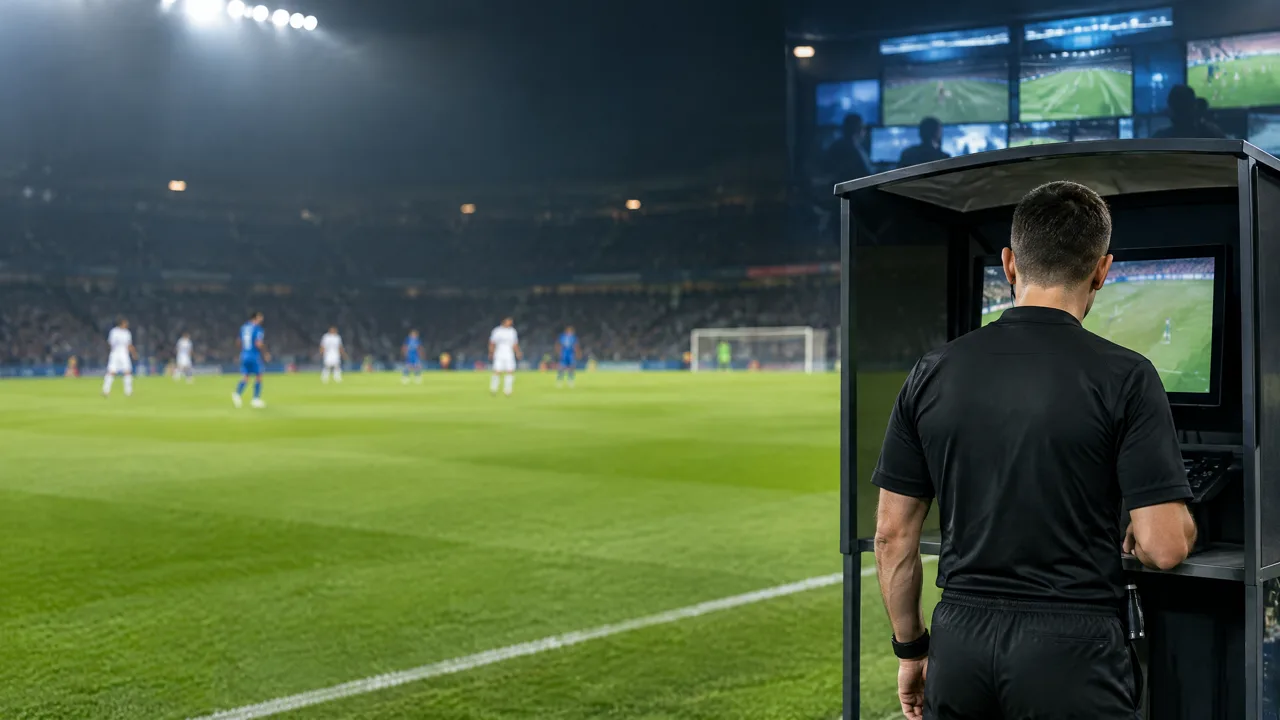
What happens when VAR checks a football decision?
How does VAR technology work in football? A video assistant referee watches authorised match footage and checks specific, potentially match-changing decisions. Most checks end quietly. If the footage suggests a clear and obvious error or a serious missed incident, the VAR can recommend a review; **the on-field referee makes the final decision**. That is the important distinction when a commentator says “VAR ruled it out.”
VAR is a protocol involving people, cameras, communication and replay—not an AI system that judges every tackle. The International Football Association Board (IFAB) sets review rules; organisers must meet implementation requirements and obtain FIFA permission. A competition's VAR rule alone cannot prove a given match ran VAR or had a review.
Which incidents can VAR review in 2026/27?
The main IFAB categories are goals or no goals, penalties or no penalties, red-card situations and mistaken identity when a player is cautioned or sent off. A goal check might look for an offside or foul in the attacking phase; a penalty check can examine whether an offence happened inside the area. The protocol is not a general way to re-referee every free kick or touchline decision.
**The 2026/27 update matters:** IFAB now permits assistance when a red card results from a **clearly incorrect second yellow card**. It also expands the mistaken-identity case where the wrong player or team has been penalised. Competitions may opt to review a **clearly incorrectly awarded corner kick** only when it can be corrected immediately without delaying the restart. The corner provision is optional; don't assume a tournament adopted it. These details are drawn from IFAB's 28 February 2026 announcement and current protocol. An older explainer that flatly says “second yellows and corners are never reviewable” misses the updated exceptions.
Check, recommendation or on-field review: what's the difference?
Picture a goal after a close challenge in the build-up. The referee first decides on the field, perhaps allowing play to continue. The VAR checks available camera angles in the video operation room. If there is no apparent clear error, the check is normally silent and the original decision stands. A replay appearing on TV does not mean the referee has formally reviewed anything.
If the VAR finds a probable error, the official communicates the observation to the referee. **Only the referee starts a review.** For a subjective question—such as the intensity of a foul—IFAB says an on-field review at the pitch-side monitor is appropriate. For a factual question, such as an offside position or where contact occurred, the referee can make a final decision from the VAR's information without visiting the screen. Both routes end with the referee communicating the decision, including the TV signal where the protocol requires it.
Who controls the replay—and who makes the call?
The VAR has independent access to the television camera footage and works with assistant VARs and replay operators. The referee can request angles or replay speeds. IFAB advises using slow motion mainly to establish factual details, while normal speed helps assess the intensity of contact. Different camera views can answer different questions; one freeze-frame does not replace a judgement about an entire incident.
The referee retains final authority whether they watch a screen or receive information through the communication system. The original call should change only when the review clearly shows the relevant error. Calling VAR an automatic “fairness guarantee” would oversell a human decision process that also depends on footage, camera placement and a specific rule. Our computer vision in sports guide explains why tracking pixels and making a sporting decision are not the same task.
Can play restart, and how long can a review take?
IFAB prioritises an accurate decision over a fixed stopwatch; the protocol has **no universal maximum review time**. The referee can delay a restart while an incident is checked. Once play has stopped and restarted, reviews are generally no longer available, with narrow protocol exceptions for mistaken identity and certain serious sending-off incidents. The optional incorrect-corner check must be immediate and cannot delay a restart. Check the current competition rules for how these options are used.
Players and coaches do not initiate VAR reviews as they might a challenge in another sport: potential reviewable incidents are automatically checked. That is why a long pause and a silent check are different signals. It is also why a claim that “every goal was VAR-overturned” needs an official incident record, not just a broadcast replay.
Does UEFA permission prove VAR was used in a particular match?
No. UEFA's 2026/27 Nations League rules say VAR **may** be used in all competition matches and leave use for all or part of a particular match to the referee's discretion. The regulations state that goal-line technology is used in all matches of the finals, not automatically in every earlier league-phase fixture. To say a named game had a VAR official or intervention, check its official match sheet and post-match report. To say a named vendor or camera system was installed, find a separate organiser or provider record.
Similarly, UEFA's documented connected-ball, semi-automated offside and goal-line programme at EURO 2024 describes **that tournament**, not every football match in 2026. VAR, goal-line technology, player tracking and sports analytics answer different questions. The sports technology guide places officiating systems alongside other uses without pretending they are interchangeable.
The practical question to ask after a controversial call
Ask four things: What was the original on-field decision? Is the incident in a reviewable category under the rules used by this competition? Did the VAR merely check it, or did the referee initiate a review? What does the official match or refereeing report confirm about the final decision? Those questions work better than assigning a goal or card to “the algorithm.” They also keep uncertainty visible when a match report doesn't document a review.
This is an evergreen protocol explanation, not an account of VAR, AI or a particular stadium system operating in France–Belgium, Italy–Türkiye or any other named fixture. We will only add match examples if a dated primary record supports the exact event and decision.
Sources and editorial method
SportyTechs checked IFAB's current VAR protocol and its 28 February 2026 announcement of the 2026/27 amendments, UEFA's Nations League 2026/27 Article 58 and UEFA's dated EURO 2024 technology account. The IFAB page displays tracked deletions and insertions; we checked the amended wording rather than concatenating old and new text. Source titles and URLs are retained in private editorial metadata. The first-party cover illustration is conceptual, not a photograph of an identified VAR intervention.