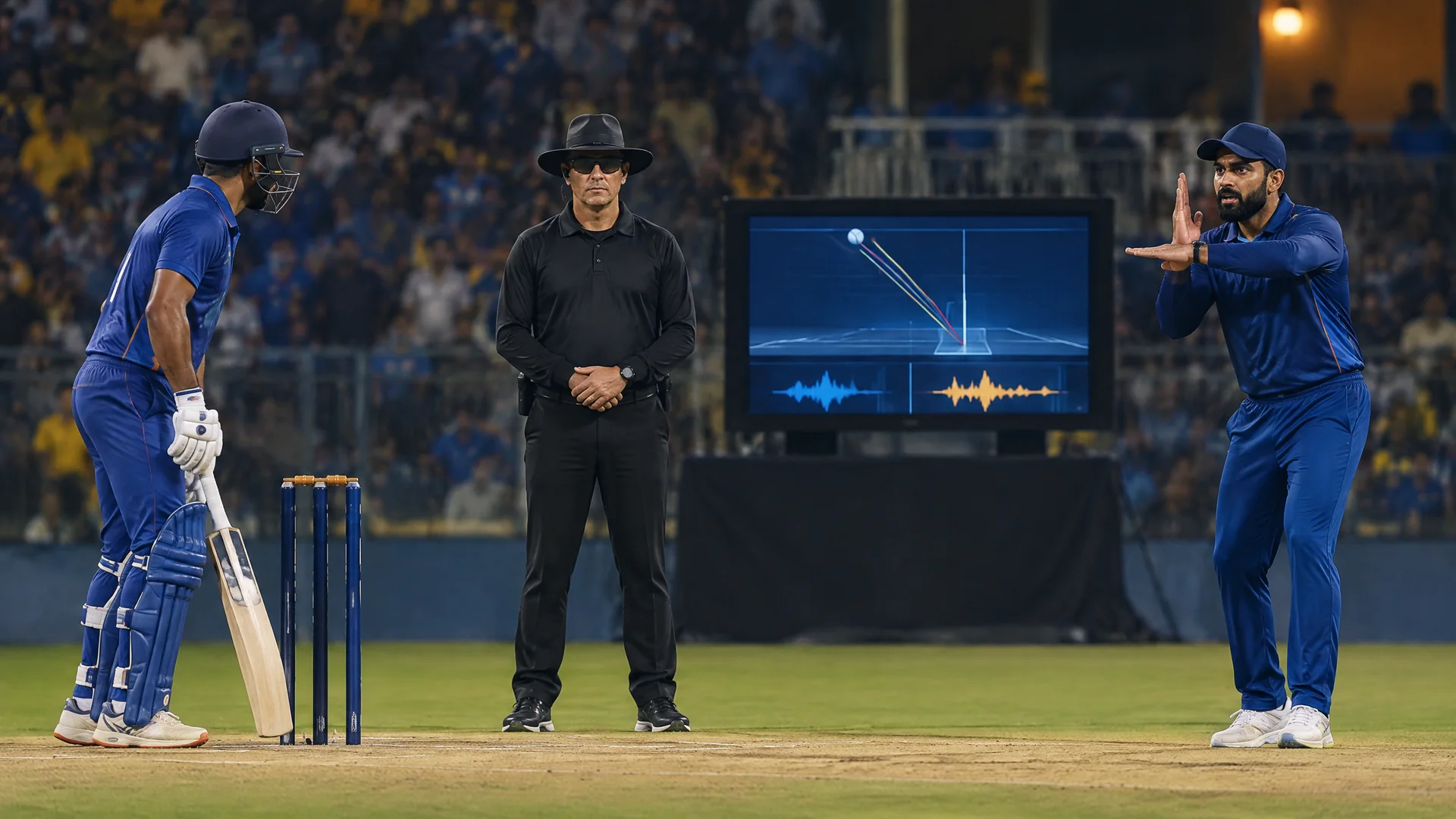
What is the DRS timer in cricket?
The DRS timer in cricket is the 15-second period in which an eligible player can ask for a Player Review after the ball becomes dead. Under the reviewed ICC protocol, the batter involved may review an Out decision and the fielding captain may review a Not out decision. The request is made with a clear forearm “T” signal. If the request is late, the on-field umpires can decline it.
The timer governs the request, not the length of the third umpire's investigation. Once a valid request is accepted, officials may inspect the permitted camera, sound and ball-tracking evidence in sequence. That distinction answers the most common confusion: the player has 15 seconds to decide whether to challenge, but the review itself can take longer because the evidence still has to be checked. The underlying technology sits within the wider field of computer vision in sports.
When does the 15-second DRS clock start?
The reviewed ICC playing condition measures the window from the moment the ball becomes dead. That is more precise than saying the clock starts when the umpire raises a finger or when the broadcast graphic appears. A delivery may include running, an attempted catch, an overthrow or another live phase before the ball is dead. The official timing point follows the state of play, not the television director's shot change.
A broadcast countdown is useful for viewers, but it is not the authority that creates the rule. The on-field umpires administer the request window. If a screen graphic appears late, freezes or is absent, the match protocol still applies. A strong explanation therefore separates the official time window from the visual timer that a broadcaster may place on screen.
What happens at 10 seconds and 15 seconds?
If no request has been made after 10 seconds, the bowler's-end umpire gives the relevant player a prompt. The player must request the review immediately after that prompt. The rule does not create a fresh five-second discussion period; it warns that the original 15-second limit is almost over. At 15 seconds, the request window closes.
This two-stage process protects both decision time and match flow. Players can confer briefly, yet they cannot wait for later information or a delayed replay. It also gives the umpire a visible operating cue rather than relying on players to judge the remaining time from a distant screen.
Who can request a Player Review?
For an Out decision, only the batter involved in the dismissal may request a Player Review. For a Not out decision, only the fielding captain or acting captain may request it. Teammates can contribute to the short discussion, but they cannot substitute themselves as the authorised requester. The protocol also excludes Timed Out from Player Review.
Player Review is different from an Umpire Review. An on-field umpire can refer specified questions to the third umpire under the applicable playing conditions. That referral does not spend a team's unsuccessful-review allowance. The distinction matters because the same delivery can raise more than one issue and because the official, not a player, initiates an Umpire Review.
What consultation is allowed before the signal?
The fielding captain may consult the bowler and other fielders. The two batters may consult each other. For an LBW appeal, the relevant side may ask the bowler's-end umpire whether the decision rested on the batter making no genuine attempt to play the ball. Other questions about the decision are not permitted before the review request.
The decision must remain with the players on the field. If the umpires believe the captain or batter received direct or indirect outside input, they may decline the request. Dressing-room signals are specifically prohibited. This rule closes a simple loophole: a team cannot use the 15 seconds to wait for an analyst, television replay or off-field message.
Why big-screen replays wait until the timer expires
The ICC protocol prevents normal-speed and slow-motion replays from being shown on the spectator screen until the 15-second request window has elapsed. Without that control, one side might see a replay before deciding while another side in a different venue or production receives no comparable help. Delaying the replay keeps the request based on field-level information.
The restriction also shows why DRS is an officiating process rather than a public vote driven by the stadium screen. Broadcast images become evidence after a valid review is initiated. They should not be an unofficial prompt that changes who requests a review or when the request arrives.
What happens after the T signal?
The on-field umpire acknowledges an eligible, timely request with the television-screen signal and opens two-way communication with the third umpire. The official identifies the mode of dismissal, the original Out or Not out decision and any relevant LBW detail about whether the batter attempted a shot. A Player Review cannot be withdrawn once it has been made.
The third umpire then checks the evidence allowed by the protocol. The review is a consultation: the third umpire reports factual findings, while the on-field umpire makes or reverses the decision under the rules. This division of responsibility is a useful example of AI in sports: a technical system can organise evidence without becoming the accountable official.
How the third umpire checks an LBW review
For an LBW review, the third umpire first checks whether the delivery was fair, including the relevant no-ball evidence. The next question is whether the ball touched the bat before striking the batter. Synchronized pictures and approved sound evidence may help with that contact decision. Only if the batter remains eligible to be out does ball tracking become decisive for the LBW path.
Ball tracking reports three separate findings: where the ball pitched, the point of impact and whether the predicted path would hit the wicket. These are linked questions, not one magic animation. A wrong input or inconclusive view early in the sequence can change whether later stages are reached. The page on computer vision in sports officiating explains why timing, evidence quality and human authority have to be designed together.
What Umpire's Call means
Umpire's Call is the protocol outcome for defined marginal ball-tracking findings at impact or wicket. It preserves the original on-field decision in those boundary cases. It does not mean the technology failed to run, nor does it award half a dismissal. The result reflects how the playing condition treats a model estimate near the specified threshold.
That is why two visually similar LBW reviews can finish differently when the original decisions differ. The model supplies estimated pitching, impact and wicket information; the rule decides how a marginal estimate affects the on-field call. The technology and the law perform different jobs.
What if the evidence is inconclusive?
If the third umpire cannot decide with a high degree of confidence that the original decision should change, the evidence is reported as inconclusive and the on-field decision stands. The protocol does not ask the third umpire to express a probability or guess which outcome seems slightly more likely.
A system can also lose part of its technology. In that case, the third umpire tells the on-field umpire what is unavailable and still provides any relevant factual information that can be established from the remaining evidence. This is an important safety boundary: degraded evidence should be labelled, not silently replaced by confidence it cannot support.
Player Review versus Umpire Review
A Player Review challenges an eligible Out or Not out decision and must be requested by the authorised player within the time limit. An Umpire Review begins when an on-field umpire asks the third umpire for help with a question covered by the playing conditions, such as a line decision or catch. The initiation, allowance and decision path are not the same.
An Umpire Review on one incident does not always remove the player's ability to review a separate incident from the delivery, but the Player Review must still comply with the timing rule described by the protocol. This is one reason viewers should avoid using DRS as a label for every television replay. The system contains more than one official review route.
Does every competition use the same DRS rules?
No. The ICC states that full third-umpire protocols sit in the appendices to each competition's playing conditions. Formats and domestic leagues can differ in the number of unsuccessful reviews, reviewable decisions or technology available. Rules can also change between seasons. A viewer should therefore check the playing conditions for the specific match instead of carrying one tournament's allowance into another.
The 15-second process explained here is drawn from the reviewed ICC protocol, but the page keeps the competition boundary visible. The same caution applies to equipment. A match may have a different approved technology package or a partial system, and absence of one tool should not be hidden behind a generic DRS label.
A delivery-to-decision sequence
- The ball becomes dead and the Player Review window begins.
- The eligible batter or fielding captain consults only permitted on-field people.
- The bowler's-end umpire prompts after 10 seconds if no request has been made.
- The authorised player makes the forearm T signal no later than 15 seconds.
- The on-field umpire confirms the original decision and mode of dismissal to the third umpire.
- The third umpire checks the delivery and then the evidence relevant to the dismissal.
- The on-field umpire announces whether the original decision stands or changes.
This sequence is easier to audit than a single screen animation. It identifies the timing owner, the authorised requester, the evidence route and the person responsible for the final match decision. For the camera and calibration limits behind cricket tracking, use computer vision in cricket.
Common DRS timer misunderstandings
The most common error is treating the televised countdown as the official clock. Another is assuming that the review must finish within 15 seconds. It does not; only the request must arrive in that window. Viewers may also think any fielder can request a review or that a dressing-room analyst can signal advice. The protocol assigns the request to named players and restricts outside input.
A final mistake is treating DRS as a guarantee that the objectively correct answer will appear. Cameras can be blocked, timing can be degraded and models have tolerance boundaries. The purpose of the protocol is to use available evidence consistently while preserving a clear decision owner when evidence is marginal or incomplete. For the wider relationship among rules, sensors, broadcasting and accountable adoption, continue with sports technology master guide.