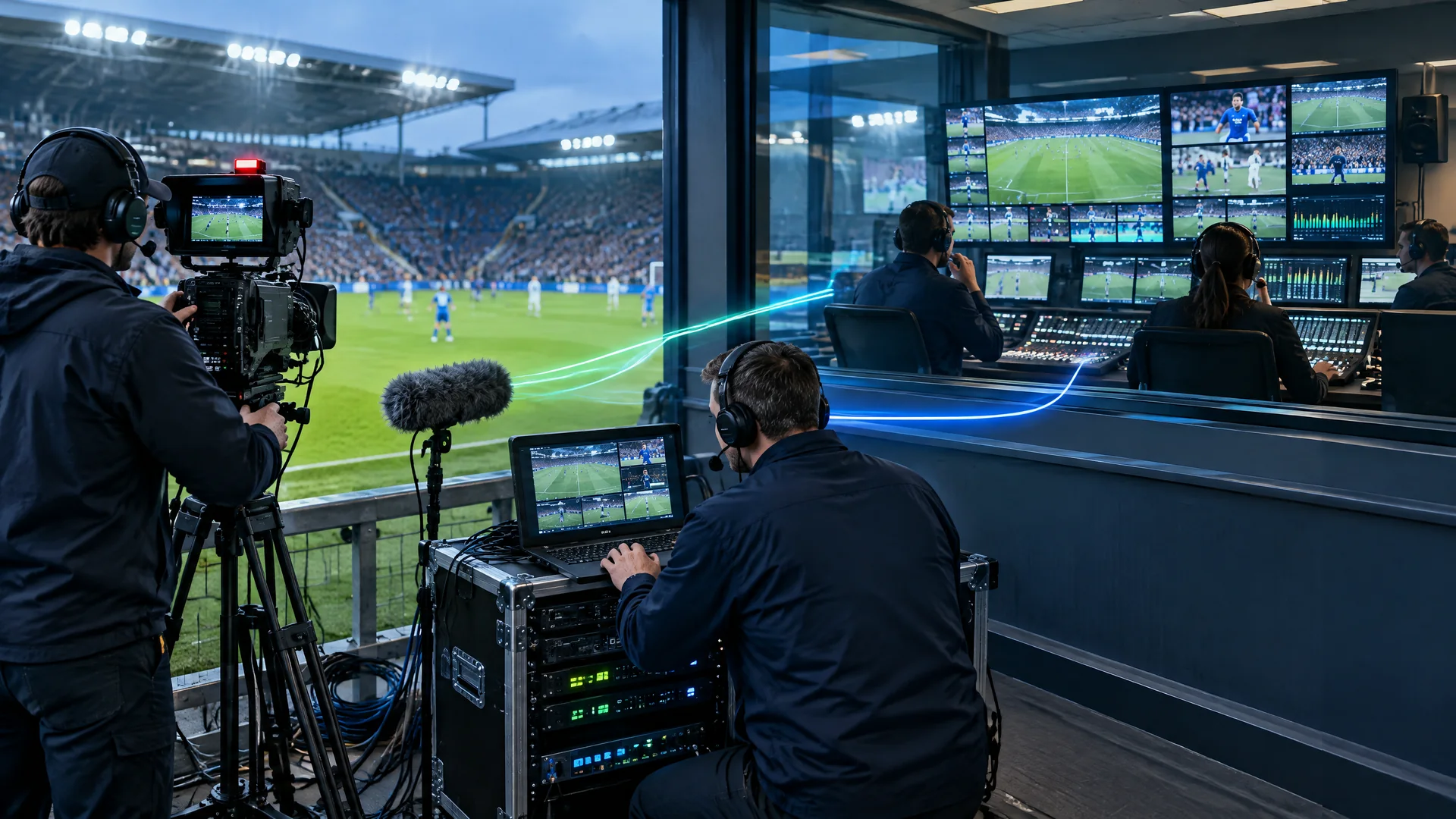
What is REMI in sports broadcasting?
REMI sports broadcasting, short for Remote Integration Model, captures a live event at the venue while selected production work happens at a central facility or controlled remote environment. Cameras, microphones and essential field support remain where the sport happens. Directing, replay, graphics, audio mixing or commentary can move away from the venue when the network and operating plan support them.
REMI is also called at-home or remote production, but the labels do not describe one fixed design. Some events send individual camera feeds to a production hub. Others keep an outside-broadcast unit on site and move only selected roles. The useful definition is operational: identify what stays local, what crosses the contribution network, what returns to the venue and who owns each handoff.
REMI versus a traditional on-site production
A traditional on-site model places the main production control room, replay, audio and graphics close to the venue, often in a mobile unit. REMI separates acquisition from some or most programme-making functions. That can reduce the equipment and crew travelling to an event, but it increases dependence on contribution paths, remote controls, monitoring and communications.
The choice is not simply truck versus internet. A top-tier event may use a hybrid design with an on-site unit for resilience and a remote hub for selected outputs. A smaller event may send a few encoded cameras to a shared control room. The broader sports broadcasting technology maps the full capture-to-viewer chain; this page focuses on where REMI moves each production responsibility.
The venue-to-control-room signal path
A basic REMI path begins with cameras, microphones, timing, score data and local communications at the venue. Signals are checked, encoded or formatted, and sent through a managed contribution path to the production hub. The hub receives and synchronises the sources, then directors, replay operators, graphics teams and audio staff create the programme.
The finished programme may return to the venue, pass to a broadcaster or enter a separate distribution system. Contribution is the high-quality route into production; distribution is the route from the programme to viewers. Keeping those paths separate in documentation makes faults easier to isolate. A healthy public stream does not prove that every contribution feed is healthy, and a clean camera return does not prove the audience output is correct.
What travels from the venue
The outgoing set can include isolated camera feeds, programme or guide audio, commentary microphones, effects microphones, score and timing data, camera metadata, replay records and engineering telemetry. Some designs send lightly compressed or uncompressed signals; others encode each source to fit the available bandwidth and latency budget. Every format conversion should be documented because it can add delay or change picture and sound quality.
A useful signal list names the source, format, timestamp, route, owner and backup. It also identifies whether a feed is clean or carries graphics, whether audio is embedded, and which rights apply. Without that record, two teams may use the same label for different material and discover the mismatch during the live programme.
What returns to the venue
REMI is not a one-way upload. Camera operators and local staff may need programme video, camera previews, tally, programme audio, mix-minus audio, cue feeds and technical confidence monitors. Talent need to hear the right mix without delayed echoes. Camera tally needs to show which source is live. A local engineer needs evidence of what arrived at the hub, not only what left the encoder.
Intercom connects directors, producers, camera operators, audio staff, officials and venue contacts. Its failure can stop coordination even while pictures continue to travel. Return paths therefore need their own monitoring and fallback. The production plan should state which return is essential, which can degrade and how the local team continues if the main communications system is lost.
What normally stays on site
Physical work stays with people near the equipment. That can include camera operation, lens care, cabling, power, wireless-frequency management, microphone placement, venue liaison, safety checks and first response to a failed field unit. A central hub cannot move a cable out of a walkway, replace a wet connector or negotiate access to a camera platform.
The exact local team depends on the event, but the responsibilities cannot disappear. Name an owner for camera readiness, contribution encoding, local audio, field communications, power, weather response and venue escalation. The event-day handoff model in remote sports production workflows provides a practical responsibility matrix for these local roles.
What moves to the central production hub
The central hub may handle vision mixing, replay, graphics, audio, editorial coordination, logging, quality control, commentary and distribution handoff. Centralising these roles can allow a specialist team or room to support several events in sequence. It can also place several programmes behind the same power, network or staffing dependency.
A hub schedule must include setup, line checks, rehearsal, handover and recovery time rather than booking rooms only for programme hours. Operators need responsive controls, synchronized multiviewers and a direct route to the venue. Back-to-back events are possible only when the first programme cannot consume the preparation time or recovery capacity reserved for the next one.
Full REMI, hybrid REMI and cloud-assisted variants
In a fuller REMI model, the venue sends several individual sources to a central control room where the main programme is built. A hybrid model retains more production on site while moving selected functions or an alternate feed to the hub. A cloud-assisted design hosts some processing or collaboration tools in a controlled cloud environment while other roles remain in a facility or venue.
These labels are less important than the actual boundary. Two productions can both be called REMI while moving different sources, staff and failure responsibilities. Document the topology for each event. The WNBA case in ESPN's WNBA REMI contingency plan shows how one production can combine remote roles, home-based analysis and venue resources without treating them as one undifferentiated system.
Timing, synchronisation and latency budgets
Multiple cameras and audio feeds must arrive in a relationship the production system can use. Fixed network delay can be compensated for; variable delay is harder because it changes over time. Buffers can smooth packet arrival but add latency. Encoding, decoding, frame conversion, graphics and distribution each add more delay.
Build a latency budget per workflow rather than quoting one network number. Camera switching, replay control, commentary, interviews, officiating feeds and in-venue screens can tolerate different delays. Measure end to end, including the return path and operator action. A low average is not enough if short spikes make talkback confusing or controls feel inconsistent.
Intercom, tally and confidence monitoring
Intercom tells people what to do, tally tells a camera when it is live and confidence monitoring shows whether the expected signal reached its destination. These systems are small compared with the video payload, but they shape whether a distributed team can work as one production. They need naming, permissions, routing and a fallback that is tested under load.
Monitor several points: the source at the venue, the feed received by the hub, the programme leaving production and the audience-facing output. A camera operator should not rely on a monitor that shows only the local signal before transport. The production engineer should be able to distinguish a venue fault from a network fault, a hub fault and a distribution fault.
Contribution paths and redundancy
Contribution may use managed fibre, wired internet, bonded cellular, satellite or a planned combination. Path choice depends on required quality, delay, mobility, geography and recovery options. Two encoders are not independent if both use the same power strip, last-mile cable or upstream provider. Redundancy has to remove common points of failure.
Define degraded modes before the event. The programme might continue with fewer cameras, a locally switched emergency feed, reduced graphics or a backup commentary path. State who invokes each mode, what viewers will receive and how the team returns to normal. The remote hub should not wait for a total outage before acting on packet loss, timing drift or unstable returns.
Security, rights and access control
REMI expands the number of network interfaces, remote accounts and people who may see live or clean feeds. Use role-limited access, event-specific credentials, encrypted transport where appropriate, change control and logs that show who connected. Shared accounts and open remote-support sessions make incident review difficult.
Rights controls must follow each feed. A clean camera, isolated microphone, player audio, replay angle or data feed may have different permissions from the final programme. Record territorial, language, platform, archive and clip restrictions at the source. Security protects the route; rights policy determines whether the material should travel or be retained at all.
Accessibility and multilingual production in India
A remote hub can help coordinate several commentary languages, captions and alternate outputs, but centralisation does not make them correct automatically. Each language feed needs source timing, names, pronunciation references, mix control and a route for late corrections. Captions need alignment with the final programme, not only the undelayed production feed.
India also presents uneven venue connectivity and mobile-first audience conditions. A production plan may need different contribution choices by venue and several distribution profiles for viewers. Accessibility services, including captions and audio description where provided, must remain in the rehearsal and fallback plan rather than disappearing when the workflow switches to a reduced mode.
How to rehearse degraded operation
A line check proves that a signal is present. A rehearsal proves that people can run the show and recover. Test loss of one camera, one contribution path, intercom, tally, venue internet and a hub workstation. Introduce timing drift or a delayed return and observe whether staff recognise the problem, communicate it and choose the planned fallback.
Record detection time, decision time, recovery time and any unsafe workaround. Include local and remote teams in the debrief because each sees different evidence. Update the responsibility matrix and contact path after the test. A recovery plan that exists only in an engineering drawing is not ready for live sport.
A REMI readiness checklist
- List every outgoing source and every required return.
- Name the owner of capture, encoding, network, hub ingest and final output.
- Measure picture, audio, control and intercom latency end to end.
- Confirm timing references and identify where conversion occurs.
- Remove common failures from primary and backup paths.
- Test tally, talkback, confidence monitoring and local escalation.
- Map rights, accounts, encryption, logs and retention.
- Rehearse a degraded programme with both venue and hub teams.
- Verify captions, language feeds and audience delivery.
- Leave enough room and staff time between events for recovery.
The checklist is a release gate, not a promise that REMI suits every event. A team may decide that an on-site or hybrid model better matches the risk, venue or rights plan. The strongest design is the one whose responsibilities and failure modes remain understandable during a live incident.
Choose the next SportyTechs guide
Use sports broadcasting technology for the full capture, production, accessibility and distribution chain. Use the venue-control field note when local responsibilities are unclear, and IP broadcast systems in stadiums when the main question is packet-based facility architecture. The Presidents Cup case in Presidents Cup split production shows separate on-site and remote editorial outputs sharing source material.
For the wider map linking broadcasting with venues, AI, sensors and accountable adoption, continue with sports technology master guide. REMI is one production pattern inside that system. It succeeds when the signal path, people, rights and fallback are designed together rather than when distance is hidden behind a network diagram.