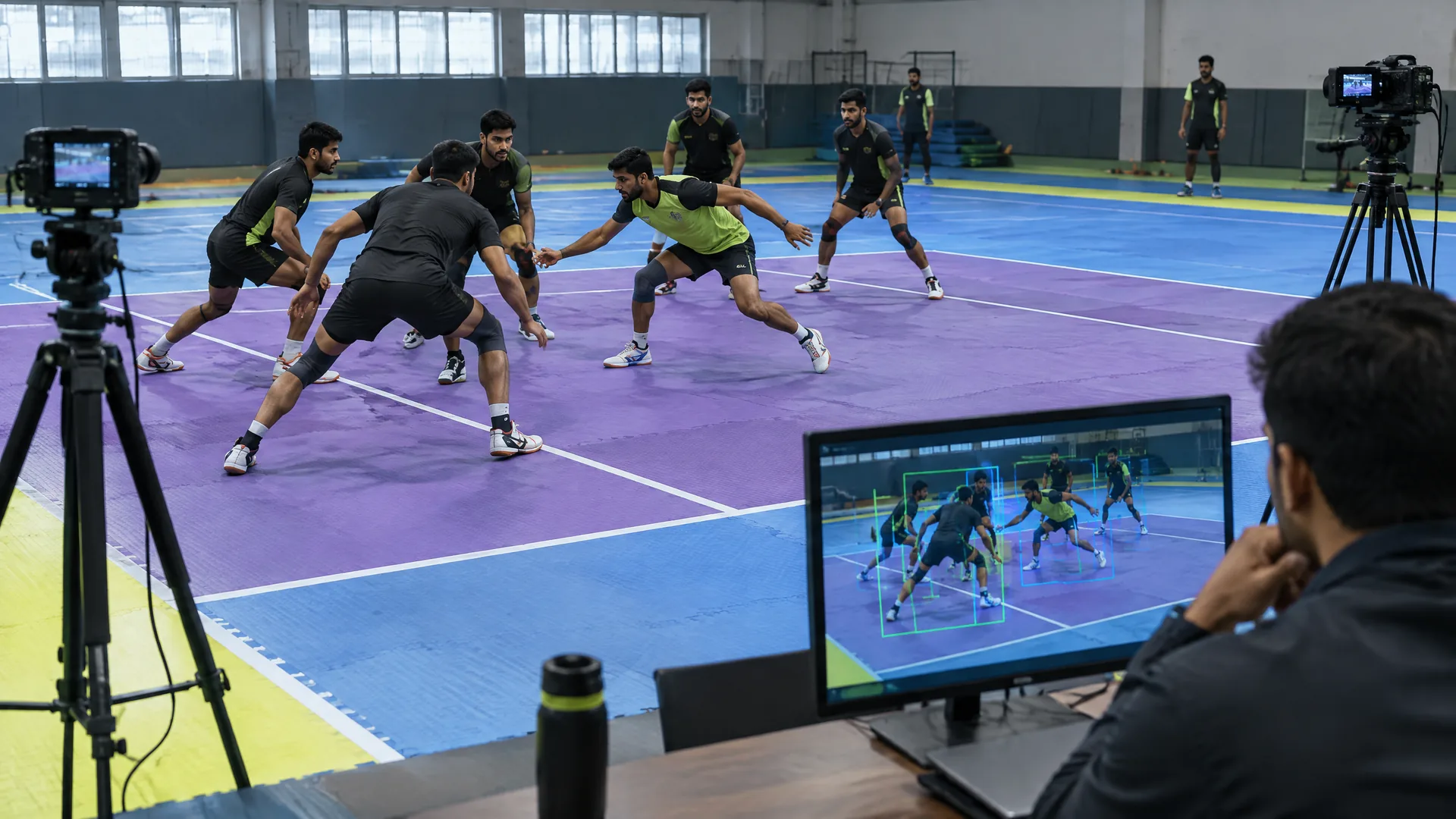
What computer vision is in sport
Computer vision in sports is the use of algorithms to convert pixels in video into structured observations: where a player, ball, line, or piece of equipment appears, how it moves, and when a recognisable event may have occurred. A camera feed is not automatically evidence. It is a sequence of partial views shaped by lens choice, light, compression, motion blur, and what the camera cannot see. A useful system preserves the distinction between an observed image feature, such as a bounding box around a player, and an interpretation, such as possession or a successful tag.
The workflow usually has four layers: capture, geometric calibration, detection and tracking, then reviewable analysis. Each layer carries assumptions forward. A missed athlete can become a broken movement path; a wrongly estimated court boundary can distort distances and zones. The strongest use is therefore not to replace sporting judgement with an opaque score, but to give coaches, officials, analysts, and players a repeatable record that can be checked against video and match context. The question is not merely whether a model produces an answer, but whether a reasonable reviewer can trace how that answer was reached.
Capture and camera calibration
Capture begins with a practical decision: which action must be visible, at what detail, and from how many viewpoints? A wide fixed camera offers stable context but may leave a small ball or hand contact too few pixels to assess. A closer view improves detail while increasing the chance that players leave frame. Frame rate affects how finely rapid actions can be inspected; shutter settings, illumination, and compression affect whether individual frames remain usable. Before a competition or training session, teams should test representative movement, clothing, weather or indoor lighting, and likely obstructions rather than relying on a clean demonstration clip.
Calibration maps image coordinates to a known sporting surface or another reference plane. It uses visible landmarks, such as court lines, field markings, or surveyed points, to estimate camera position, orientation, and lens distortion. This makes it possible to compare positions in metres rather than arbitrary pixels, but only where the underlying surface and camera setup support that estimate. A shifted tripod, zoom change, temporary markings, or camera vibration can invalidate a previous calibration. At multi-use grounds in India, movable furniture, changing boundary layouts, glare, and mixed daylight can make a documented pre-session check especially important.
Detection and tracking
Detection identifies candidate objects in an individual frame, often as a box, mask, or keypoints around a body. Tracking links those detections across successive frames to form a trajectory. A box states an estimated image region; a mask attempts to separate visible pixels of one object from the background; keypoints estimate landmarks such as shoulders, knees, or ankles. These outputs can support simple counts, movement paths, or time in a defined zone, yet their precision should be stated in terms that match the decision. An approximate route may be sufficient for workload review, while a disputed line decision demands much stronger visual and geometric evidence.
Good implementation records the camera source, frame timing, calibration version, model version, settings, and any filtering used to smooth a path. Smoothing can reduce jitter, but it can also conceal a short change of direction or move an estimated position across a boundary. The ball, especially when small or blurred, deserves separate validation from player tracking. Analysts should inspect examples from the actual sport and venue, including fast motion, substitutions, officials, spectators, similar kit colours, and partial views. A system that tracks open-field running well may fail when a player is only briefly visible behind another body.
Re-identification through crowded play
Re-identification is the process of deciding that an athlete seen after a gap or occlusion is the same athlete seen earlier. In crowded play, this cannot safely rely on jersey colour alone. Algorithms may combine appearance features, likely movement, team assignment, field position, and short-term track history. In kabaddi, close physical contact and overlapping bodies make those cues ambiguous: a player may disappear behind a group, reappear with only a partial torso visible, or exchange apparent position with a teammate. The result is a hypothesis about identity, not a fact supplied directly by the image.
Practical safeguards include using more than one camera where proportionate, retaining an explicit "unknown" identity state, and marking every identity handover for review. Team rosters and manually confirmed starting identities can provide a reference, but they should not force a match when the video is insufficient. A false identity can contaminate all later measures attributed to that athlete, from distance to involvement in a phase of play. For this reason, reports should separate continuous, high-confidence tracks from reconstructed segments, and should allow analysts to correct an identity without erasing the original automated output.
Confidence, validation and failure conditions
Confidence is an estimate of how strongly a system supports an output under its own assumptions; it is not a guarantee that the output is correct. A detection score can reflect how well an image resembles patterns seen during model development, but it does not independently prove the player, ball, or event is correctly identified. Validation compares outputs with a carefully reviewed reference set from relevant matches or sessions. It should examine different cameras, light, kit colours, ages, body types, playing surfaces, levels of crowding, and action speeds, rather than reporting a single blended result.
Failure conditions should be declared before the output is used. Examples include severe occlusion, rain or glare, low resolution, unreliable timestamps, a moved camera, missing field markings, unusual uniforms, and actions occurring off camera. Define thresholds that trigger a flag, a pause in automated calculation, or mandatory human review. Review samples from apparent successes as well as obvious errors: a system can make plausible mistakes that are harder to spot than a blank result. When a decision may affect selection, officiating, payment, or reputation, uncertainty and evidence gaps should be visible to the decision-maker, not hidden behind a tidy dashboard.
Human review and the audit trail
Human review gives automated observations sporting meaning and supplies a route to challenge them. The reviewer should see the relevant video clip, frame range, camera identifier, overlays, calibration state, output confidence, and the rule or definition used to create a metric. For an event label, this may also include the alternative candidate frames and any disagreement between camera views. Reviewers need clear instructions about what they are confirming, changing, or rejecting; otherwise a correction becomes another undocumented judgement rather than quality control.
An audit trail is a time-stamped record of the inputs, processing versions, automated outputs, edits, reviewer identity or role, and final decision. It should preserve the original output rather than silently overwriting it, explain material changes, and link each conclusion to the underlying footage where access is authorised. Access should be role-based: an official may need a review package, while a coach may need aggregate training analysis. An accessible interface matters too. Clear labels, keyboard operation, readable contrast, captions or transcripts for verbal review notes, and exportable evidence reduce the chance that usable scrutiny depends on one person or one device.
Privacy, rights and access
Sports video can identify players, officials, spectators, and staff, and derived tracks or event records can reveal participation patterns. Collection should have a documented purpose, a defined retention period, and a clear explanation of who may see footage and derived data. The authority to film a venue is not necessarily authority to reuse identifiable material for analysis, publication, or model development. Agreements should distinguish match operations, coaching, research, media use, and onward sharing. Where children or community participants are involved, safeguarding requirements and the capacity to understand notices deserve particular care.
Rights and access should be planned before capture, including who controls raw footage, who can correct an identity or annotation, and how a participant can raise a concern. Minimise collection where possible: use the smallest camera coverage, retention period, and data fields needed for the stated purpose. Separate operational access from broader analytical access, protect exports, and avoid treating biometric-style inferences as routine metadata. In India, implementation should account for applicable law, tournament rules, local venue arrangements, language needs, and unequal access to devices or reliable connectivity. Privacy notices and review routes should be understandable to participants, not only to technical staff.
Choose the next specialist guide
Use this hub to frame the chain from camera placement to a decision that can be inspected. If the immediate problem is turning a playing surface into a dependable spatial reference, continue with camera calibration for sports analytics. If the main risk is losing or swapping identities when players converge, continue with computer vision player tracking. These specialist guides address narrower implementation choices while keeping the same discipline: identify assumptions, retain source evidence, and set a review path before relying on an output.
For venue-specific context, computer vision in cricket considers practical constraints around a changing ground environment, while kabaddi player tracking focuses on the particular ambiguity of close-contact play. Choose the guide that matches the first weak link in the workflow, not the most sophisticated-looking model. Improving capture, calibration, identity handling, or review documentation can be more defensible than adding a new automated label to uncertain footage.