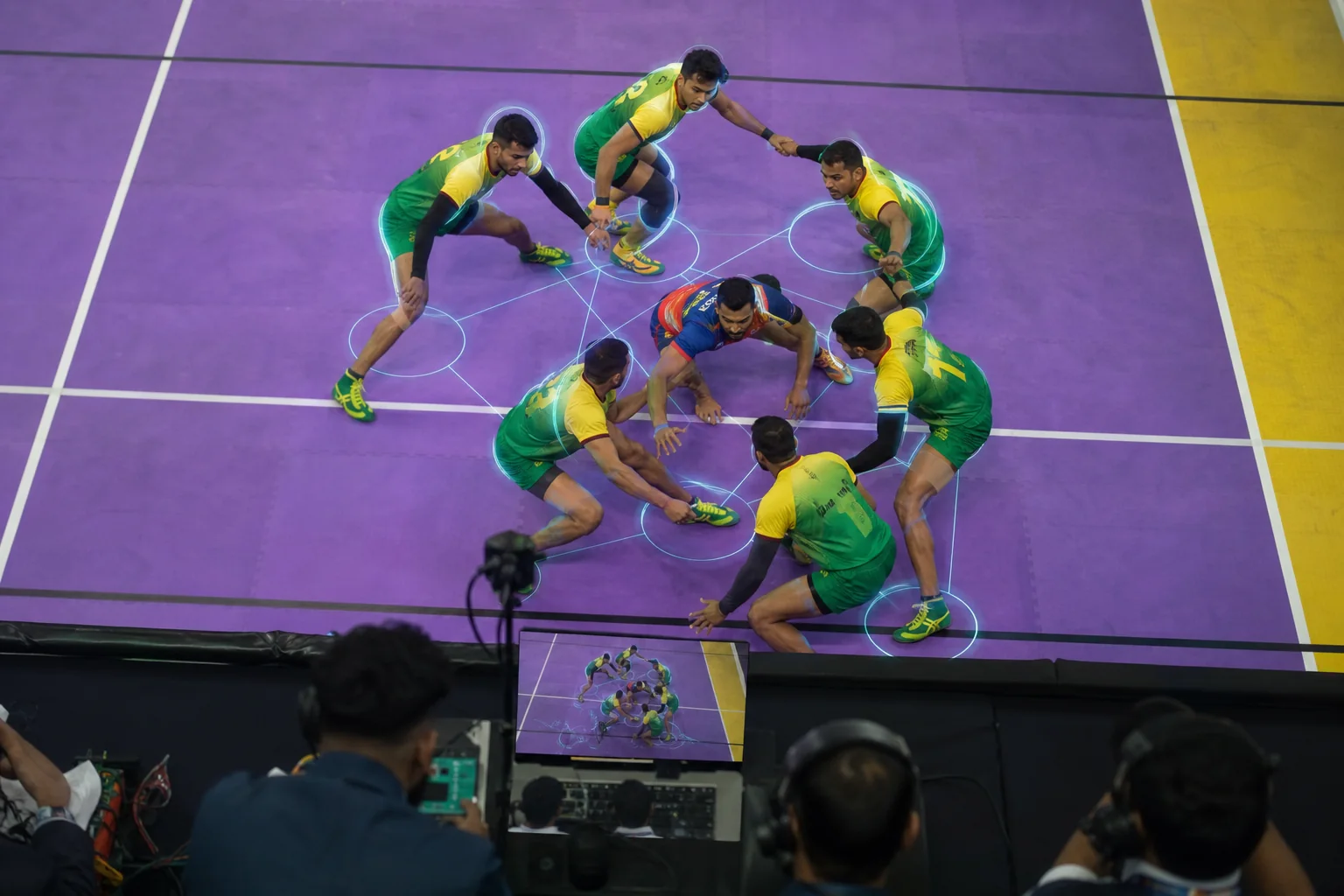
Build the record from traceable material. Use court geometry, entry and exit lines, synchronized side views, visible limb landmarks, whistle timing, and operator annotations, and document where each item came from and when it was created. The analytical method is to segment play into approach, engagement, and resolution phases, using multiple candidate tracks through contact instead of forcing one uninterrupted identity path. Keep primary evidence distinct from interpretation, and make a missing source visible rather than silently substituting a proxy. A dossier or review package should enable a colleague to revisit the same material and reasonably understand how the conclusion was reached.
Operators verify court corners and time alignment before the session. The model produces candidate trajectories and contact windows; reviewers only inspect windows with low confidence or implausible speed changes. Coaches receive phase clips and a conservative spatial summary, while the original frame range remains one click away for challenge. The operating rhythm should leave room for correction without treating it as failure. Capture edits with a reason, preserve earlier wording when a substantive judgement changes, and ask whether recurring corrections reveal a weak definition. That history is especially valuable when staff rotate or when a later decision depends on how confident the earlier team actually was.
An evidence-led approach to Optical tracking for kabaddi contact phases begins with a question that admits uncertainty: when the visual record supports a reliable phase reconstruction and when it should be handed to manual review. That matters in a compact court where a raider and defenders repeatedly obscure one another during high-speed engagement, where a fast conclusion can carry more weight than the material supports. State what would count as supporting evidence, what would count against it, and what remains unknown. This gives the work a disciplined scope and makes it easier for colleagues to add observations without being pushed toward an early consensus.
Different roles need different moments to contribute. Start independent observation before group discussion, then have an editor or lead reviewer test the emerging claim against the original sources. This ordering reduces the chance that an early opinion becomes the category through which every later clip or note is read. Use a short challenge prompt: what contextual explanation, alternative interpretation, or missing match would most change the current view? In practice, record this step in the shared operational log so that the next reviewer can see the context, owner, and unresolved question without reconstructing it from memory.
Assess the record rather than merely the headline. Use phase-boundary agreement, identity continuity before and after contact, reviewer time per raid, and error concentration by camera position. Read those measures alongside an intentionally selected set of ambiguous examples. A high coverage number may still lack the decisive context; agreement may be high because the rubric is too broad. The test is whether the evidence supports a practical next action while accurately signaling the conditions in which that action might not transfer. In practice, record this step in the shared operational log so that the next reviewer can see the context, owner, and unresolved question without reconstructing it from memory.
The record also has ethical and procedural boundaries. hands and feet may be hidden, uniforms blend within a cluster, and a single elevated view can miss the difference between proximity and actual contact Set clear purposes for athlete footage, restrict access to coaching and analysis roles, and do not infer injuries, emotions, or personal traits from contact video. Protect youth participants with stricter permissions. Make access proportionate and give the people responsible for the process a route to query errors or misuse. Sensitive athlete-linked materials deserve the same discipline whether they appear as video, notes, scores, or seemingly harmless metadata.
Act on the strength actually available: Budget for an extra side view before spending on more elaborate inference. Use tracking to organize film and test tactical questions, not to settle every contested contact automatically. When the correct next move is another observation, a narrower test, or no automated action, say so directly. Credibility comes from a process that can decline to overstate its case. Over time, this creates a library of better questions as well as better answers. In practice, record this step in the shared operational log so that the next reviewer can see the context, owner, and unresolved question without reconstructing it from memory.