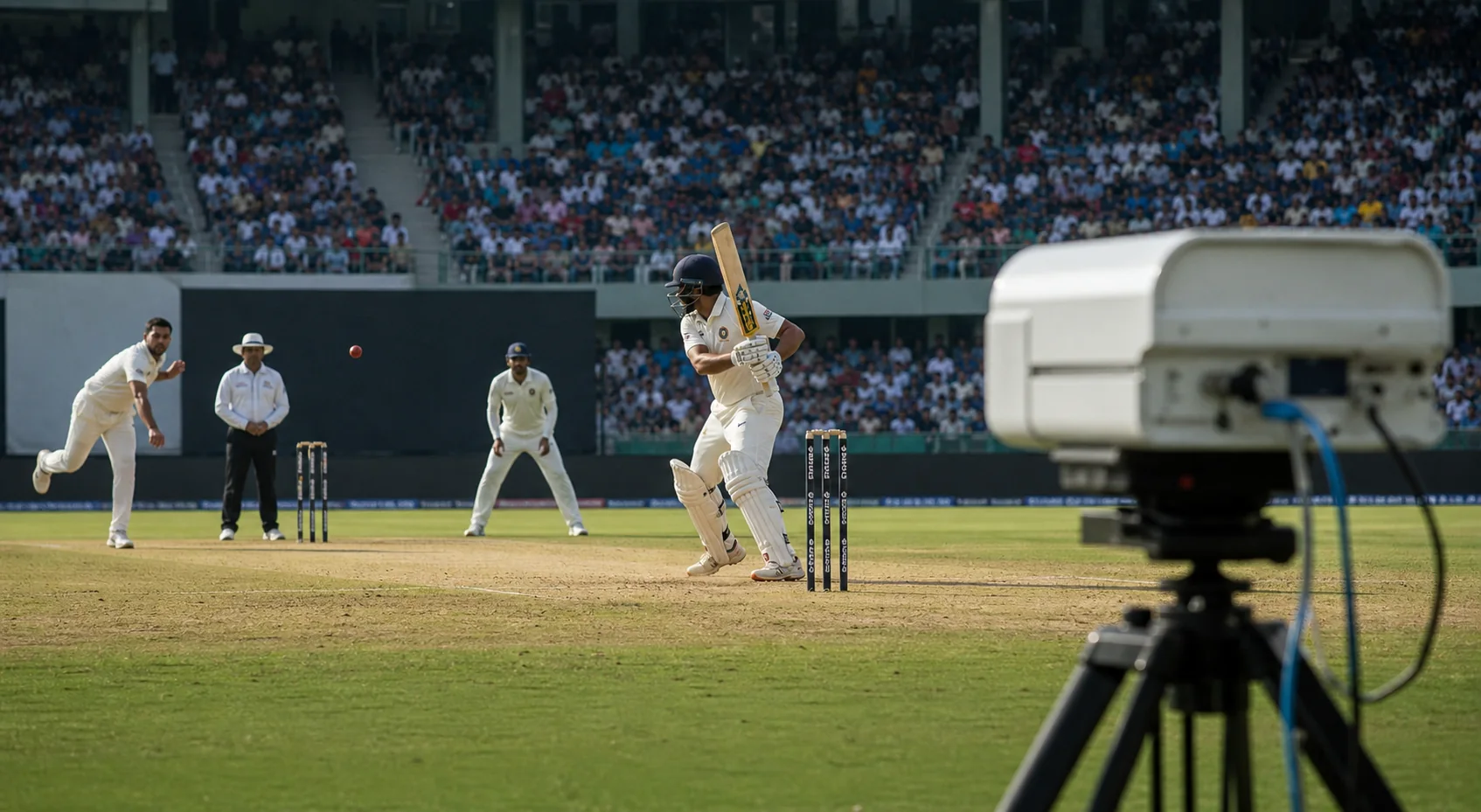
At a field site, Computer-vision deployment for cricket at multi-use Indian grounds has to survive the conditions that staff actually face. The live question is which visual signals remain reliable enough to support post-match review under locally variable conditions. In a venue where the boundary, lighting, access routes, and camera positions can change from one fixture to the next, begin with observation: walk the space, speak to the operators, and list the parts of the day that vary. This ground truth prevents a plan from assuming stable power, views, attendance, staffing, or participant expectations. It also reveals where a small intervention could make an immediate difference.
Choose signals that are available and defensible. For this work, they are crease and pitch markings, boundary reference points, scorebook timing, camera placement photos, and short site-condition notes. Use them to build each match capture around a repeatable ground walk, a simple reference survey, and a declared confidence level for every derived spatial output. Keep a note of what is directly observed, what is estimated, and what has been supplied by another system or person. A simple source ledger gives later reviewers a way to challenge a conclusion without treating every issue as a conflict. It also helps a programme learn which collection work is worth repeating.
To evaluate progress, use detection and projection quality by lighting period, coverage of the intended field zones, and the number of minutes requiring manual recovery. Compare like with like and retain enough context to interpret a change. For example, an intervention that appears to improve flow or coverage might instead reflect a different timetable, crowd mix, opponent, or lighting condition. Measurement earns trust when it is paired with a practical account of what changed and what remained outside the observer’s view. In practice, record this step in the shared operational log so that the next reviewer can see the context, owner, and unresolved question without reconstructing it from memory.
The first setup should favour reproducibility over sophistication. Take setup photos, use stable naming conventions, and give each role a short checklist. Avoid dependencies that a local operator cannot reset or explain. If the site needs a more advanced component, pair it with a manual alternative that keeps the core review process moving. A resilient field design anticipates weather, schedule changes, temporary structures, and ordinary human error. In practice, record this step in the shared operational log so that the next reviewer can see the context, owner, and unresolved question without reconstructing it from memory.
Before play, the operator photographs each mount, records lens presets, captures the pitch and boundary markers, and notes shade or temporary structures. After the innings, an analyst compares automated detections against a small clip sample from different angles. The report separates verified ball-in-play views from material that is only suitable for navigation. Include a brief end-of-day debrief that captures what staff noticed outside the instruments. Those comments often explain an anomaly better than a retrospective guess. Keep corrective actions small and assigned; a list of observations without ownership becomes institutional memory that disappears with the next shift.
Field limits deserve their own operating response: monsoon weather, glare, mobile towers, spectators near boundaries, and an altered rope can invalidate assumptions that worked at a previous ground Agree venue permissions in advance, avoid capturing adjacent private areas where possible, and publish simple notices describing the sporting purpose and footage retention. Do not repurpose crowd imagery for individual profiling. Say in advance what will be turned off, escalated, or reviewed when those limits appear. This is particularly important where participants may have less power to question a programme or where the capture environment includes people who are not central to the sporting activity.
For the next fixture or cycle, Start with a single innings question such as fielding-position review, then expand only after the ground walk and quality log are routine. A modest, repeatable setup beats a complex installation that cannot be reset. Write the adjustment onto the site card and test it with the people expected to perform it. Scale only when the routine is workable under normal staffing. The lasting asset is not the first visualization; it is a local process that produces useful, bounded evidence again and again. In practice, record this step in the shared operational log so that the next reviewer can see the context, owner, and unresolved question without reconstructing it from memory.