What moved into daily operations
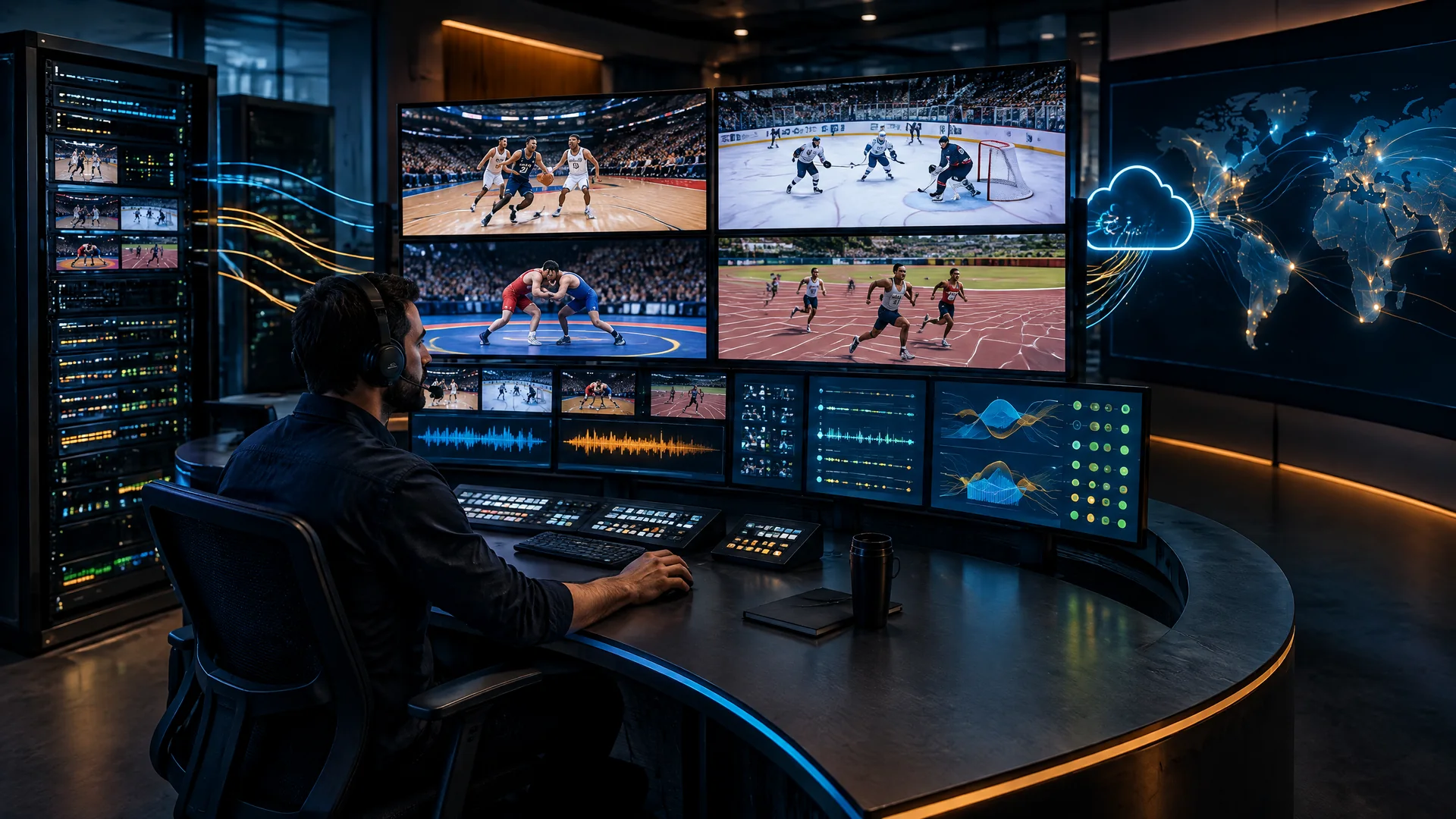
FloSports says an internally built Master Control Room is now fully embedded in its StreamOps platform after going live around the end of the second quarter. The system places live pictures, audio meters and distribution telemetry in one operator-facing view. That is the material change: the company is not only describing an AI experiment or future product. It is reporting a monitoring tool used in routine live-stream operations. The distinction matters because adjacent tools in the same account remain at different stages. Live Clipping has launched for college-season use, CapCom assists troubleshooting from previous incident records, and a smartphone version of AI Producer is still being developed. One announcement therefore contains a deployed dashboard, a launched clipping workflow, an internal assistant and an unfinished mobile product.
The problem begins with stream volume
A streaming operation can carry many simultaneous events, including competitions with several active mats or playing surfaces. The operator does not simply need a wall of pictures. They need to know whether each assigned stream is arriving, whether audio is present, whether the processing path is healthy and whether the audience-facing output matches the source. FloSports says its annual schedule exceeds 50,000 live events, so a useful monitoring surface must help people find the small number of streams that need attention without hiding the rest. SportyTechs’ guide to sports broadcasting technology explains the broader chain from capture to delivery. The Master Control Room account adds a practical example of how one organization is trying to make that chain visible to operators.
Comparing ingest with CDN output
The dashboard is described as showing a low-latency ingest view beside the stream leaving through the content-delivery network. That comparison can help an operator narrow the location of a problem. If the source view is healthy but the delivered view is not, the investigation can move downstream. If both are wrong, the team can look earlier in the chain. Audio meters and telemetry add evidence that a picture alone cannot provide, while filters let operators focus on the events assigned to them. FloSports also says the interface can page automatically through active streams. These are workflow descriptions, not proof of availability or fault detection. The report publishes no false-alert rate, feed-availability log, recovery distribution or independent service-level audit.
AI-assisted coding changed the build process
FloSports attributes the rapid build to a small engineering effort using AI-assisted software development. The company says two people produced a working minimum version in weeks and then refined it with operator feedback, contrasting that with a much longer conventional estimate. The important boundary is that the AI assisted software creation; it is not described as autonomously directing a live sports broadcast. Human operators still watch, interpret, investigate and escalate. That separation aligns with SportyTechs’ guide to responsible AI for player decision support: a system can organize signals and shorten a task without becoming the accountable decision-maker. For a production team, the test is not how quickly code appeared, but whether the resulting tool is observable, maintainable and safe to use during a live event.
Reported effects need attribution
FloSports reports that incident-response time fell by 75 percent, that the dashboard avoids more than 100,000 dollars in annual cost and that additional monitoring can be absorbed without proportional headcount growth. These figures are useful because they identify what the company chose to measure. They are not an independent before-and-after audit. The source does not define the incident sample, starting response time, severity mix, measurement period, excluded events or cost model. A responsible reading therefore treats the numbers as company-reported operating outcomes. Teams considering a similar system would need their own baseline: time from alert to operator acknowledgement, time to isolate the failing segment, restoration time, missed incidents, false alarms and the effect on operator workload.
Clipping and CapCom address adjacent tasks
The same operating account describes two narrower tools. Live Clipping is said to detect moments such as hockey goals and create shareable clips. FloSports reports that one workflow can fall from about ten minutes to under 45 seconds, and says the tool is being shared with selected partners after a college-season launch. CapCom uses previous troubleshooting records to help answer questions raised in an internal messaging channel. The two systems do different work: one accelerates content extraction, while the other searches operational memory. Neither removes the need to verify the event, check the clip boundary, protect restricted information or record who approved a response. The existing SportyTechs guide to video tagging that keeps up with the week offers a useful comparison between automation speed and review quality.
Mobile AI Producer is not yet deployed
FloSports says its automated production platform can frame action, change cameras and generate graphics, but the smartphone version described in the report remains in development. Work to integrate CapCom into that mobile workflow is also ongoing. These status words should not be collapsed into a single product claim. A deployed control-room dashboard has different evidence from an app that is being built. Before a mobile production tool could be evaluated, a team would need to know the sports supported, camera-placement assumptions, connectivity requirements, human override, graphics checks, failure modes and what happens when the device overheats or loses network service. SportyTechs’ article on remote production without losing venue control makes the same point: remote capability is useful only when local responsibilities and fallback paths remain explicit.
What another operator should evaluate
The FloSports case is most useful as a checklist, not a purchase recommendation. Start with the decision the operator must make, then identify the smallest set of pictures, audio signals and telemetry needed to make it. Preserve access logs, alert history and a route for correcting the system when an event is misclassified. Test the dashboard under peak concurrency, degraded connectivity and incomplete metadata. Measure missed incidents as well as faster responses, and examine whether automation reduces cognitive load or merely concentrates more screens around one person. Finally, separate development velocity from operational assurance. AI-assisted coding may compress the first build, but live sport still needs review, change control, security, rehearsal and a documented rollback path. That human operating model is the durable lesson behind the reported gains.