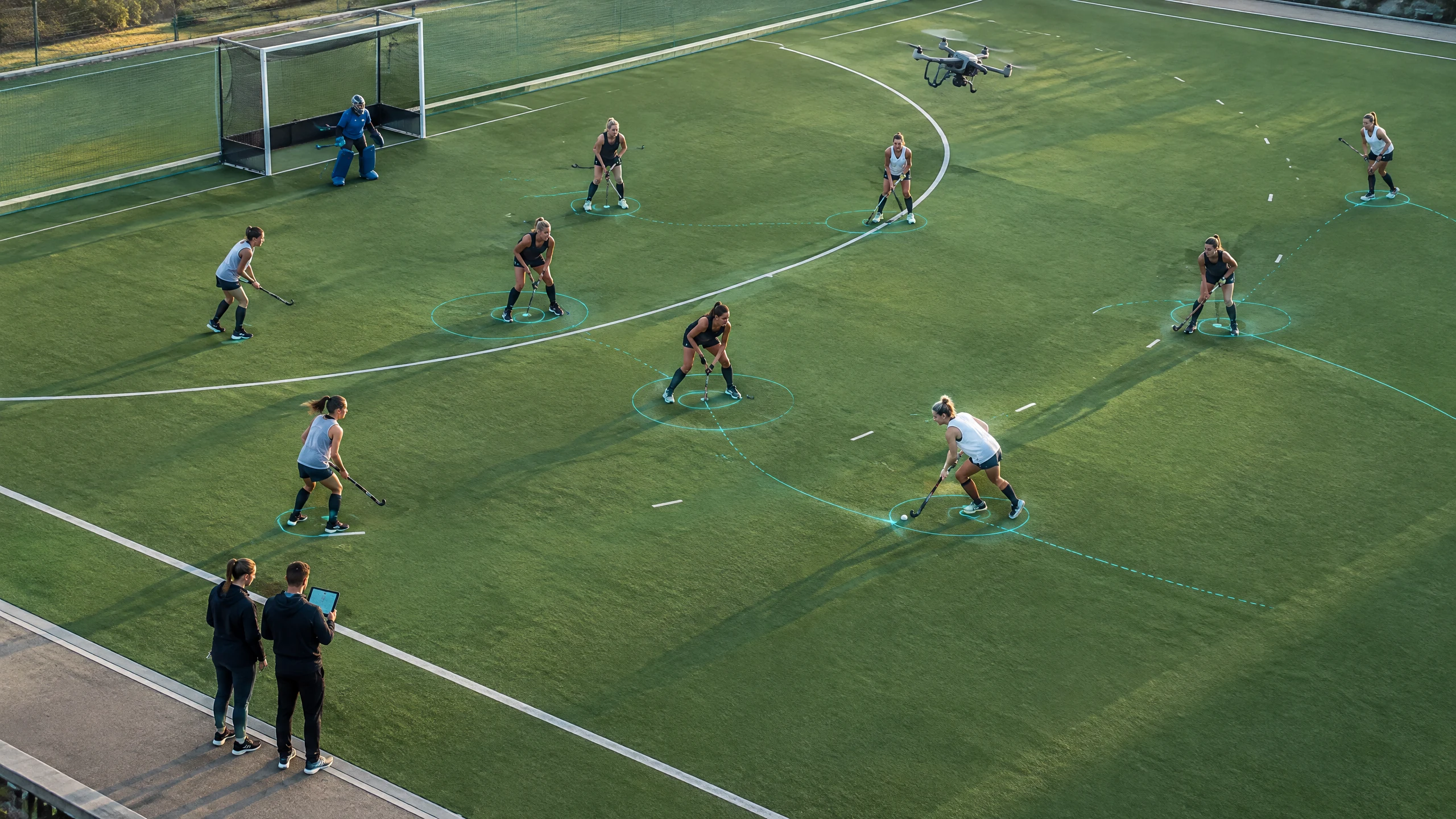
South Korea’s women’s field-hockey team and national shooting programme are using artificial-intelligence-assisted video analysis in current pre-Asian Games training, SBS News reported on 12 September. The reported field-hockey setup combines drone footage with AI processing to show player movement, the distance between players and the spaces they are assigned to cover. On the shooting range, SBS reported that the system analyses joint positions, posture angles and movement stability, then supplies firearm-angle movement and swing-speed measures to coaches. The development is a reported deployment in national-team preparation, not a product announcement: it places computer-derived video outputs inside tactical and practice review. Its practical significance lies in the sequence after capture, when staff decide whether an output is credible enough to shape the next coaching instruction.
For the hockey side, SBS says aerial video is processed into a view of movement, inter-player distance and coverage space. That changes the material available for a review without changing the coach’s responsibility for interpreting it. Korea Institute of Sport Science researcher Kim Ji-eung told SBS that AI can make the production of analysis footage more time-efficient. Women’s field-hockey captain Lee Yu-ri said the analysis helps players understand movement and positioning more quickly, while head coach Kim Yong-soo said the equipment can help assess opponents and support customised strategies. Those are practitioner accounts of how the material is being used. They establish that players and coaches are engaging with the output; they do not independently establish that a particular spacing pattern, opponent assessment or strategy produces a better result.
The shooting workflow has a different unit of analysis. SBS reports that the system recognises joint positions and examines posture angle and movement stability, rather than mapping the relationship among a group of players. National shooting-team general manager Jang Gap-seok said firearm-angle movement and swing speed are delivered to coaching staff. SBS also reported training sessions designed to simulate distractions such as applause and music, alongside the use of facial-expression detection. The important distinction is between what the report documents and what it does not: it documents the collection and review of those signals in practice, but it does not show that the signals identify an athlete’s mental state, predict a shot outcome or improve competitive performance.
Across both sports, the useful operational question is what happens between a computer-vision signal and the next observable instruction. A hockey movement display or a shooting posture measure is not, by itself, a tactical intervention. Footage has to be captured, an output reviewed, and its relevance judged in the context of the drill and the athlete before a coach turns it into a cue that can be tested in the next representative repetition. This is where a faster route from footage to analysis can matter to daily practice: it can place a review item in front of staff sooner. It does not remove the need for human validation, and SBS’s report gives no basis for treating the output as an autonomous coaching decision.
The two programmes also illustrate why a single label such as AI analysis can conceal different coaching loops. In hockey, the reported information concerns a team shape: movements, distances and coverage responsibilities can be reviewed against a tactical situation. In shooting, the reported information concerns individual position and equipment movement: joint locations, posture stability, firearm-angle movement and swing speed can be brought to the coaching staff. Both may be presented through video, but their relevance depends on different questions. For the field-hockey staff, the issue is whether a pattern of spacing or coverage is meaningful in the play being reviewed. For shooting staff, it is whether a detected variation is meaningful for that athlete and that training task. The technology’s role is therefore bounded by the drill, the review process and the coach’s judgement.
The evidence has clear limits. SBS provides accountable on-location reporting and identifies the institute researcher, hockey captain and coach, shooting general manager, and a Korea Institute senior research fellow, but the report names no vendor, model, training data, accuracy rate, false-positive rate or baseline comparison. It offers no data-retention policy, access controls or other athlete-data governance detail. Nor does it report outcome measurement for tactical performance, injury prevention, confidence, emotional regulation, selection decisions or competition results. The facial-expression element is especially limited: the report describes detection, not a validated inference about emotion or psychological condition. The available SBS English companion is AI-translated, so the Korean original remains the appropriate basis for checking any wording attributed to the report or its named sources.
This is best understood as an early view of a coach-facing review workflow within two South Korean national-team programmes. SBS has documented the inputs, the types of outputs and the practitioners’ stated use of them. It has not documented whether analysis footage changes a coach’s decision, whether a cue changes an athlete’s execution, or whether either ultimately changes an outcome. A later evidence-led assessment would require a defined signal, a record of who validates it, a clear point at which athletes see it, and a comparison that can distinguish faster review from better performance. Until such information is available, the confirmed story is the deployment of AI-assisted analysis in pre-Games training, with coaching judgement still at the centre of the process.