The study asks two different questions
A peer-reviewed Scientific Reports paper examines how machine learning might identify patterns associated with injury risk and separately estimate what could change under an intervention. Those are not the same task. Prediction asks whether a combination of recent observations is associated with a future event. Causal estimation asks whether changing one factor would alter that outcome under stated assumptions. The authors built two connected components rather than presenting a single risk score as proof of cause. That design makes the study relevant to teams considering analytics, while its limitations prevent it from becoming clinical guidance. SportyTechs’ article on why recovery technology needs better questions provides the practical starting point: a measurement is useful only when the decision and its uncertainty are explicit.
Data from 342 elite team-sport athletes
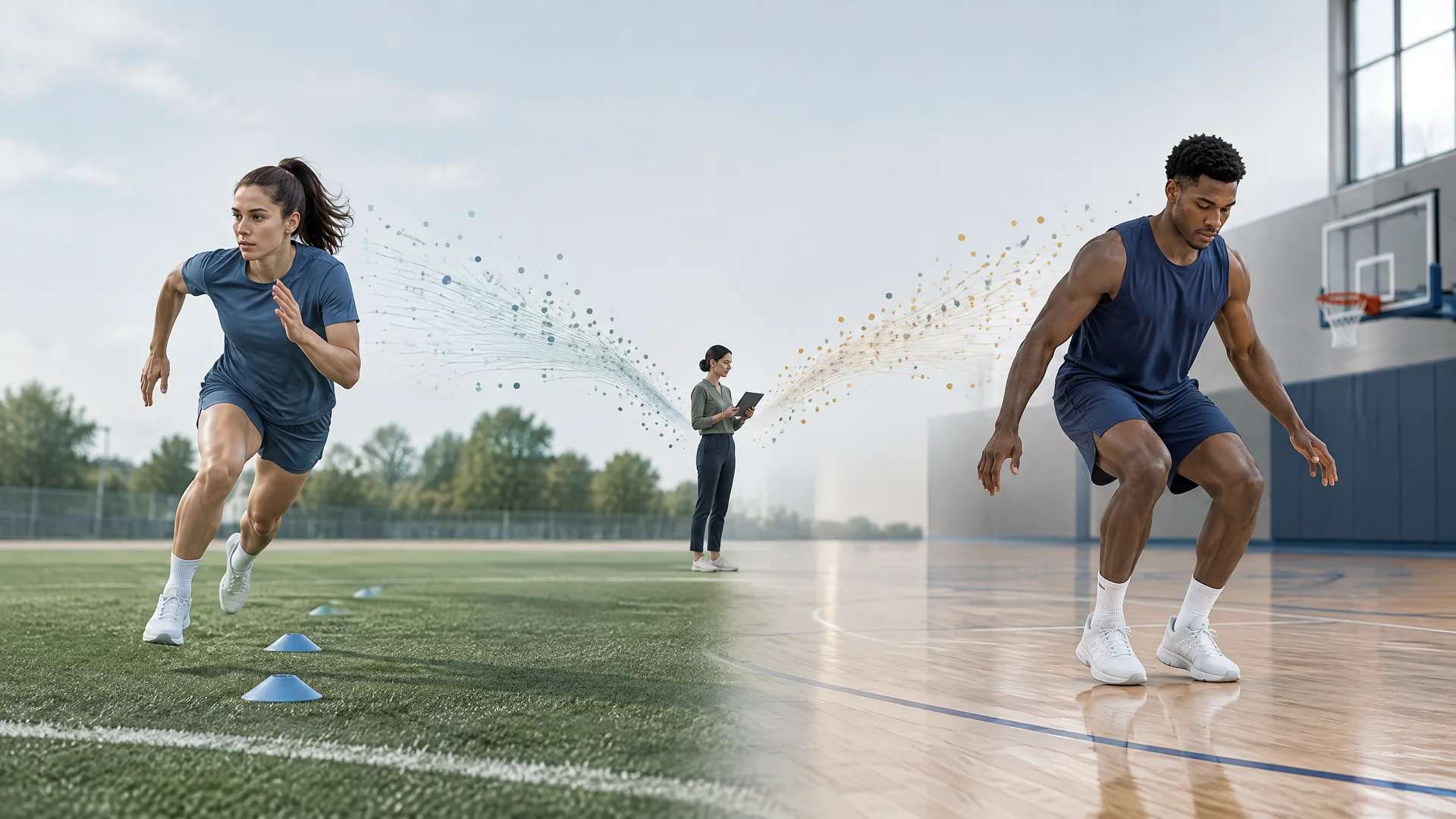
The development dataset contains longitudinal monitoring information from 342 elite soccer and basketball athletes across six organizations. A temporal-convolutional encoder with attention pooling supports predictive discrimination, while a treatment-agnostic representation network with confounder balancing supports counterfactual estimation. The causal component depends on three stated assumptions: conditional ignorability, positivity and no interference. In plain language, relevant confounding must be adequately represented, each compared intervention must be possible for suitable athletes, and one athlete’s treatment must not change another athlete’s outcome. Those are demanding conditions in team environments. Shared coaching, schedules, facilities and competition exposure can connect athletes, so an estimated effect remains conditional on the design rather than becoming a universal rule.
The headline reference can flatter performance
The model recovered injury-relevant factors with reported precision and recall of 0.92 against an expert-consensus reference under five-fold athlete-stratified cross-validation. The authors immediately qualify that result because the same expert panel helped draft the candidate list. A system tested against a reference partly shaped by the same knowledge can appear stronger than it will against a truly independent target. The paper reports Fleiss’ kappa of 0.71 for inter-rater reliability, showing substantial but imperfect agreement among experts. This is why validation design matters as much as a headline metric. The SportyTechs guide to validating a wearable before it shapes selection applies the same principle: the test population, reference and decision context determine what a performance number means.
Independent checks lower the defensible range
When the researchers compared the framework with an independent 18-factor literature-derived set, precision remained 0.85 while recall fell to 0.61. In a semi-synthetic simulation with known ground truth, precision again measured 0.85 and recall reached 0.79. The authors identify this lower band, not the matched 0.92 result, as the defensible operating range. They also report predictive AUC-ROC above 0.82, a calibration slope of 0.97 and a 56 percent reduction in causal-effect mean absolute error compared with standard deep learning. These values describe performance within the study’s data and assumptions. They do not show that a model will remain calibrated after a new season, league, training culture or athlete population. Model drift after the season changes explains why that external transition needs fresh monitoring.
The prospective comparison was exploratory
The paper also reports a six-month prospective comparison. Eighty-nine athletes received an intervention informed by the framework and 87 served as controls. The groups recorded 11 and 18 time-loss injuries respectively. The resulting point estimate corresponds to a 40 percent relative reduction, but the study was not randomised, was not prospectively registered and was effectively allocated at institution level. That last detail is important because athletes in the same organization share staff, routines and other conditions. The independent unit is therefore closer to the organization than to each athlete. With only six clusters, an individual-level calculation can overstate precision even when the total athlete count looks substantial.
The uncertainty does not support a prevention claim
Only 29 time-loss injuries occurred in the prospective comparison. The individual-level interval ranged from a 19 percent increase to a 70 percent reduction, with a p value of 0.14. Cluster-aware intervals were wider. The authors also note that a cluster-level permutation p value of 0.05 is simply the smallest value available with six clusters, not a decisive confirmation. These facts leave the direction and size of any real effect uncertain. It is accurate to say that the intervention group had fewer observed injuries in this pilot. It is not accurate to say that the model prevented injuries, proved a treatment effect or can identify which action an individual athlete should take. The point estimate is a signal for a better trial, not a result that should direct care.
Governance and clinical judgment stay outside the score
An injury-risk system combines sensitive performance and health-adjacent information. Teams need a defined purpose, role-based access, correction routes, retention limits and a way for athletes to understand or contest an inference. Building an athlete data rights charter provides a first-party framework for those controls. The study does not replace an examination, diagnosis or treatment plan. Analysts should communicate what variables were available, which data were missing and how uncertain the estimate is; qualified sports-medicine staff remain responsible for clinical decisions. A coach should not use a model output as proof that an athlete is fragile, uncommitted or unfit for selection. The practical boundary is decision support with documented human review, not automated medical authority.
What a confirmatory trial must establish
The authors call for a properly powered, multi-centre cluster-randomised trial. Such a study would need prospective registration, enough independent organizations, a pre-specified intervention, consistent injury definitions, blinded outcome assessment where feasible and a published analysis plan that accounts for clustering. It should report adherence, withdrawals, missing data, harms, subgroup uncertainty and whether the workflow transfers beyond the original soccer and basketball settings. Teams would also need to test data quality and workload, because a technically accurate model can still fail if staff cannot explain or act on it consistently. Until that evidence exists, the paper’s strongest contribution is methodological discipline: separate prediction from causal estimation, test against independent references, publish calibration and sensitivity, and state when an apparently promising effect remains uncertain.