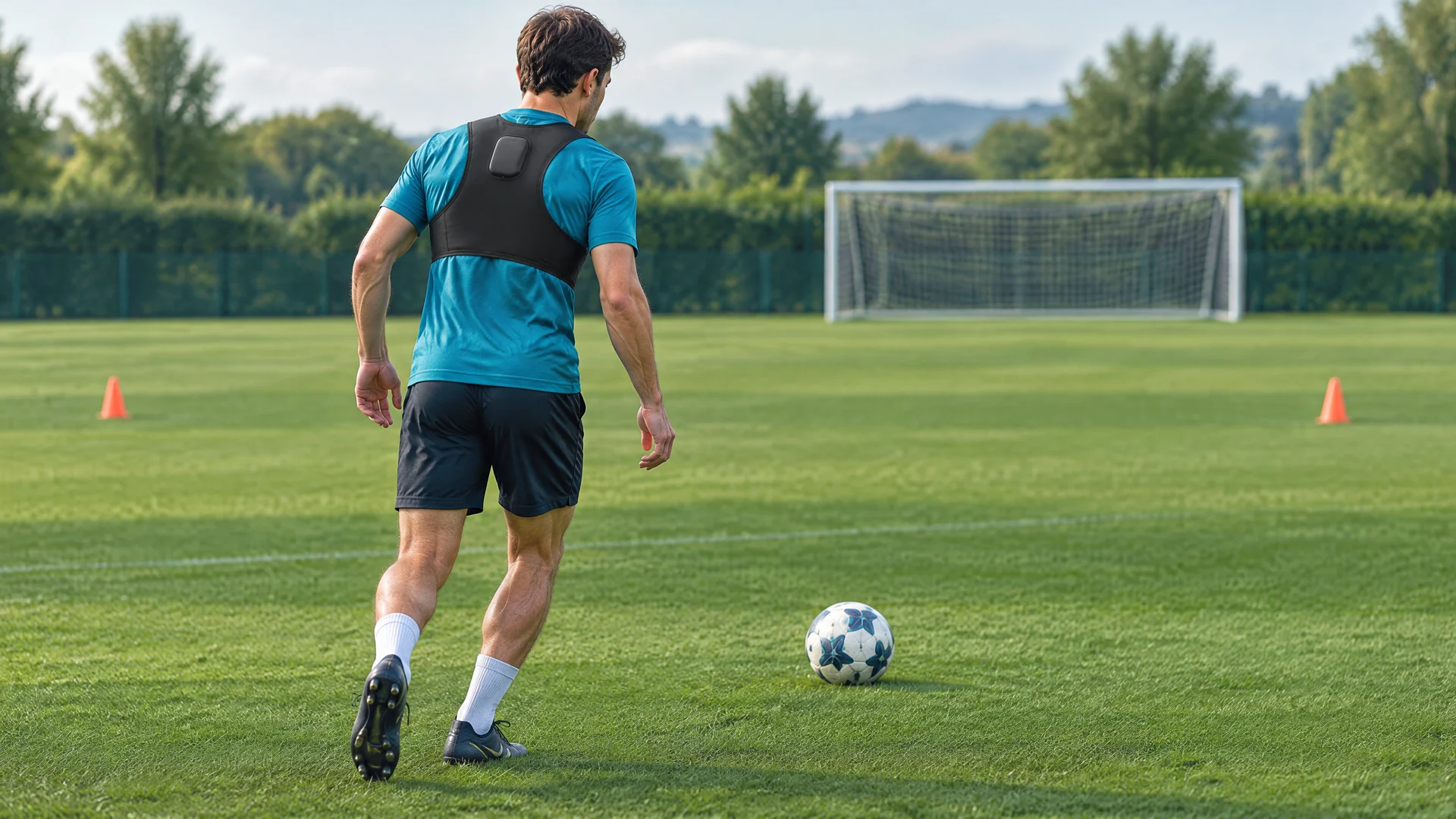
Wearable futbol means wearable technology used in football—also called soccer—to record parts of a player's movement or physical response. A tracking vest can help describe running distance and speed exposure. A heart-rate monitor can add information about cardiovascular response. Together with coaching observation and the player's account, these records can help a team understand what happened during a session.
The equipment does not turn a footballer into a complete set of numbers. A player can make an excellent positional decision without running the furthest, while someone covering more ground may simply have been given a different role. Wearables are useful when they answer a clear question, such as whether a drill produced the intended running exposure. They are less useful when a dashboard becomes a ranking of talent, commitment or health.
This guide develops the supplied football-wearables topic into a practical introduction to the devices, their data and the decisions they can support. It also explains match permission, accuracy and privacy, with a clearly constructed two-player example. The official rules and research were checked on 14 October 2026; no equipment was tested hands-on for this article. Our wearable technology in sports guide covers the wider sensor families, while this page focuses on football.
What is inside a football tracking vest?
The vest is usually the garment that holds the tracking unit in a stable position. In an upper-back system, a small pocket keeps the unit near the player's shoulder blades. The sensing and recording happen in the electronics, not because the fabric itself can measure every movement. Other approved wearable arrangements may use different locations, so an upper-back pocket is an example rather than the only possible design.
An outdoor tracking unit may contain a satellite-positioning receiver and inertial sensors, with a battery and storage or communication hardware. Software later processes the recordings into metrics. The exact components and reporting workflow depend on the system. A unit that stores a session for later review does not necessarily provide live data to a coach beside the pitch.
Fit matters because the device needs to remain secure and comfortable. A loose unit can move differently from the body, while an awkward garment can distract the player. Follow the equipment instructions and check the actual kit arrangement. A photograph of a professional player wearing a vest is not proof that another garment or device is suitable, safe or permitted.
GPS, motion sensors and heart-rate monitors answer different questions
GPS is one satellite constellation within Global Navigation Satellite Systems, often shortened to GNSS. A compatible receiver estimates outdoor position over time; software can derive movement paths, distance and speed. The how GPS tracking works guide explains the measurement chain in detail. Indoors or under poor satellite coverage, another positioning method may be needed rather than pretending the outdoor system has perfect reception.
An inertial measurement unit, or IMU, can combine acceleration and rotational measurements. Software may use those signals to describe movement or construct a device-specific load metric. A composite score is not automatically a direct measure of muscle strain, tissue damage or energy expenditure. Know what the vendor includes before comparing scores from two systems.
Heart-rate monitoring describes a different part of the session: one aspect of the body's response. It is not the same as distance covered or a direct reading of every player's fatigue. Devices and attachment methods vary, and data quality still needs checking. Football wearable sensors may combine several sources, but putting them on one platform does not make their outputs interchangeable.
What can football wearables tell a coach?
Useful outputs can include total distance, time or distance above defined speed thresholds, accelerations, decelerations and movement traces. These describe selected aspects of activity. They can help a coach compare the planned drill with what players actually completed, provided the recording is sufficiently complete and the metric matches the question.
Thresholds need definitions. “High-speed running” is not self-explanatory if one programme uses a different boundary from another. Acceleration counts can also depend on filtering and event rules. Changing a setting can change a report without any change in the player. Our GPS tracking practical guide develops those metric-interpretation issues without presenting one universal threshold.
A short report is often easier to use than a crowded dashboard. Show the relevant measure, session duration, the drill or role, a data-quality note and the question it raises. If the original recording is incomplete, say so before discussing the result. More available fields do not automatically mean more useful football information.
External workload and internal response are not the same
External workload describes selected work or activity performed, such as running distance and speed exposure. Internal load concerns the athlete's response, which can be explored through measurements such as heart rate and the athlete's perceived effort. Two players can complete similar external work and report different demands.
Bourdon and colleagues' Monitoring Athlete Training Loads: Consensus Statement, published in 2017, places athlete monitoring within a multidisciplinary framework. The 2020 review by Kupperman and Hertel also explicitly distinguishes GPS-derived movement records from physiological response. Neither gives a universal formula that turns a kilometre total into an exact fatigue verdict.
Ask the player about context rather than assuming a disagreement means a device or person must be wrong. Heat, previous work, the drill's purpose and the player's condition may help explain a difficult session. An athlete's report should remain visible even when the platform produces a persuasive colour-coded score.
A worked example: less distance does not mean less useful work
Imagine two players each completing a 20-minute training segment with the same recording system and the same defined high-speed threshold. Player A records 1,800 metres in total, including 260 metres above that threshold. Player B records 1,400 metres, including 300 metres above it. These are constructed teaching values, not recordings from a club or equipment test.
Player A's total-distance rate is 90 metres per minute, compared with 70 metres per minute for Player B. However, above-threshold distance represents approximately 14.44% of A's total and 21.43% of B's. B covers less overall distance but more distance in the selected faster-running category. The calculations do not establish that either player worked harder physiologically or needs a particular training adjustment.
The next question is what each player was asked to do. A role involving short, fast runs differs from one involving steadier movement, and recording quality must also be considered. The numbers can prompt a review; they cannot rank commitment or ability by themselves. Our sports analytics guide explains why a useful conclusion begins with the sporting question rather than the most eye-catching statistic.
Football roles change the meaning of a movement record
A player's position and instructions influence the opportunities to move. A full-back supporting attacks, a centre-back holding space and a goalkeeper completing a separate exercise do not share an identical movement task. Comparing their totals as though they were doing the same job can produce a misleading judgment.
Drill design matters too. Pitch dimensions, player numbers, work and rest periods, opposition and tactical objectives change what a segment asks of participants. A shorter segment is not necessarily a failed session; perhaps the activity ended early or the player performed another task. Keep that information with the record rather than making staff reconstruct it later.
Movement traces also need visual context. A run might be an overlap, a recovery run or a response to losing possession. GPS alone does not reliably explain every football action. Use appropriate video and coaching observation when the question concerns timing, positioning or decisions, rather than inferring tactical intent from a line on a pitch map.
Wearables cannot fully measure football skill
Ball control, passing choices, anticipation and tactical awareness are not fully described by running distance. A player who reads the game well may avoid an unnecessary sprint. Another player might cover more ground while responding late. Neither interpretation can be established from the movement total alone.
Automated event labels deserve similar care. If software calls a movement a sprint, jump or impact, check the definition and the conditions under which the label has been evaluated. A classification is a processed interpretation, not a guarantee that staff have identified the sporting meaning of the event.
Wearable records and video can complement each other. Our AI video analysis guide explains how tracking and event detection require human verification. Use the wearable to help locate an interesting segment, then inspect the football context. The objective is better understanding, not replacing the player's game with a physical-output leaderboard.
Can players wear tracking devices in official matches?
Training use does not automatically establish match permission. The current IFAB Law 4: The Players' Equipment prohibits players from wearing or using electronic or communication equipment except where EPTS is allowed. EPTS means Electronic Performance and Tracking Systems; it is a regulated category, not permission to bring any consumer gadget onto the pitch.
For wearable EPTS used in official competitions under FIFA, confederations or national associations, Law 4 places responsibilities on the organiser. The attached technology must not be dangerous and must meet the wearable EPTS requirements of the FIFA Quality Programme. Where the organiser provides the system, it is responsible for reliable and accurate information transmitted to the technical area during official matches.
Check the applicable competition requirements before buying or using a system for match recording. A smartwatch used for an individual run should not be assumed permissible in football. Our GPS vests in football matches guide addresses the permission question in more detail. Do not treat a device's marketing label or another team's photograph as approval.
What FIFA testing does—and does not—establish
FIFA's EPTS programme began with wearable player-safety testing in 2017. In 2019 it expanded to performance tests for both optical and wearable systems. FIFA explains that public reports describe positioning and velocity accuracy across different velocity brackets. These are meaningful, defined checks, rather than one blanket claim that a system measures everything perfectly.
Separate the scope of each result. A safety assessment addresses dangers posed by the equipment; a positioning or velocity report addresses those measured outputs under its test conditions. Neither independently establishes every derived workload score, tactical label or injury forecast a platform might display.
Read the actual report and identify the system tested. Ask whether the tested setup and intended conditions resemble your programme. The wearable validation guide explains why a technical result should not be stretched into an unsupported selection or medical conclusion. Certification, accuracy and useful application are related questions, not synonyms.
Accuracy starts before the session report
A recording can be compromised by assignment errors, poor fit, insufficient battery, missing segments or unsuitable signal conditions. If the wrong player is attached to a device record, a technically good measurement still becomes a bad athlete report. Confirm identity and session timing before discussing a surprising result.
Satellite positioning also has practical limits. Structures, covered spaces and the movement being measured can affect data quality, while software settings influence the final metric. Report a rejected or missing segment as missing. Filling a gap with an estimate and presenting it as measured would make the record look more complete than the evidence supports.
Keep changes visible when hardware, settings or software alter the process. A sudden trend break might reflect a recording change, not a change in fitness. Our wearable data chain-of-custody guide explains how assignment, timestamps and corrections help preserve an understandable history.
Why injury prevention needs more than a wearable score
Wearables can supply information relevant to a workload discussion, but they cannot independently diagnose an injury or determine when a player is safe to return. Symptoms, medical assessment, rehabilitation history and other appropriate evidence remain important. A favourable dashboard colour is not permission to ignore pain or a qualified practitioner's advice.
Kupperman and Hertel's 2020 Global Positioning System–Derived Workload Metrics and Injury Risk in Team-Based Field Sports review found the available evidence inconclusive for consistent injury prediction across the examined sports. It highlighted differences in injury definitions, metric definitions and statistical methods. This is a finding about its historical evidence base—not a declaration that every future research method is useless.
Association is also different from an individual prediction. A relationship found in one dataset does not prove the metric caused an injury or identify precisely who will be injured next. Use observations to support qualified review and record uncertainty. Do not introduce a universal “safe” workload ratio or let a single score decide rehabilitation clearance.
What recent football research actually shows
A 2025 study by Saberisani and colleagues examined GPS-based injury prediction in professional football. Its final sample involved 25 outfield players from one Persian Gulf Pro League team in Iran, using recordings from the 2022–2023 season. It gathered 214 training sessions and 34 competition sessions and evaluated a decision-tree approach using external-load information.
That is a documented research example, not a test conducted by SportyTechs or evidence about every current wearable platform. The single-team sample, outfield-player selection, season and model method matter when interpreting it. The paper's reported performance should not be copied into a generic claim that football wearables predict injuries with that accuracy everywhere.
The broader lesson is to evaluate the actual question and population. A model would need appropriate testing before use with another club, age group or role. Researchers exploring a possible signal and coaches being able to rely on a validated everyday decision are different stages. Keep the distinction clear when reading headlines about AI and player monitoring.
Player privacy and trust are part of the system
Training data may reveal routines, physical-response information and movement patterns. Players should know what is collected, why it is needed, who sees it and how long it is retained. Explain the programme in ordinary language before collection, not only when someone challenges an unexpected score.
Give athletes a practical way to correct an assignment or add missing context. A record should not silently become a public comparison or be repurposed for a new use because the platform makes sharing easy. Access should match the stated purpose; a tactical discussion does not automatically require everyone to see all health-adjacent records.
Youth programmes need age-appropriate explanations and the applicable guardian and organisational processes. Avoid promising that all data stay on the device unless that has been verified for the exact system. Our athlete data rights charter guide develops notice, access, corrections and athlete-facing accountability without turning this article into legal advice.
A practical starting point for academies and smaller clubs
A programme should begin with a clear football question. For example, staff might want to understand whether a drill produced a particular distribution of running exposure. Identify who will interpret the report and whether a simpler session log would answer the question before adding equipment.
Test fit, assignment and reporting during ordinary practice. Check whether the information arrives in time to be useful and whether players understand its purpose. The cost includes garments, maintenance, software and staff effort, not just the price of a tracking unit. This article does not quote a local price or recommend one brand as universally best.
Our grassroots football wearables field note covers a smaller, rotating programme and the burden on staff. That article owns the implementation detail; this explainer introduces the technology and its boundaries. Expanding only when the process remains useful is more sensible than collecting an entire squad's data without anyone available to interpret it.
How AI could support wearable analysis
A learned model may help classify activity or identify patterns in a sufficiently suitable dataset. A simple alert based on a fixed threshold, however, is a rule-based calculation—not automatically AI. Ask which method is used and what evidence supports its intended purpose rather than accepting the label as proof of sophistication.
Potential future developments include closer connections between wearable measurements and reviewed video, clearer handling of missing data and better explanations of why an observation was flagged. These are directions for development, not claims that every current system already has those capabilities or will deliver a specific improvement.
The valuable outcome is a clearer conversation between player and staff. A system should be able to show its evidence, uncertainty and correction route. Our AI in sports practical guide explains the additional evaluation required for automated recommendations. Human responsibility remains necessary even when the analysis becomes faster.
Questions about wearable futbol
Are football tracking vests just GPS devices?
Not necessarily. A unit may combine satellite positioning with inertial sensors, and another arrangement may use a different positioning method. Check the exact hardware and metric definitions rather than assuming every vest collects the same data.
Does running farther mean a footballer played better?
No. Distance is one movement observation. Position, instructions, playing time and the quality of football decisions matter. Use an appropriate comparison and coaching context instead of ranking performance solely by a distance total.
Can wearables predict or prevent every injury?
No. They cannot guarantee injury prevention or independently diagnose a player. Research findings depend on the data and method; clinical concerns and return-to-play decisions require appropriate qualified assessment.
Does a FIFA test mean every metric is accurate?
No. Read the scope of the actual safety or performance report. Positioning and velocity results do not automatically validate every workload score, tactical inference or medical prediction.
Can an academy use the same thresholds as a professional club?
Not without examining the purpose, population, device and definitions. A threshold used in one programme is not automatically a suitable personal target or a fair comparison for another team. Qualified staff should define and interpret the measures appropriately.
Continue exploring football tracking technology
For deeper explanations, read our GPS tracking practical guide, football video analysis software comparison and wearable technology guide. They develop the individual measurement and review methods without treating wearable data as a complete account of a footballer.
Page metadata and source notes
SEO title: Wearable Futbol Explained: Football Tracking and Its Limits.
Meta description: Learn how football wearables use GPS, sensors and heart-rate data, with a practical example, match rules, privacy and workload-monitoring limitations.
Sources checked on 14 October 2026: FIFA, Electronic Performance and Tracking Systems; IFAB, current Law 4, The Players' Equipment; Bourdon and colleagues, Monitoring Athlete Training Loads: Consensus Statement (2017); Kupperman and Hertel, Global Positioning System–Derived Workload Metrics and Injury Risk in Team-Based Field Sports: A Systematic Review (2020); and Saberisani and colleagues, Prediction of football injuries using GPS-based data in professional football players (2025). Official source URLs and research records are retained privately. All reader navigation remains within SportyTechs. The two-player arithmetic and generic cover are expressly illustrative, not athlete recordings, a tested product or a claimed certified device.