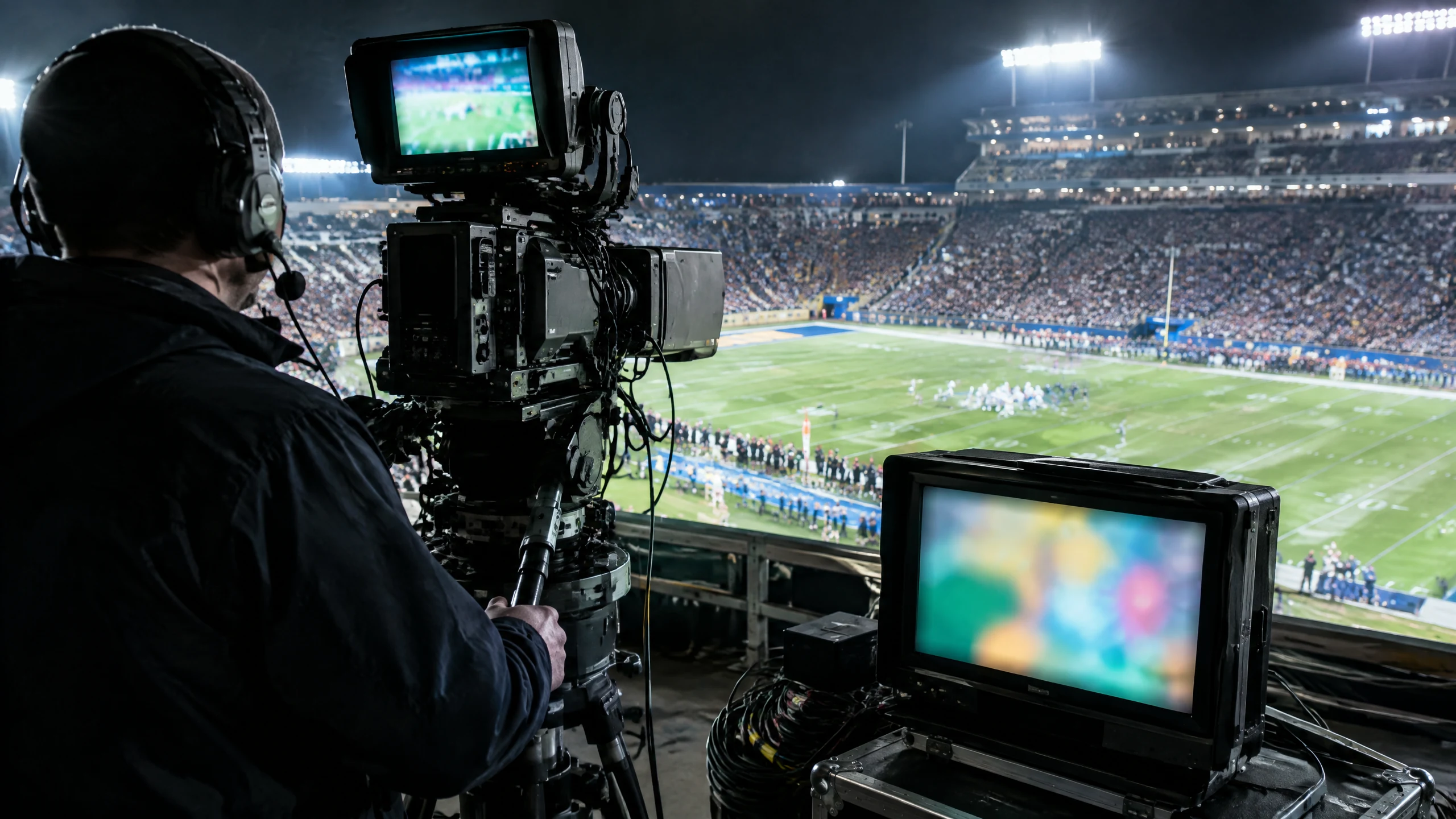
CBS Sports is phasing native high dynamic range production across its six core National Football League crews and its lead college-football crew, according to Sports Video Group’s report on the broadcaster’s 2026 plan. The rollout began in Week 1 with the NFL B game and the lead college game, and CBS is targeting all of its NFL crews by mid-season. That is a confirmed development in the broadcaster’s operating plan, rather than a completed fleet conversion: CBS is expanding the workflow in stages, and the published account does not establish that every NFL game is already being produced in HDR.
The production format CBS says it will retain is Hybrid Log-Gamma, or HLG. In this context, HDR is not a single camera setting or an isolated image upgrade. CBS’s rollout joins compatible capture, camera shading, monitoring, signal conversion, quality control and the people running each part of that chain. The operational point is important because a change at one point in the workflow does not by itself demonstrate a consistent consumer presentation. CBS’s approach places the format within a live production system whose components must operate together from the camera position through the mobile unit.
The mobile-unit work is a practical expression of that system requirement. CBS said that NEP and Game Creek Video upgraded the relevant mobile units over the summer. The work included HDR monitor walls for the front bench and HDR monitoring for camera shading, according to the broadcaster’s account. NEP and Game Creek Video are the companies identified with those unit upgrades; the report does not provide independent performance measures for their work. What the disclosed changes do show is where HDR production has to be observed and controlled: not only at acquisition, but also where technical personnel assess and adjust the live signal.
CBS’s schedule further frames the initiative as operational sequencing, not a cosmetic switch. After launching the NFL B game and lead college-football game in Week 1, the broadcaster plans to pause the expansion for its Week 3 production in Rio and then add one crew every two weeks. CBS expects the full set of NFL crews to be operating in HDR by mid-season. CBS Sports executives told Sports Video Group that the staged approach is intended to give technicians time to become fluent in the workflow. The broadcaster’s A crew has been producing in HDR since Super Bowl LVIII, but that earlier use does not make the wider 2026 deployment complete.
The viewer-facing layer extends beyond the image format, although it should be treated separately from HDR. CBS also plans broader use of NFL Next Gen Stats in FingerWorks telestration and Chyron graphics. Those are planned presentation changes attributed to CBS, not evidence that tracking-data graphics or HDR will produce a better viewing experience. For viewers, the near-term consequence is a transition across CBS game crews rather than a universal promise about every screen or distribution path. For venue and production operators, the rollout is a concrete example of how display capability, conversion, calibration and crew practice are interdependent in live sport production.
The evidence has clear limits. Sports Video Group reported detailed implementation information from named CBS Sports operational executives, which supports the description of the broadcaster’s stated schedule and workflow. However, the available reporting contains no independent picture-quality testing, HDR-capable-device reach, viewer-satisfaction results, cost figures, outage or error rates, or outcome data from a completed all-crew rollout. It therefore cannot establish that all CBS NFL viewers receive HDR, that HDR increases engagement, or that the planned graphics changes improve audience response. Any later assessment of the project would need completed deployment evidence and measured results, neither of which is public in the material reviewed.
For now, the confirmed story is a broadcaster phasing an HDR operating model across a defined set of NFL crews, while retaining HLG and investing in the monitoring and mobile-unit conditions that production staff use to run it. The National Football League is the competition whose broadcasts are affected, while CBS is the broadcaster making the production changes; the broader claims about the schedule, technician fluency and graphics remain CBS’s own statements. The rollout’s significance lies in its visible operational dependencies, not in an unverified claim of improved outcomes. The confirmed near-term position is that the defined rollout has begun; it is not a verified assessment of consumer delivery or a completed operational result. Until the staged plan reaches mid-season and public evidence emerges, the appropriate description remains that CBS is phasing HDR across its NFL package.