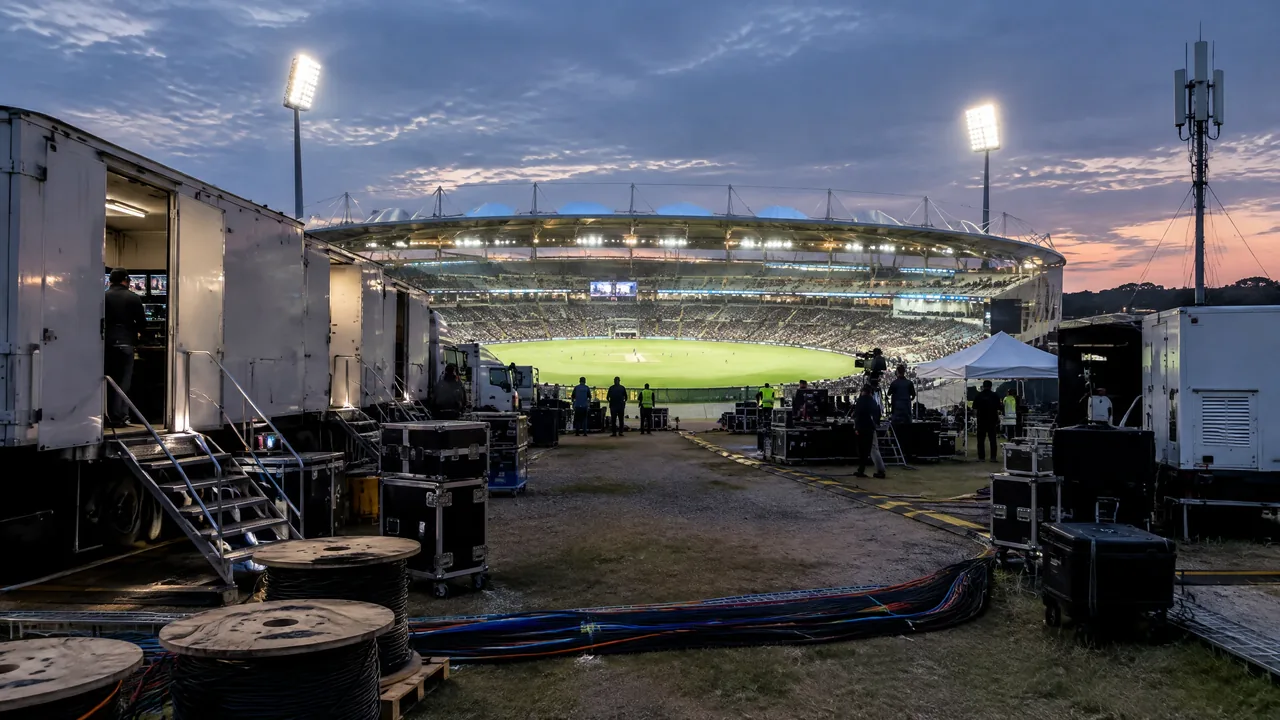
Netflix’s first NFL game in Australia, the 10 September San Francisco 49ers–Los Angeles Rams game at Melbourne Cricket Ground, used a temporary Internet Protocol host-broadcast operation involving Netflix, NBC Sports and NEP. Sports Video Group reported the completed production the following day, making the Melbourne event a specific case of how an international live broadcast is assembled rather than an announced future plan. The defining feature was not a permanent change to the stadium. It was the temporary local system that gathered pictures and signals at the MCG, moved them through a designed network path and handed production functions to a team working at a distance. In that setting, venue connectivity is part of the broadcast operation itself: it underpins the movement of live signals between the compound and the remote production environment.
Sports Video Group reported roughly 25,000 active SMPTE ST 2110 flows across a reported 2.4 Tb/s uplink. SMPTE ST 2110 is a set of standards used to carry uncompressed or lightly processed professional-media elements over IP networks, allowing video, audio and associated data to be handled as separate networked flows rather than only as a single traditional broadcast feed. The figures describe the reported scale of this installation, but not a quality or reliability result. A high flow count means that the compound had to manage a large number of concurrent media paths and their hand-offs. The uplink figure similarly describes reported capacity in the production design; it does not by itself establish the quality of a viewer’s experience or the performance of the network under every condition.
The local plant was also deliberately temporary. According to Sports Video Group, the MCG compound combined two NEP TFC IP Fly Away Kits, two IP trailers and a support truck. That combination placed networked production equipment outside the venue for the event rather than recasting the equipment as part of the stadium’s permanent technical estate. The distinction matters operationally. A remote production model still depends on a physical arrival point for cameras, routing, encoding, power, access and the people who operate the event-side systems. In Melbourne, the compound was that arrival point. The reported configuration shows why a global production is not simply a connection from a stadium to a distant control room: the local build has to form a controlled interface between venue activity and the wider broadcast network.
Sports Video Group described the production format as 1080p HDR, with selected 4K sources, and reported 46 game cameras alongside eight studio cameras. Those specifications distinguish the event’s production architecture from any claim about a single consumer delivery format. HDR refers to a production approach designed to preserve a wider range of brightness and colour information, while selected 4K sources indicate that some cameras or feeds used that resolution. Neither detail establishes that every source was 4K or that consumers received a 4K programme. The camera count instead illustrates the coordination task at the compound: game coverage and studio output generated multiple feeds that had to be carried, selected and incorporated into the programme. It also reinforces the dependence of picture production on the transport and control infrastructure surrounding the cameras.
For transmission, Sports Video Group reported diverse red and blue 10-Gb/s paths through Lumen and Telstra, together with JPEG XS paths and high-efficiency video coding, or HEVC, connectivity. In broadcast engineering, diverse paths are intended to separate routes so that a disruption affecting one does not necessarily affect another, while compression choices shape how signals are transported under available bandwidth and latency constraints. JPEG XS is commonly used where low-latency contribution workflows are needed, and HEVC is a video-compression standard used for efficient delivery. These are descriptions of the reported workflow choices, not evidence that the routes prevented an outage or achieved a particular latency level. Their practical consequence is that local connectivity design includes more than total capacity: it involves route diversity, the treatment of different signal types, and a defined path from the venue compound to the teams receiving the feeds.
The remote element extended the Melbourne operation beyond the stadium. Sports Video Group reported that studio programming used a remote integration model, or REMI, workflow to NBC Sports in Stamford. Sports Business Daily separately reported that NBC handled the behind-the-scenes production for Netflix. REMI does not remove the importance of the venue-side operation; it changes where selected production functions are carried out. The Stamford team could only work with signals that had been captured, prepared and transported from the MCG through the local compound and its network connections. This creates a shared operational boundary. Camera, network and compound decisions in Melbourne affect what can be received and integrated remotely, while the remote control-room design depends on clear hand-offs from the event site. The case therefore links global reach to local technical coordination rather than treating the two as separate systems.
Important evidence limits remain. The capacity and topology details were reported from participants and are not independent network telemetry. No public information establishes cost, measured latency, packet loss, failures, recovery actions, audience response or permanent-infrastructure changes at the MCG. There is also no public basis to say that the red and blue paths avoided an incident, that the production had zero outages, or that the system delivered a measured improvement in resilience. The available reporting does, however, identify the operational questions placed at the venue edge by a temporary international IP build: compound space, power, fibre access, permissions, network-route diversity, contingency arrangements and responsibility for each hand-off. Those questions are the lasting significance of the Melbourne case. The reported system makes the temporary interface between stadium and remote production visible, while the unreported results set clear limits on what can be concluded about its performance.