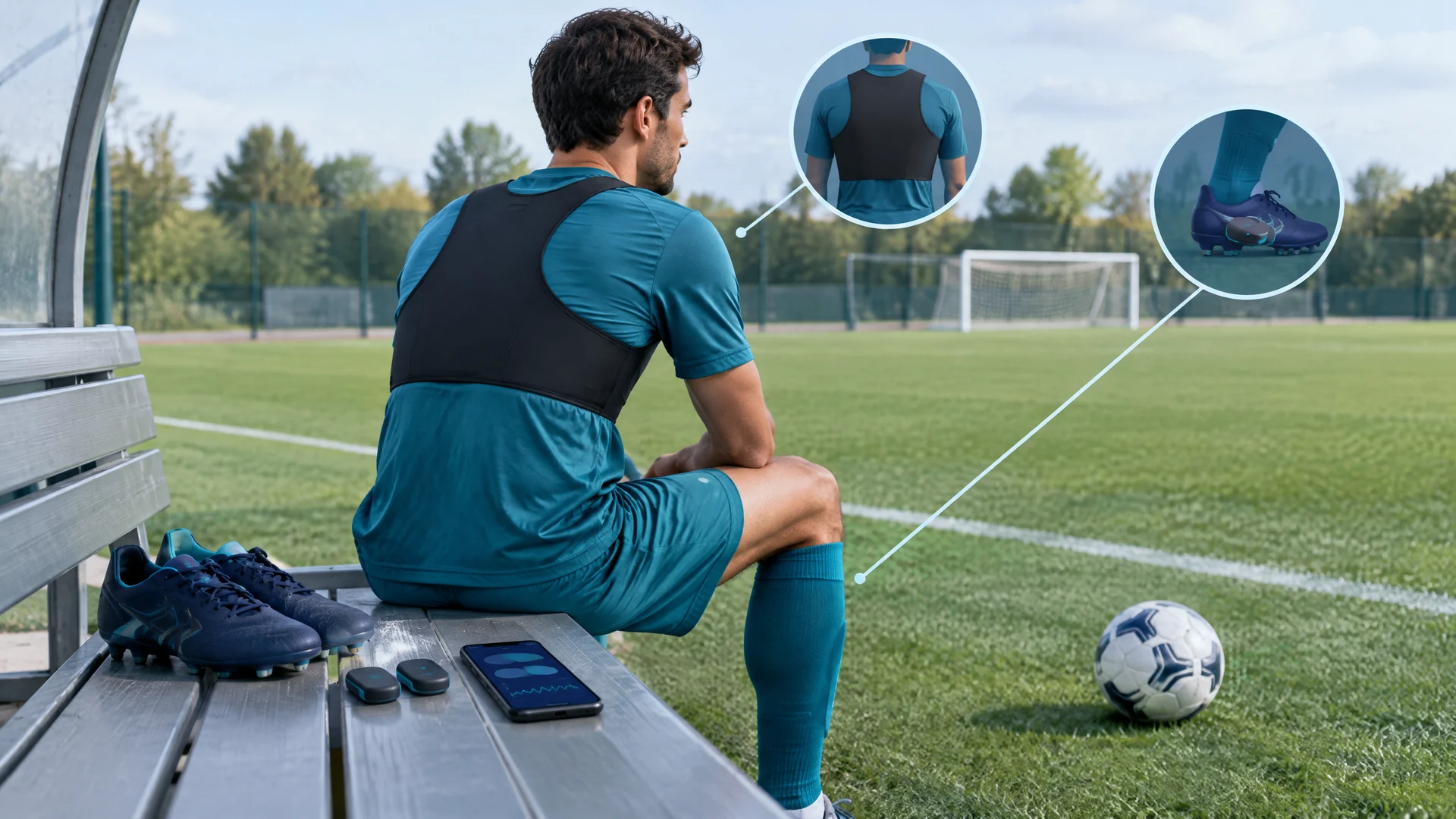
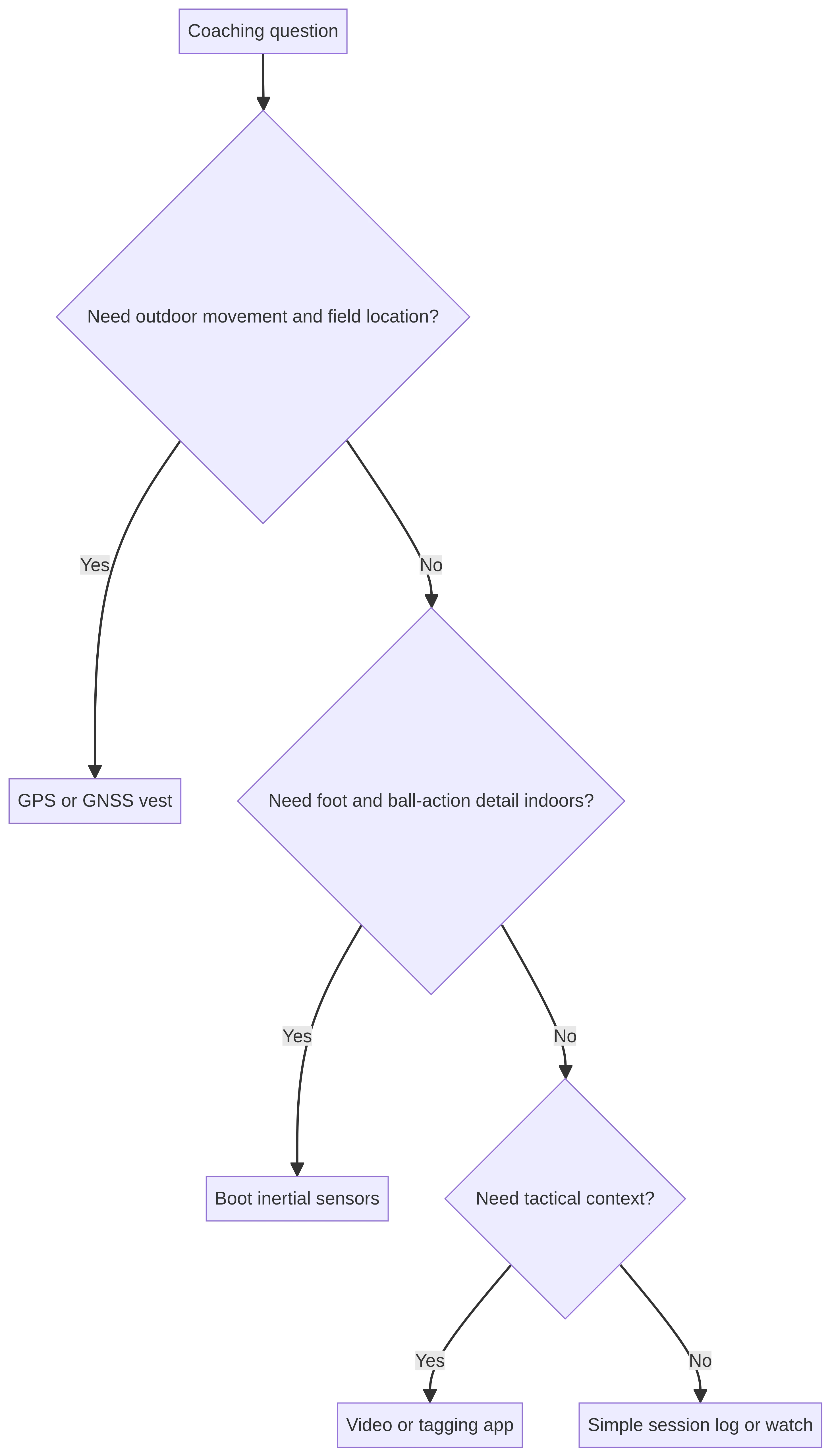
A soccer performance tracker is best chosen by the coaching question it can answer, not by the longest feature list. GPS vests are usually the clearest fit for outdoor running load and field movement; boot-mounted inertial sensors can add foot and ball-action detail, including indoors; watches, video and apps fill different context gaps. None is automatically the best soccer performance tracker for every player, venue or session.
This educational comparison, not a product test or ranking, uses three manufacturers’ public documentation as examples. Start with a decision such as “Did our winger repeat enough hard running?” or “How quickly did the player release the ball in a tight drill?” That keeps a soccer performance tracker useful instead of turning it into a scorecard.
Key takeaways
- Choose GPS or GNSS when the question is primarily about outdoor movement volume, speed and where work happened on the field.
- Choose boot-mounted inertial sensors when foot movement and documented ball-action metrics matter, especially for indoor or futsal sessions.
- Use video or a structured app workflow when the coaching question needs tactical context that a sensor cannot see.
- Treat provider scores, benchmarks and training claims as provider-defined outputs. They can prompt a review, but they do not diagnose injury, predict selection or guarantee improvement.
Start with the question, then pick the measurement method
A useful football performance tracker records a signal, turns it into a metric and leaves someone to decide what it means. The signal might be satellite position, boot motion, heart rate, video or a coach’s tagged observation. The final judgement still needs the session plan, playing time, position and video context.
“Who worked hardest?” is too vague to purchase against. A clearer outdoor question is: “Did each full-back complete the planned repeated-running exposure in this 35-minute block?” A clearer technical question is: “Is a player holding the ball longer than intended in a small-sided passing constraint?” The first points toward movement and duration data; the second toward foot sensing or video, with a defined coding rule.
That distinction is the foundation of a decision-first performance-tracking framework. It also prevents a common category error: a soccer GPS tracker follows the player’s location and movement; it is not a ball tracker. A boot sensor may infer or classify foot and ball-contact events according to its provider’s algorithm, but it does not make every ball location visible. A camera or dedicated ball-tracking system answers different questions again.
The measurement classes: GPS vests, boot sensors, watches and video/apps
GPS and related GNSS units estimate outdoor position from satellite signals. Carried high on the back in a vest or harness, they can support distance, speed bands, accelerations, decelerations and movement maps. For the signal-to-session process, see how GPS tracking works in sports.
Boot-mounted inertial systems use motion sensors rather than satellite position. Playermaker, for example, describes a six-axis accelerometer-and-gyroscope sensor strapped to each shoe. This class can suit questions about touches, release time, kicking or turning—but only within the provider’s definitions and session conditions.
Watches can provide a simple activity record or, with compatible accessories, heart-rate information. They are not football-specific GPS vests or boot sensors merely because they display distance. Check their documented location, speed, heart-rate and export capabilities.
Video and apps are measurement methods, not just add-ons. A fixed camera and repeatable tagging can show whether a sprint happened to press, recover or overlap, and whether a low touch count reflects role or classification. The football video-analysis guide and AI video-analysis overview explain why footage needs a clear question and review process.
| Measurement class | Typical useful outputs | Best setting | What it does not establish on its own |
|---|---|---|---|
| GPS/GNSS vest or back-worn unit | Distance, speed, speed-band distance, acceleration/deceleration counts and movement maps where supported | Outdoor training and matches with a suitable sky view | Ball location, quality of a decision, exact technical execution or cause of fatigue |
| Boot-mounted inertial sensors | Foot movement, turns and provider-defined technical and physical metrics; some providers classify touch-related events | Outdoor, indoor and futsal when the specific system supports it | A full field-position map or a tactical explanation without video or observation |
| Watch or general activity wearable | Provider-dependent duration, movement and, where supported, physiological data | Individual training and simple workload records | Football-specific touch, pass or tactical measures unless documentation explicitly says otherwise |
| Video, tagging app or camera workflow | Observable actions, positional context and tactical sequences | Any venue where capture, consent and review are workable | Internal effort, satellite distance or an automated technical score without a validated method |
Outdoor and indoor suitability changes the answer
For outdoor full-pitch football, a GPS or multi-constellation GNSS vest is often the direct route to movement volume and location-based outputs. STATSports Academy says its unit sits in a vest and lists total distance, maximum speed, high-speed running and accelerations among its 24 metrics. SOCCERBEE’s Pro 2 shop page describes a back-worn unit with GPS and GLONASS. Those are manufacturer statements, not an accuracy comparison or recommendation.
Assess satellite positioning in the actual venue. Roofing, indoor halls and obstructed sky can make it unsuitable. The key is whether the documented method works where the team trains. Use the GPS metrics and training guide before setting speed zones or comparing sessions.
For indoor football, futsal and covered areas, boot-mounted inertial sensing may be more practical because it does not need a satellite signal. Playermaker says its system collects indoors and outdoors without GPS or Wi-Fi and fits football boots, artificial-turf shoes and futsal shoes. Check fit, surface guidance, battery and app requirements before relying on it.
Video can work in either setting if the angle is stable and participants are identifiable. It needs safe storage and someone to define and review tags. A simple app may be enough for attendance, duration and a coach note. The goal is a reliable routine, not the largest data set.
A limited look at three documented manufacturer examples
The examples describe what the manufacturers publicly say their products do. They do not rank accuracy, test durability or establish improvement. Features and commercial terms change, so confirm current support, compatibility and conditions with the provider.
| Manufacturer and system | Measurement approach stated in current public documentation | Examples of stated outputs or operation | Sensible verification before use |
|---|---|---|---|
| STATSports Academy | GPS tracker carried in a vest | Its Academy page states 24 metrics, including total distance, maximum speed, high-speed running and accelerations; its support page defines some thresholds and notes optional heart-rate monitoring | Confirm session-editing workflow, applicable speed settings, heart-rate accessory needs and the competition’s equipment rules |
| Playermaker | Two shoe-mounted six-axis motion sensors using an accelerometer and gyroscope | The company says its system records physical outputs plus provider-defined technical measures such as touches, time on the ball, release time and turns; it states indoor/outdoor operation without GPS | Confirm boot/strap fit, activity mode, battery/session limit, membership terms and how the coach will interpret algorithmic touch categories |
| SOCCERBEE Pro 2 | Back-worn GNSS unit described as GPS plus GLONASS, supplied with a vest | The shop page lists a mobile app and a stated 14-hour full-charge recording figure; it describes physical performance tracking for team sports | Confirm current subscription requirement, local support, app compatibility, vest fit, outdoor reception and whether desired metrics are available in the plan |
STATSports’ support material defines high-speed running through a stated threshold and RPE as self-reported. “High speed” is therefore not a universal football fact; keep the provider definition consistent when comparing sessions. Its coaching and drill offerings are product features, not proof that hardware itself produces an outcome.
Playermaker is most relevant here when the question is foot- or ball-action-focused. Its metric labels—ball possessions, release time and kicking power—are its operational definitions. Compare prior sessions only when footwear, session type, recording habits and metric definition are stable.
SOCCERBEE’s shop page says Pro 2 includes a tracker and vest, uses GNSS with GPS and GLONASS, and requires a subscription after a trial. Recurring access can be as consequential as hardware. List membership, team seats, data storage, replacements, optional hardware, taxes, shipping and review time rather than assuming an initial price is total cost.
Understand the metrics before comparing players or sessions
Distance is a volume measure; distance per minute helps when players log different minutes. High-speed distance is volume above a configured threshold. Acceleration/deceleration counts depend on thresholds, filtering and duration logic. A work-rate, strain or match score is more dependent still on a provider model, so do not compare such scores across brands as though they share a scale.
A constructed example shows why definitions matter. Suppose an outdoor session is trimmed to 52 minutes and a player records 5,200 metres total distance. The distance-per-minute value is 100 m/min: 5,200 ÷ 52 = 100. If the system reports 480 metres in its configured high-speed band, the high-speed share is 9.23%: 480 ÷ 5,200 × 100 = 9.23. Those numbers demonstrate arithmetic, not a target for any age, position or competition. Change the session boundary or speed threshold and the comparison changes.
For a trend, keep the device, placement, start/stop convention and definitions consistent. Record session type. A winger’s lower distance could reflect minutes, task or a missed recording—not commitment. Pair the report with a coach note and, for tactical questions, a video clip.
The same restraint applies to force, movement-quality and fatigue language. Sensor data can indicate movement patterns or external load; it does not independently reveal pain, readiness, technique quality or injury risk. For the underlying distinction between observed motion and the conclusions attached to it, see sports biomechanics: motion, forces and useful analysis.
A worked selection scenario: one squad, three questions
Consider a community squad that trains outdoors on Tuesday, plays futsal on Thursday and has an outdoor league match at the weekend. The coach wants one answer after each activity, not a dashboard full of unrelated numbers.
For Tuesday, the question is whether planned running exposure was completed. A vest-style GPS/GNSS unit can suit a pitch with adequate sky view and consistent session boundaries. Review total distance, a pre-agreed speed band and time on task; do not turn one top-speed value into a football verdict.
For Thursday, the question is whether a receiving-and-release constraint changes behaviour in a crowded indoor drill. A foot-mounted system may suit if its documented touch metrics match the drill and footwear. Video can audit a sample. If sensor category and footage disagree, inspect the definition or setup rather than blame the player.
For the weekend match, the question might be why a midfielder covered less high-speed distance than usual. First check minutes, role, scoreline, opponent and device status. Then review a few relevant video sequences. Perhaps the team defended deeper, perhaps the player was substituted, or perhaps the tracker was not recorded for the full match. The best answer may be “insufficient context,” which is more useful than a confident but false conclusion.
Match equipment, permissions and safety are separate checks
A device being advertised as tested, approved or suitable does not settle whether a player may wear it in a specific competition. IFAB’s Law 4 covers players’ equipment and includes wording about wearable technology used as part of electronic performance and tracking systems in official competitions. The practical rule is to check with the competition organiser well before match day and follow the referee’s equipment process; use this GPS-vest match-day equipment check as a practical prompt. Training permission does not transfer automatically to a league, tournament or school competition.
FIFA’s Electronic Performance and Tracking Systems Quality Programme is also a different concept. FIFA says the programme began with wearable-safety testing and later added performance testing, with public reports for tested systems. A quality mark or a provider’s use of FIFA-related wording is not a blanket competition permission, a universal accuracy guarantee or a reason to ignore local rules. Ask the organiser about the exact model, its position on the body, whether it must be covered, and whether data collection itself has conditions.
This is especially important for boot-mounted hardware. A lower-limb device can raise practical questions about secure attachment, safety and what a competition accepts. Check the provider’s current documentation and the organiser’s written guidance rather than relying on social posts, old product pages or another team’s experience.
Recurring costs, privacy and young players belong in the decision
The hardware is only one part of the commitment. A football performance tracker can create recurring costs through membership, cloud processing, team dashboards, data exports, replacement items and staff time. STATSports currently labels Academy “subscription free” on its public page, while Playermaker’s FAQ says an active membership is needed to record or sync new sessions and states a renewing plan. SOCCERBEE’s product page says a subscription is required. These are current provider statements, not durable prices: check the terms that apply in the buyer’s country before purchase.
For a young player, begin with a simple, written data practice. State what will be collected, why it is useful, who can see it, where it is stored, how long it is retained, whether it will be shared and how a parent or guardian can ask for correction or deletion. Obtain the appropriate consent and follow the school, club and local privacy requirements that apply. Keep access narrow: a coach may need a session summary, while a full history, location trail or account credentials should not be casually shared.
Do not use a youth tracking score as a selection shortcut, a medical assessment or a public ranking. Children develop at different rates, and a metric can be distorted by growth, position, minutes, recording quality and the task set by the coach. A considerate programme lets players ask what a measure means, correct mistakes and opt out where policy allows. The wider wearable-football guide provides useful context on where wearables fit in the sport.
Make the tracker earn its place in the session plan
The strongest purchase decision is usually modest: select the measurement class that answers one repeated question, run a short pilot and decide whether the team can collect, review and act on the information consistently. Write the metric definitions down, set a review rhythm, and compare like with like. If no action follows the number, remove it from the report.
GPS vests, boot sensors and apps are complementary rather than interchangeable. A GPS vest can make outdoor load visible. A foot sensor can provide provider-defined detail closer to the foot. Video can explain the action and tactical setting. Used carefully, they support better conversations; they do not replace coaching observation, clinical advice or a player’s own account of how a session felt.
Page metadata and source notes
SEO title: Soccer Performance Trackers: GPS, Boot Sensors and Apps
Meta description: Compare soccer GPS vests, boot sensors and apps by what they measure, setup, costs and limitations. Choose a tracker around your training needs.
Primary keyword: best soccer performance tracker
Related terms used naturally: soccer performance tracker; soccer GPS tracker; football performance tracker.
Source caveat: This comparison relies on manufacturer documentation for product features and commercial terms, plus official IFAB and FIFA materials for equipment and EPTS context. It is not a hands-on product test, exhaustive market survey, accuracy validation, injury-prediction tool or guarantee of training benefit. No keyword volume or keyword-difficulty figures were verified or claimed. Full URLs, retrieval date and the claim-source map are held in the private research record.