Sports biomechanics asks a movement question before collecting a number
Sports biomechanics applies mechanics to athletic movement. It studies what the body and equipment do, as well as the external and internal forces associated with that action. The useful starting point is not a dashboard. It is a clear question: is the question about the timing of a sprint stride, the path of a bat, the force exchanged with the ground during a jump, or how equipment changes a task? A good biomechanical analysis chooses a measure that can actually address that question.
That approach separates a useful observation from a broad verdict about an athlete. A result may describe one trial, one surface and one task. It does not automatically define perfect form, explain a painful symptom or predict an outcome. For the wider map of measurement tools and decisions, visit sports science and training technology.
Kinematics describes motion; kinetics considers forces
Kinematics describes motion without explaining its causes. Examples include joint angle, segment position, stride length, velocity, acceleration and timing. In joint kinematics sports work, a graph might show when the knee, hip or shoulder reaches a chosen angle during a movement. It answers “what moved, how far and when?”
Kinetics concerns forces and moments connected with motion. These can include the external force from the ground, gravity and calculated joint moments in a model. The distinction matters because similar-looking movements can have different force-time patterns, while a force value alone cannot show the whole movement. Mass General Brigham and the peer-reviewed Sports editorial both make this kinematics–kinetics distinction.
What common measurement tools actually capture
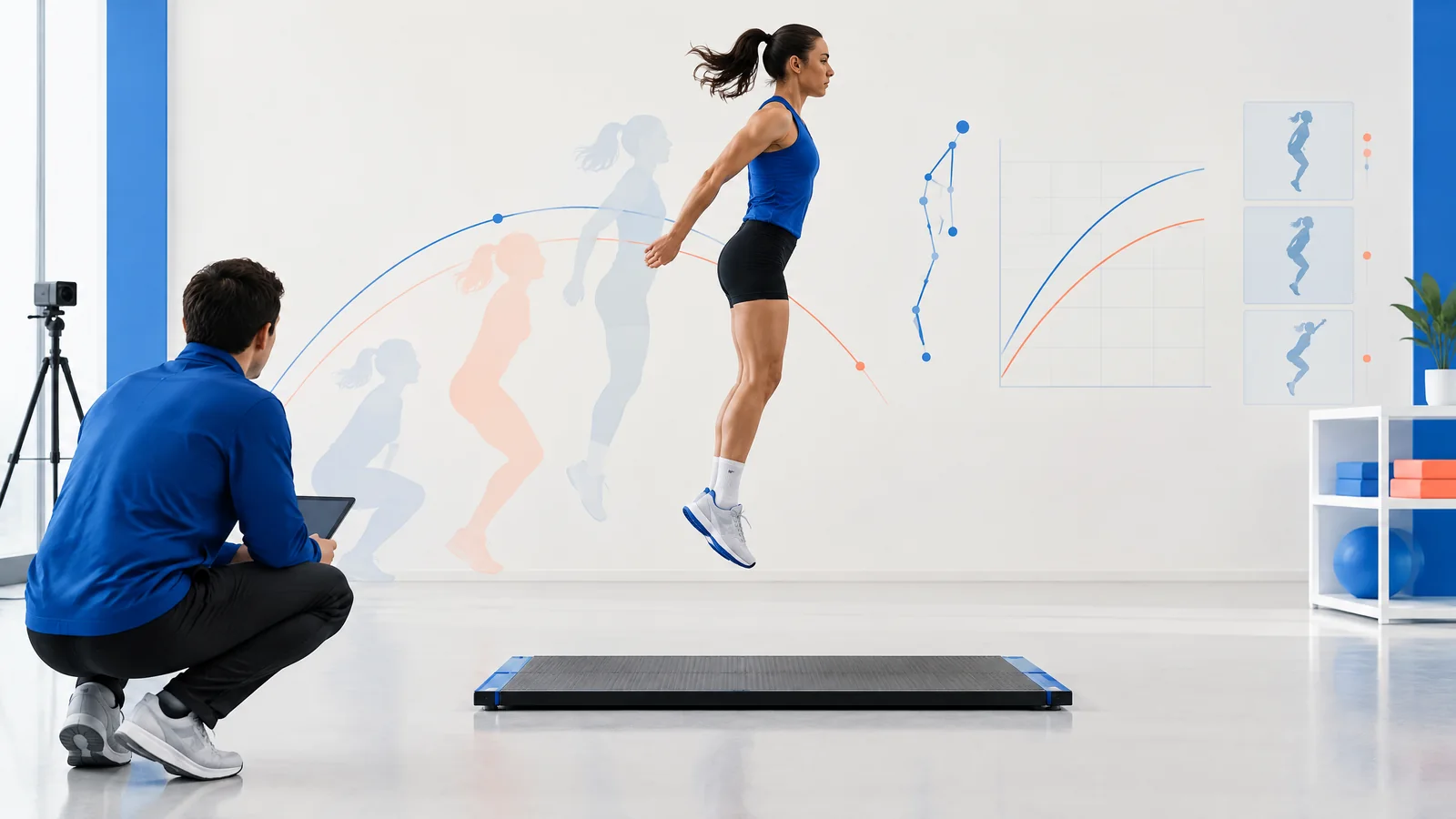
A high-speed video can make a fast event visible across frames. A camera or wearable system can estimate positions, timing and segment motion. A force plate records the external ground-reaction force under the person or object on it. Kistler’s technical documentation describes three-component platforms measuring vertical, horizontal and transverse force components; it does not say that a plate directly measures muscle force, joint loading or technique quality.
Several measurements can be combined when the question requires it. A jump video can indicate body position while a plate traces force over time. A running biomechanics session may compare stride timing and ground interaction under a repeatable condition. The detailed ways optical, inertial and marker-based systems collect movement belong in motion capture in sports; a measurement setup is not a conclusion.
Turn a trace into a testable explanation
Raw signals first need context: task, surface, footwear or equipment, instruction, number of trials, sampling rate and calculation rule. Next, choose one or two measures that map to the original question. A coach might examine the time between a foot contact and toe-off, or the order of visible segments in a throwing action. A biomechanics of pitching question can be about timing between trunk rotation and ball release; it should not be turned into a universal throwing cue from one graph.
Hypothetical calculation, not a test or recommendation: if a 70 kg athlete has an upward acceleration of 3 m/s² at one instant, a simplified vertical support-force estimate is mass × (gravity + acceleration): 70 × (9.81 + 3) ≈ 897 N. That is an external-force illustration, not a measure of what any muscle, tendon or joint experienced. It also shows why body mass, direction, timing and the measurement method must be recorded before comparing figures.
Biomechanical modeling fills gaps with assumptions
Biomechanical modeling uses measured or estimated motion, body-segment properties and equations to calculate quantities that may not be directly measured. For example, positions from video can help estimate angular velocity, and a model using force and segment data can estimate a joint moment. Such output is valuable only when its assumptions match the athlete, task and data quality. A model is not a direct window into a body.
Ask four questions when viewing a modelled result: What was measured directly? What was estimated? Which assumptions or filtering steps were used? Does the result answer the practical question? This is especially important when software labels a value as a score, asymmetry or risk flag. It may be a useful prompt for further observation, but not a diagnosis or a label for a person.
Why protocol consistency beats a long metric list
Force plates can produce many numbers from a relatively simple task. Robles-Palazón and colleagues note that commercial software can produce more than 100 variables from a countermovement jump, with some metrics duplicative or similar. More outputs do not create more certainty. Select measures before testing, describe how they are calculated and repeat the task under comparable conditions.
Badby and colleagues’ 2025 PLOS ONE review found substantial variation across studies in hardware, test choice, cues, surfaces, warm-ups, familiarisation and metric definitions. Even “peak force” can refer to different phases in different studies. That does not make force plate analysis useless. It means a week-to-week comparison is more credible when the protocol, data processing and question are stable. Read the broader decision process in performance technology in sports.
Use findings as a conversation, not an athlete verdict
A useful report states the task, the observed pattern, uncertainty and the next question. For example: “In these repeat trials, the left-right timing difference appeared after a change in speed; capture another comparable session before interpreting it.” This is clearer than saying one side is broken, that a score proves fatigue or that a number forecasts injury.
Biomechanical screening can help focus a coach, athlete or qualified practitioner on what to observe next, but it cannot by itself diagnose a condition or prescribe a correction. The companion guide biomechanics screening without chasing perfect form explains why a movement observation should start a careful conversation rather than chase a single ideal shape.
Sources
This explainer draws on Beth Wilcox’s Sport Biomechanics for Mass General Brigham (2024); Kistler’s Force plate technical glossary (checked 2026); Antonino Patti’s peer-reviewed Biomechanics and Sports Performances in *Sports* (2025); Badby and colleagues’ peer-reviewed PLOS ONE review, Scoping review of methods of monitoring acute changes in lower body neuromuscular function via force plates (2025); and Robles-Palazón and colleagues’ PLOS ONE protocol, Force plate methodologies applied to injury profiling and rehabilitation in sport (2023). Together, these sources support the definitions, measurement scope and protocol limits described above.