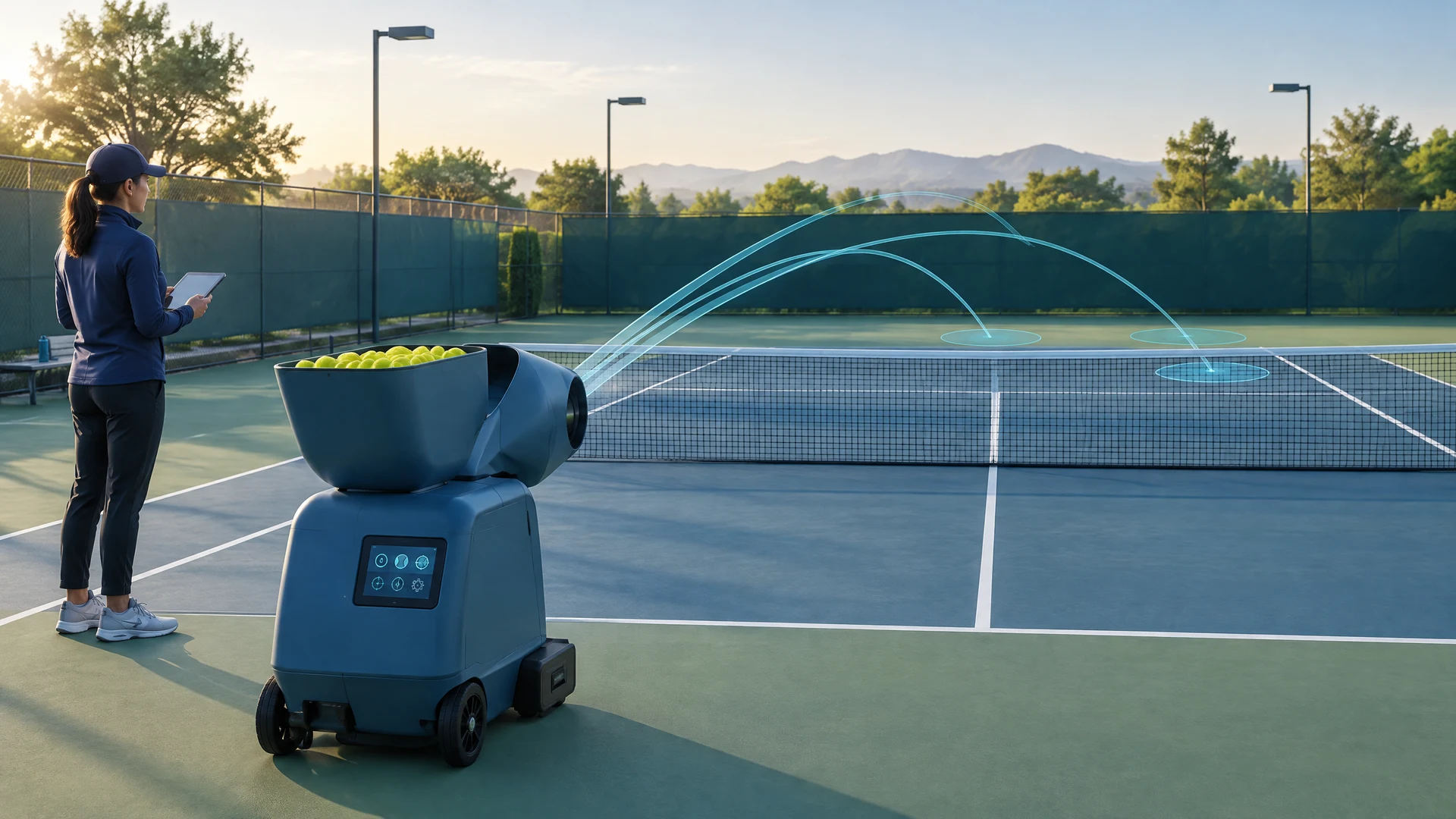
Robotic training systems in sports turn an exercise plan into controlled physical actions. Motors move a mechanism, sensors report what is happening, and software decides when to deliver the next ball or movement. Some systems repeat a saved sequence. More advanced research systems observe a ball or opponent and change their response. Both can support practice, but their capabilities are different.
For a player, the useful question is not whether the machine looks like a robot. It is whether the equipment delivers the right exercise, makes its behaviour understandable and leaves a coach in control of progression. A tennis launcher can create repeated returns without understanding tennis tactics. A camera-equipped robot can track a ball without knowing whether an athlete is tired or ready for a harder task.
This guide explains the hardware, software and feedback behind robotic sports training equipment. It uses documented machines and research projects, plus clearly labelled teaching examples. For the broader context of measurement and coaching decisions, start with our smart training equipment guide. Here, the focus is what makes a training system act, not simply record data.
Key takeaways
- A training machine combines mechanical delivery, control and an exercise plan; not every automated device uses AI.
- Motor feedback can regulate the machine without measuring the athlete’s response.
- Computer vision can add ball and player observations, but uncertainty and delayed measurements affect decisions.
- Useful progression requires reliable deliveries, appropriate practice design and human review.
- Stop controls, guarding and manufacturer instructions matter even when an app describes the machine as intelligent.
What counts as a robotic training system?
A robotic training system is equipment that uses controlled mechanisms to provide a physical training task. A launcher might feed tennis balls to a chosen area. A programmable cricket machine might vary deliveries. A robotic arm might return a table-tennis ball after observing its flight. The common feature is controlled action; the degree of sensing and autonomy varies considerably.
The word robotic is sometimes used loosely in product descriptions. A motorised feeder with a timer is an automated machine, even if it cannot observe the athlete. A sensor-guided device has a feedback path, but that alone does not prove artificial intelligence. Keeping those descriptions separate makes it easier to understand what a particular system can actually do.
A useful way to describe the equipment is by its task: ball delivery, rally response, resistance control or movement guidance. Then describe the control method and evidence. This is more informative than sorting everything into intelligent and unintelligent boxes. Simple, predictable automation can be appropriate when a coach wants consistent practice conditions.
The same distinction applies to robot training systems for athletes. A device designed for repetition is not automatically an autonomous coach. It might handle one useful part of a session while a person selects the task, checks technique and decides when to stop. Technical sophistication should be judged against that job, not against the appearance of the hardware.
The architecture: plan, act, measure and review
The core architecture has a planning layer, a control layer and a physical mechanism. The planning layer describes the exercise. The control layer turns the requested settings into motor commands. The mechanism produces the delivery or movement. Sensors then provide observations that may correct machine behaviour or inform the next exercise decision.
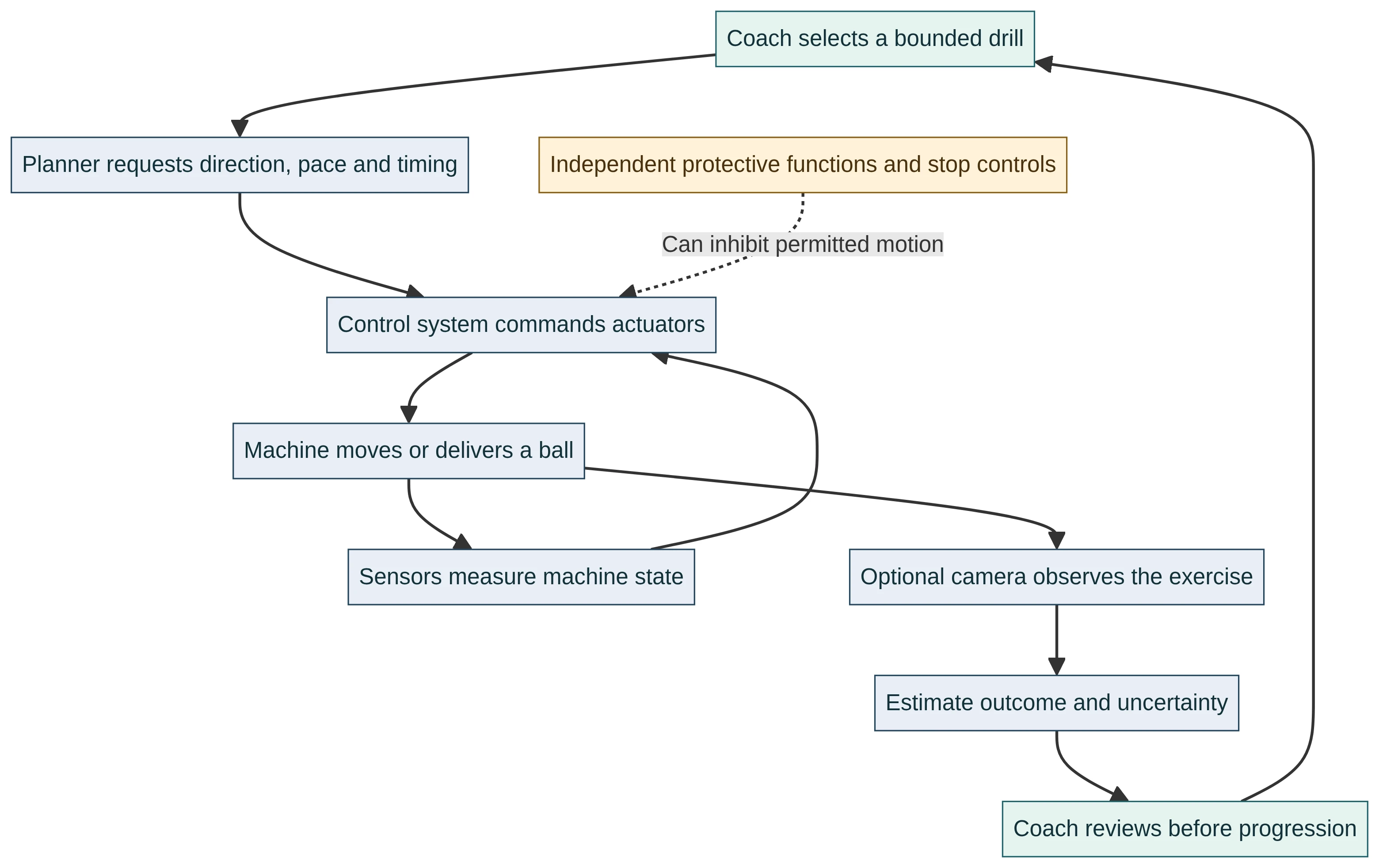
There can be several feedback loops inside the same system. One loop keeps a delivery wheel near its commanded rotation speed. Another checks whether a ball entered the feeder. A third, if supported, estimates where the player returned the ball. These loops measure different things and may operate at different update rates.
This separation matters when a display reports a successful drill. The motors could have behaved correctly while the ball missed the intended bounce area. The camera could have found the bounce while losing the player’s identity. The athlete could complete the task using a movement pattern that the coach wants to change. A single success icon conceals those different outcomes.
Sports robotics technology becomes easier to evaluate when each layer is visible. Ask what the machine requested, what it physically delivered, what the sensors observed and what the coach concluded. A system that records those distinctions provides more useful evidence than one that converts every observation into an unexplained overall score.
Mechanical components: the frame, joints and working area
The frame supports the mechanism and keeps its geometry stable. In a stationary launcher, it supports the hopper, delivery head, electronics and power supply. In a rally-playing robot, it supports joints, links and the racket attachment. A mobile device also needs wheels or another movement base, with a defined area in which it may operate.
Stability is part of delivery quality. A machine that shifts slightly can change its release direction even when the control setting stays the same. Loose mounting, an uneven surface or repeated impacts can alter the geometry. The visible target setting is therefore only one part of the actual ball path.
Joints allow movement around or along an axis. A rotating joint can aim a delivery head. A linear mechanism can move a component along a rail. A multi-joint arm combines several motions to place and orient its racket. More axes offer flexibility, but also create more possible motion paths and more coordination work.
The working area must include more than the footprint of the machine. It includes moving parts, the delivery path, possible rebounds and the space needed by the player. Guards and housings help separate people from internal mechanisms. Their purpose is not cosmetic; they reduce access to components that may continue moving after a feed command stops.
Motors: where controlled motion begins
A motor converts electrical energy into rotational motion. That rotation may drive a launch wheel directly or pass through a transmission. The control electronics regulate the motor using electrical commands. Depending on the design, measured speed, position or current can help the system maintain the requested behaviour under changing loads.
BOLA’s official Professional cricket-machine description provides a concrete example: brushless motors drive concave moulded urethane wheels. It also describes electronic wheel braking and adjustable line and length. Those features explain how its delivery mechanism is controlled. They do not, by themselves, establish that the machine observes batting technique or learns a training plan.
Motor speed and available turning force are related but not interchangeable. A mechanism can rotate quickly without having enough capacity for a demanding load. Starting, stopping and accelerating also matter. A motor may need time to reach a new setting before the next delivery can reproduce the intended condition.
The important practical outcome is consistent, permitted operation rather than the largest advertised speed. A suitable machine should make changes understandable and provide clear operating limits. Coaches should not infer athlete readiness from motor capability. The hardware’s maximum setting describes what it may deliver, not what a particular player should face.
Actuators, transmissions and positioning
An actuator is the part of a system that produces controlled movement. An electric motor can be part of an actuator, but an actuator can also include gearing, sensors and a housing. Some systems use mechanisms that produce linear movement. Others use pneumatic or hydraulic actuation, although this guide’s documented ball machines mainly illustrate electrically driven delivery.
A transmission changes how motion reaches the working component. Gears, belts or other arrangements can change speed, turning force or movement direction. They also introduce practical issues such as flexibility, friction or play between parts. The controller must work with the mechanism’s real behaviour, not an ideal drawing of it.
Positioning requires a reference. An encoder measures rotation or position, while a limit sensor can identify a boundary. A servo system uses feedback to reduce the difference between a requested position and a measured one. A stepper arrangement moves in commanded increments, but its accuracy still depends on load, sensing and the full design.
For the athlete, positioning affects where the challenge appears. A launcher that aims left and right needs to reach its intended orientation before release. A racket robot needs to coordinate several joints around an incoming ball. Neither task is solved by adding more motors; timing, calibration and safe movement limits must work together.
How a ball-launching system handles one delivery
A ball-launching system first stores balls, then meters them into the delivery mechanism. The hopper holds the supply. A feeder or gate separates individual balls so the mechanism can handle the intended number at the intended time. A chute or guide aligns the ball before the wheels, striking mechanism or other delivery method transfers energy.
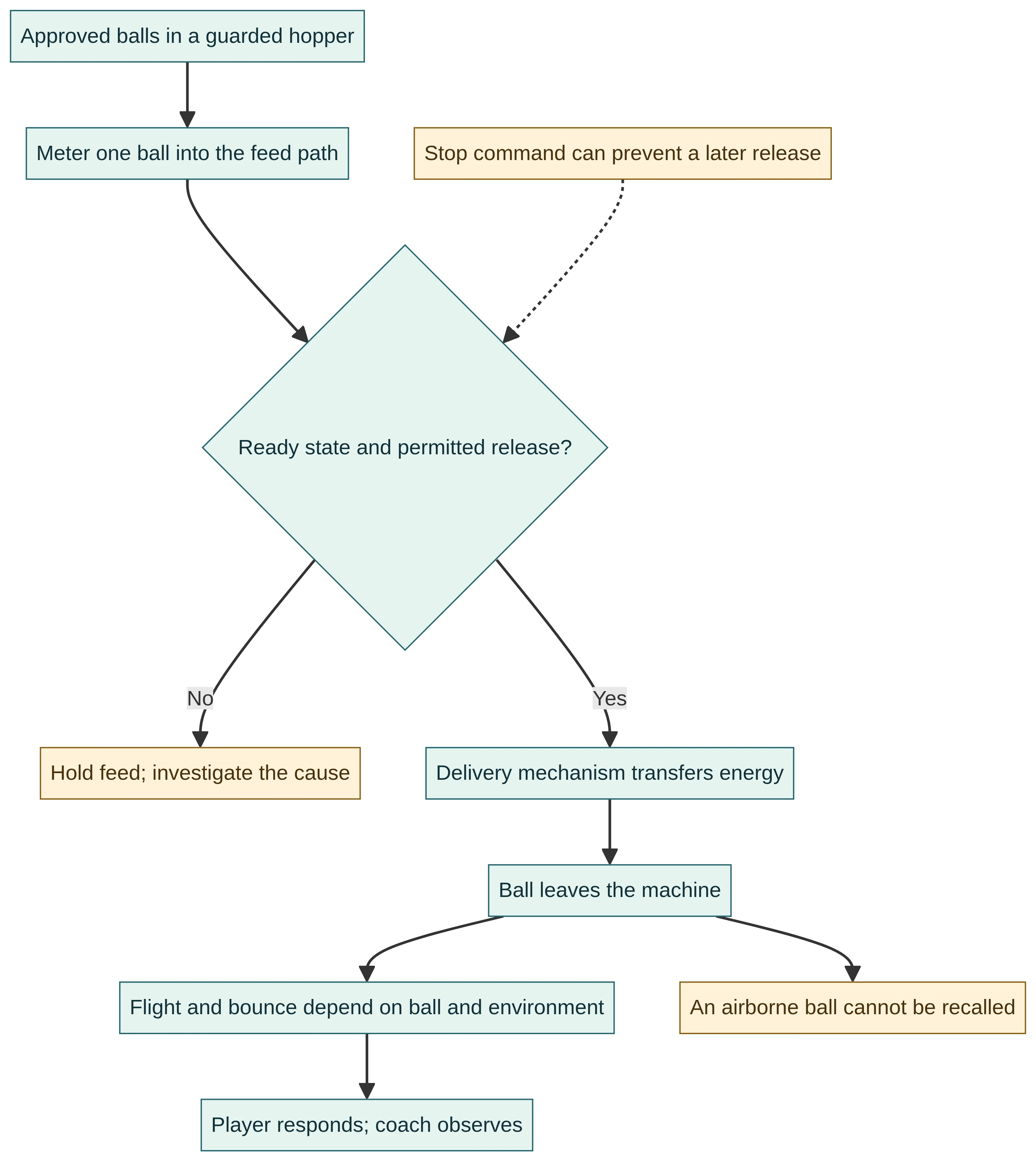
The feed sequence is as important as the final launch. Two balls arriving together, an unsuitable ball or a delayed feed can disrupt the exercise. A sensor may confirm presence, while the controller checks a ready condition. Not every product has the same sensors or release checks, so the specific manual remains the reference.
The player needs a predictable relationship between the start command and the first delivery. A countdown, warning signal or visible ready state can support that relationship. BOLA documents countdown and warning features for its optional feeder. The availability of an accessory should not be confused with a standard feature on every version of a machine.
Automated sports training machines also need a clear way to pause between blocks. Feeding continuously is not the same as conducting a well-designed session. Refilling, clearing the area and discussing the task require deliberate pauses. A machine that produces more balls per minute can still provide less useful practice if the player never has time to reset.
How delivery wheels change pace and spin
Wheel-based launchers transfer energy through contact between rotating surfaces and the ball. The wheels grip and compress the ball during that brief contact. Their speed, geometry and surface properties influence how it leaves. The general principle explains a common type of launcher, but it is not a formula for predicting every product’s output.
In a simplified two-wheel arrangement, similar wheel surface speeds can support a mainly forward delivery. A difference between wheel speeds can add rotation. The orientation of the wheel arrangement influences the spin axis. Real systems also depend on ball grip, deformation and the time spent in contact with the wheels.
A wheel’s rim speed is related to its radius and rotation rate, but ball speed is not automatically equal to that rim speed. Slip, pressure and material behaviour can change the transfer. This is why a displayed setting should not be treated as a directly measured ball speed unless the system actually measures and validates it.
Spin then interacts with flight and bounce. A spinning ball does not behave exactly like a non-spinning ball launched in the same direction. Wind, court surface, ball condition and impact also matter. For tennis or cricket practice, a useful description includes the resulting challenge, not just a dial position labelled spin.
Sensors: measuring the machine before measuring the athlete
Machine sensors can monitor rotation, position, ball presence, motor current or temperature. Each serves a particular purpose. An encoder can help regulate motion. A presence sensor can support feed timing. A temperature reading can indicate a condition that needs attention. No single sensor supplies a complete view of the exercise.
A measured motor state is not the same as a measured training result. A launcher may know that its wheels reached the requested speed without knowing where the ball bounced. A racket robot may know its joint positions without knowing whether the player’s return was technically sound. Those outcomes require additional observations and definitions.
Sensors also have limits. They may sample too slowly for a fast event, become misaligned or produce uncertain readings under difficult conditions. A missing observation should not silently become a zero score. The system should distinguish an observed failure from an unobserved event, especially when its output affects progression.
Wearables can add information about workload or heart-rate response, but combining devices does not remove uncertainty. Data need matching timestamps and a clear purpose. Our wearable technology guide explains those measurement limits. A robot should not turn a consumer sensor estimate into an automatic medical or readiness decision.
Computer vision: finding the ball and interpreting the scene
Computer vision uses camera images to estimate useful features of the exercise. The first task may be detecting the ball. Tracking links observations across successive frames. With suitable calibration, the system can estimate where the ball is moving relative to the court or table. Some arrangements also estimate player position or racket movement.
The camera’s view affects what can be inferred. A player can hide the ball. A small fast object may blur or leave the frame. Bright light and changing backgrounds can make detection difficult. A camera that works well in a controlled demonstration may need a different setup on a busy outdoor court.
Position is only one part of a ball’s state. Speed, direction, bounce and spin influence what happens next. Estimating spin is particularly demanding because it involves more than finding the centre of the ball. Advanced research may combine several cameras or other sensing approaches, rather than rely on one ordinary video feed.
Our AI video analysis guide separates detection, identity, tracking and event interpretation. The same distinction applies here. Seeing an athlete near a target does not prove that they completed the intended movement. A camera estimate can support review without being treated as a complete explanation of technique.
Why timing and calibration change the result
A robotic sports system acts on measurements that are already slightly old. Exposure, image processing, communication and actuator response all take time. A planner must account for that delay when deciding where a moving ball will be. Reacting to the last observed position alone can send the mechanism toward where the ball was rather than where it will arrive.
A simple teaching calculation shows why delay matters. At a hypothetical speed of 20 metres per second, a ball travels 0.2 metres in 10 milliseconds. That comes from multiplying speed by time: 20 × 0.01. It is not a product benchmark, and a real ball may accelerate, curve or bounce during a longer interval.
Calibration connects camera measurements with the physical environment. A pixel coordinate must be related to the table, court or machine reference before it becomes a useful position estimate. Moving the camera or changing the machine’s orientation can disturb that relationship. A visually convincing overlay can therefore be misplaced even when the ball detector works.
Reliable training feedback should carry those uncertainties forward. A borderline landing near a target line may need review rather than a confident pass or fail. For an overview of spatial measurement, see our motion capture guide. Accuracy is a property of the complete setup and task, not just the camera specification.
Programmable drills: turning settings into an exercise
A programmable drill is a sequence of requested actions. In a tennis machine, those requests can include height, direction, spin, pace and the delay between deliveries. The sequence may repeat a single challenge or alternate among several positions. The coach supplies the training purpose that connects the settings.
Spinshot’s official Player page describes 12 pre-programmed drills that can be customised, including six sequential shot settings. It lists direction, height, spin and speed controls, along with horizontal and vertical oscillation. These documented features illustrate programmable variation. They do not prove that the machine independently evaluates the athlete or generates a learned coaching plan.
For a beginner, a saved exercise might support learning a repeatable contact position. For a more experienced player, variation might require movement and a choice between responses. Those are different training objectives. The machine should not be judged only by how many patterns it stores, because a complicated pattern can obscure the skill being practised.
A useful drill record includes the intended task, initial settings, allowed changes and a reason to stop. The coach can then compare sessions without guessing what produced the challenge. Our AI-generated training plans guide explains why a generated schedule still needs human interpretation and athlete context.
Adaptive difficulty: changing the task using feedback
Adaptive difficulty means changing an exercise in response to observations. It could adjust target size, delivery variation, time between attempts or another parameter. The system first needs a definition of success and a reliable way to observe it. Without those, adaptation can react to measurement noise rather than player performance.
A basic rule might hold a drill steady until the coach approves a change after a block of attempts. A more automated rule might use a recent success rate to propose that change. Both are examples of rule-based adaptation. They do not become machine learning simply because software performs the arithmetic.
Difficulty has several dimensions. A faster ball, a shorter preparation interval and a less predictable location all change the challenge in different ways. Increasing them together makes it difficult to understand why performance changed. It can also make a previously useful exercise inappropriate for the player or the environment.
The feedback loop should therefore respect approved limits and uncertainty. If tracking fails, the sensible response may be to hold the task rather than increase it. If an athlete reports discomfort or cannot recover between attempts, the coach should intervene. A recent success percentage cannot replace those observations.
A worked example: separate bad feeds from player outcomes
Consider an illustrative block of 20 planned tennis deliveries. A coach defines the task as returning a usable ball into a marked target area. Four deliveries fall outside the agreed delivery area, so they are marked unsuitable. Of the remaining 16 opportunities, the player returns 12 into the target. These are invented teaching numbers, not results from a real athlete session.
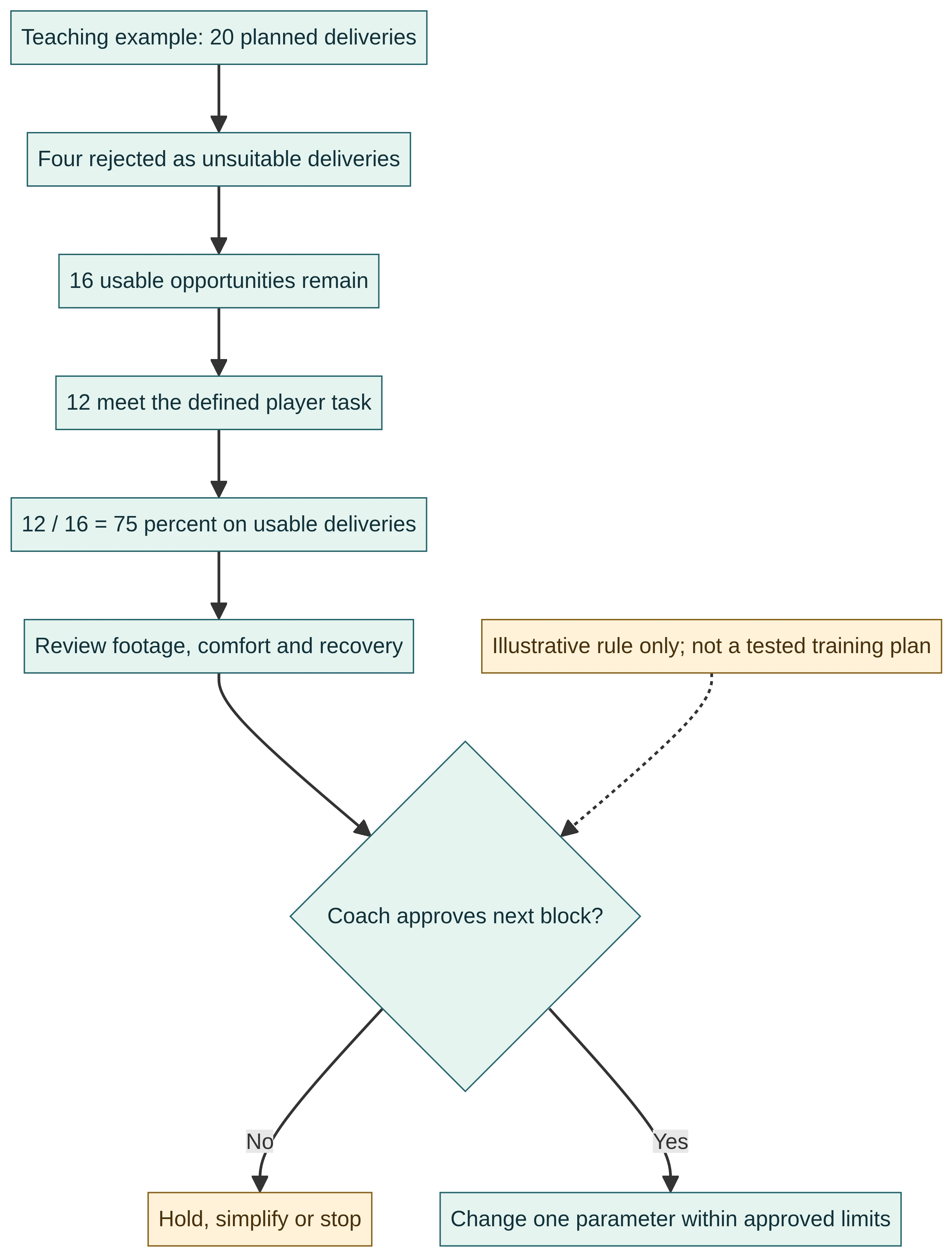
The player’s task success is 12 divided by 16, or 75 percent on usable deliveries. Dividing 12 by all 20 planned deliveries gives 60 percent. Both calculations are mathematically correct, but they answer different questions. The second includes machine-delivery problems in the denominator and should not be presented as the same player-performance measure.
The machine’s usable-delivery rate is 16 divided by 20, or 80 percent in this example. Recording it separately helps identify what needs attention. The coach can investigate delivery quality before assuming that the athlete needs a different drill. A scoreboard that merges these measures can send training in the wrong direction.
Progression still does not follow automatically from 75 percent. The coach may keep the task unchanged while checking technique, recovery and camera observations. If a change is appropriate, it should be clear which parameter changed and why. This simple example demonstrates trustworthy bookkeeping, not a scientifically validated training prescription.
AI versus rule-based control
Rule-based control follows explicitly designed conditions and calculations. A timer can release a ball after a set interval. A position controller can correct a measured error. A drill selector can choose a saved sequence. These functions can be complex and useful without learning from a dataset or from repeated interaction.
Machine learning fits a model or policy using examples or experience. A vision model can learn to identify objects. A learned motion policy can map observations to actions. Reinforcement learning develops behaviour using an objective and feedback during training. The method may be combined with conventional controllers rather than replace them.
AI-powered sports training robots should therefore be described by the learned function. Does AI detect the ball, choose a response or propose the next exercise? How was that function evaluated? A device with an app and random drills does not establish any of those capabilities. Random selection and adaptive learning are different mechanisms.
A hybrid design often makes sense: a learned perception model supplies estimates, a planner selects a permitted action, and a conventional controller handles the motors. Protective functions remain a separate engineering requirement. An impressive learned response is not evidence that all software decisions, or all unexpected physical interactions, are safe.
Robotic tennis training machines: repetition and movement
Robotic tennis training machines can provide a repeatable supply of returns to practise stroke mechanics or footwork. Programmable direction and trajectory allow a coach to create a known pattern. Variable patterns can make the exercise less predictable, but the player still needs a defined task and an appropriate amount of recovery.
The documented Spinshot Player controls show how one commercial example implements this idea. Its page describes touch-panel and app operation, configurable drills and optional remote-watch control. It also documents random mode. Those are control features reported by the manufacturer, not independently measured improvements in match performance.
A stationary launcher cannot fully reproduce a human opponent. Its release point is fixed relative to the court, and its cues differ from a player’s preparation and swing. The athlete may learn the rhythm of the machine rather than read an opponent. This does not make the drill useless; it defines what the drill can train.
A balanced session can use the machine for a selected technical task, then include appropriate human interaction to test transfer. The relevant question is whether the intended skill appears when the conditions change. More precise repetition is not automatically better if it removes the decisions the athlete needs during a real rally.
Cricket bowling machines: control without claiming a human bowler
Cricket bowling machines let coaches work on a particular delivery challenge repeatedly. Wheel settings and head alignment influence pace, spin, line and length. BOLA’s documented ball joint and fine adjustment provide a concrete example of mechanical aiming, while its optional feeder supports scheduled delivery. Hardware and accessories must be checked for the actual model being used.
A repeated delivery can help a batter focus on contact or a specific movement. It also lets the coach observe several attempts under broadly similar conditions. However, the batter’s response to a machine is not identical to reading a bowler. Run-up, arm action and release cues are part of human bowling and may be absent or different.
Visual cues can be added in some designs, but an animation or image should not be treated as a complete recreation of a human delivery. The timing must match the physical release, and the cue still has limitations. The useful claim is that the system supplies a particular practice condition, not that it duplicates every opponent.
For an academy, setup and ball compatibility are basic requirements. The operator should follow the manufacturer’s instructions and keep a clear delivery area. Our sports analytics guide explains why repeated measurements need consistent definitions. A batting result becomes more useful when delivery conditions and rejected attempts are recorded alongside it.
Football and robotic goalkeeper training
Robotic goalkeeper training commonly means using a machine to send controlled shots, crosses or other balls toward a goalkeeper. It does not necessarily mean that a robot acts as the goalkeeper. A launcher creates the delivery stimulus; the human goalkeeper responds, while the coach checks positioning, handling and the intended technical task.
Globus describes its EuroGoal 1500 as a football ball-shooting machine with electronically adjustable delivery speed, vertical movement and spin effects. That supports an example of controlled football delivery. The public description does not establish that it recognises a goalkeeper’s fatigue, uses a learned tactical model or autonomously decides which skill the goalkeeper should train.
Repeated deliveries can help isolate a movement, but they also change the information available to the player. A machine does not naturally supply an attacker’s body shape, approach or last-second decision. A goalkeeper may know the source and rhythm in advance. A coach should recognise that difference when connecting the exercise to match play.
Some drills can combine a controlled delivery with permitted player interaction, but extra participants change the risk and the task. Clear spacing, supervision and predictable operating procedures matter. Our football video-analysis software guide provides context for reviewing footage; the footage supports coaching, rather than proving that the launcher recreated a match situation.
Table tennis: a feeder is not the same as a rallying robot
A table-tennis feeder supplies balls at chosen settings. A rallying robot must respond to a ball sent by the other side. It needs perception, prediction and timed contact with a racket. This adds a much harder problem: the incoming ball is not fully specified by the robot’s own drill program.
Google DeepMind’s original 2024 competitive-table-tennis project illustrates learned rally control. It describes a high-level controller selecting among low-level skills, simulation-to-real development and adaptation to unfamiliar opponents. The skills and their limitations inform selection. This is different from simply cycling through a sequence of preselected feeder settings.
The project reports 29 human-opponent matches, with 13 won by the robot. It also reports losses against all advanced and advanced-plus opponents. The evaluation used rule modifications because the system could not physically serve. Those details belong beside the result: this was a bounded research demonstration, not proof of universal competitive ability.
Most importantly for training, winning a match is not the same as helping a human learn. A practice robot might need to sustain a suitable rally or provide a specific challenge rather than maximise its own score. A separate athlete-development study would be needed to establish learning benefits from repeated use.
Resistance and movement-guidance applications
Not every sports-training robot launches a ball. A controlled resistance device can adjust force during an exercise, while a movement-guidance mechanism can help define a motion path. These applications introduce direct physical interaction with the athlete. The control problem is therefore different from aiming an independent ball-delivery machine.
Sensors may measure displacement, movement speed or applied force, depending on the design. A controller can use those readings to regulate the mechanism. However, a measured resistance value is not a diagnosis of muscle condition. The equipment still needs a clearly specified exercise purpose, appropriate supervision and operating limits.
Movement guidance also needs careful interpretation. Following a constrained path can make a task repeatable, but it may not represent the athlete’s natural movement in open play. A mechanism can influence the motion that is being measured. That means the apparent consistency is partly a result of the device, not necessarily improved independent control.
Our strength and conditioning analytics guide explains how movement measurements can support decisions without replacing them. These applications are presented here as categories of controlled training equipment, not as a claim that a named device is suitable for rehabilitation or safe for every athlete.
Safety begins with the whole exercise area
A safe setup has to consider the machine, athlete, operator and surroundings together. Potential hazards include moving mechanisms, fast balls, unexpected rebounds, cables and trip points. A stationary launcher can still create a wide exposure area. A robot arm can move through space that looks empty when the equipment is at rest.
OSHA’s industrial robotic-systems guidance emphasises application-specific hazard assessment, safeguarding and trained operation. Those are useful general engineering principles. The guidance is not a sports-product certificate, and it should not be presented as an automatic statement of legal duties for every academy in India or elsewhere.
Computer vision used to score an exercise is not automatically a safety-rated presence detector. An ordinary camera pipeline can miss a person, become delayed or fail under unusual lighting. A design that uses vision for a protective function needs that function assessed on its own terms. Training analytics cannot be assumed to provide protective stopping.
The operator should understand the manufacturer’s permitted setup, ball types, clearances and inspection requirements. A coach should also account for children, unfamiliar users and people moving through the area. Labels such as autonomous or intelligent do not remove the need for supervision appropriate to the equipment and setting.
Feed stop, emergency stop and energy isolation are different
A normal feed-stop command may prevent the next ball from entering a launcher. It does not necessarily stop every moving component immediately. A pause in an app can therefore have a different physical effect from a protective stop or an emergency stop. The operator needs to know the behaviour defined for that machine.
An emergency-stop function is designed for an emergency response, but it is not a substitute for guarding or planned hazard reduction. A ball already airborne cannot be recalled. A rotating component may take time to slow. The system’s stopping behaviour and reset process must be understood before anyone approaches the mechanism.
Maintenance introduces another distinction: stopping movement is not necessarily isolating hazardous energy. Electrical supplies, stored mechanical energy or other energy sources can remain relevant. OSHA’s guidance discusses control of hazardous energy during service. The applicable procedure should come from the manufacturer and competent personnel, not a guessed sequence based on an app screen.
Do not reach into a feed path or remove a guard merely because delivery has paused. If the mechanism jams, follow the documented fault procedure and obtain qualified help when needed. This guide explains the concepts; it does not provide repair, bypass or energised-maintenance instructions for a particular product.
Ball condition, wear and calibration drift
The same settings can produce different results as equipment and balls change. Ball surface, pressure, size and material affect contact with a launching mechanism. Worn or unsuitable balls can alter flight and bounce. Mixing ball types may therefore add variation that looks like a player-performance issue.
Mechanical wear can also change behaviour. A delivery wheel’s surface, a belt’s condition or movement at a mounting point may affect repeatability. A sensor can remain electronically functional while its reference shifts. A useful inspection process considers the complete delivery path rather than checking only whether the display turns on.
Calibration records help distinguish expected variation from a developing fault. A facility can track when the machine was inspected, which approved balls were used and whether the delivery area remained consistent. The purpose is not to promise identical flights. It is to make differences visible enough to investigate.
The maintenance schedule and permitted checks should follow the actual manual. A coach can record symptoms without attempting an undocumented adjustment. If output becomes unpredictable, the exercise should be paused and assessed. Continuing until the hopper empties is not a reliable way to determine whether a mechanism needs service.
Measuring benefit without confusing repetition with improvement
A useful evaluation starts with the skill the athlete is meant to improve. Counting delivered balls measures activity. Counting usable deliveries measures part of machine reliability. Measuring a defined player task gives another outcome. These numbers should not be collapsed into one claim that the robot improved performance.
A player may become better at the machine’s particular pattern without improving under varied human opposition. That is why transfer matters. The coach needs to see whether the intended behaviour appears when relevant cues or conditions change. The comparison should be appropriate to the sport and the exercise, not chosen only because it is easy to measure.
Before-and-after scores also need context. Familiarity with the test, a different surface or a change in delivery settings can affect the result. A short demonstration cannot isolate the effect of the equipment from the rest of training. Claims about durable athlete improvement require evidence designed to answer that question.
Our reaction-time training guide makes a similar distinction between a measured test and sport-specific decision-making. Robotics can make selected practice tasks more repeatable. Whether that repetition is valuable depends on the exercise, the athlete and the quality of feedback, not on automation alone.
Practical limits: fatigue, uncertainty and missing context
A robotic system observes only the inputs available to it. It may know ball position, machine state and a recent task score. It may not know sleep quality, confidence, previous workload or the reason the athlete missed a delivery. More sensors can add context, but they also add measurement errors and interpretation requirements.
Adaptive software can be misled by a changing environment. Poor lighting can reduce detection quality. A different bounce can change success rates. If the system treats every missing observation as a player miss, it may simplify the drill for the wrong reason. If it ignores uncertainty, it may progress without enough trustworthy evidence.
Fatigue presents a particular challenge because a player can complete a target task while movement quality changes. The software’s score may stay high even when the coach wants a pause. A camera can assist review, but a visible movement pattern is not a complete health assessment or injury prediction.
Good systems make uncertainty and operator intervention straightforward. They should not require the athlete to continue merely to complete an automated block. In practice, the most useful control can be the ability to hold a setting, stop the exercise and discuss what happened before accepting the next suggestion.
Data privacy and meaningful records
Camera-enabled training can collect identifiable video, movement traces and performance observations. The facility should know which information stays on the device and which may be sent to an account or remote service. An internet-connected control app does not automatically need every recording to leave the training site.
Players should understand the purpose of recording, who can access the information and how long it is retained. These questions are especially important for children and group sessions. A practical setup can minimise unnecessary capture by positioning cameras for the task and avoiding unrelated people where possible.
Access to records should be tied to a clear need. A coach may need to review an attempt, while a maintenance technician needs machine diagnostics rather than the athlete’s complete video history. Separating those records can improve both privacy and troubleshooting. Export and deletion options should be checked rather than assumed.
Our privacy and data practices page explains the publication’s own approach. For a training facility, the relevant product terms, local requirements and organisational policies need their own review. This article is an educational guide, not a legal determination about a particular recording setup.
What future developments are grounded in current research?
The clearest research direction is better integration of perception, prediction and physical control. Faster sensing can provide more timely observations. Improved state estimation can help predict a ball’s arrival. Better hardware models can make learned behaviour transfer more consistently from simulation to an actual machine.
Sony AI’s Project Ace explainer, published in April 2026, describes a research table-tennis system combining high-speed frame and event-based sensing, reinforcement learning and purpose-built robot hardware. Its discussion also acknowledges remaining tactical, timing and simulation-reality limitations. It is evidence of a research direction, not proof that the same capability is available in a consumer training machine.
Event-based sensing responds to changes in a scene rather than producing only conventional complete frames. That can support specialised fast-motion measurement, but it still needs appropriate processing and calibration. Combining sensing methods is an engineering choice, not a guarantee that every ball state will be estimated correctly.
Future athlete-training tools may become better at tailoring practice while explaining their decisions. That would require more than a stronger opponent robot. It would require suitable training objectives, athlete-focused evaluation and dependable intervention controls. Predictions about widespread adoption or guaranteed performance gains would go beyond the evidence used here.
Questions to ask before relying on a system
Start by asking what action the equipment can perform and what information it actually measures. A clear answer should separate delivery settings, measured ball outcomes and athlete observations. If the description says AI, ask which function is learned and what evidence supports it. A demonstration should show the required exercise, not only an impressive isolated shot.
Next, consider control and recovery. Who can pause the drill? What happens after a communication failure? How are unsuitable deliveries or uncertain camera events represented? The right answer depends on the product, but it should be understandable before the equipment becomes part of a regular session.
Practical operation matters as much as software. Approved ball types, storage, setup time, maintenance support and permitted environmental conditions determine whether a facility can use the machine consistently. A complex system can become difficult to evaluate if every session begins with different positioning or undocumented settings.
Finally, ask how progress will be checked away from the machine. The strongest reason to use robotics is a well-defined practice need that the equipment can support. Keep the coach’s purpose visible, preserve time for recovery and review, and treat the robot as one controlled part of training rather than the authority over it.
Common questions about robotic sports training
Does a ball machine count as AI?
A ball machine can be programmable without using AI. Timers, saved drill sequences and random selection are automation features. AI becomes relevant when a learned model or policy performs a specified task, such as detecting a ball or selecting a response from observations. The product should describe that function rather than rely on a label.
Can a training robot replace a coach?
A machine can provide delivery or feedback for part of a session. That does not establish that it understands the athlete’s broader needs. Exercise selection, technique interpretation and decisions about progression remain important human tasks. The systems described here are equipment and research examples, not evidence that coaching can be removed.
Is random delivery the same as adaptive difficulty?
Random delivery changes the challenge according to a selection process. Adaptive difficulty changes it in response to relevant feedback. A random sequence might never measure the athlete. An adaptive system needs defined observations and approved rules or learned behaviour. Neither feature alone proves that the resulting exercise is appropriate.
Are robotic goalkeeper systems robot goalkeepers?
Often the phrase describes a machine that delivers shots or crosses for a human goalkeeper to practise. An autonomous robot that defends a goal would be a different system with different sensing and movement demands. The documented football example in this guide is a delivery machine, not a humanoid defending the goal.
What is the most useful measure of training quality?
There is no single universal measure. Record whether the machine supplied usable attempts, whether the player completed the defined task and whether the intended skill transfers to appropriate sport conditions. Interpret those observations with the coach. A large number of deliveries or an attractive software score is not sufficient on its own.
Page metadata and source notes
SEO title: How Robotic Training Systems Work in Sports: Technology Explained.
Meta description: Learn how sports training robots use motors, sensors, ball launchers and control software, with real examples, adaptive drills, safety and practical limits.
Primary keyword: robotic training systems in sports.
Related query coverage: sports robotics technology; robotic sports training equipment; robot training systems for athletes; automated sports training machines; AI-powered sports training robots; robotic goalkeeper training; robotic tennis training machines.
Planned canonical path: /robotic-training-systems-sports. This is one article owner; the slash-ending form is normalized to the same path.
Source 1: Spinshot Sports, Spinshot Player Tennis Ball Machine, official product description, retrieved 14 October 2026. Used for documented drill, sequencing, oscillation and control features; no independent athlete-effectiveness claim is inferred.
Source 2: BOLA Manufacturing, BOLA Professional Bowling Machine, official product description, retrieved 14 October 2026. Used for motor, wheel, aiming and optional-feeder explanations. Accessory availability and compatibility depend on the specific model.
Source 3: Globus Sports & Health Technologies, EuroGoal 1500, official product description, retrieved 14 October 2026. Used as an example of football ball delivery, not an autonomous goalkeeper or verified adaptive learner.
Source 4: Google DeepMind, Achieving Human Level Competitive Robot Table Tennis, original 2024 project and linked research paper, retrieved 14 October 2026. The 13 wins in 29 matches belong to that evaluation with its stated player levels and serving-related rule modifications; they are not athlete-learning results.
Source 5: Sony AI, Inside Project Ace, 22 April 2026, retrieved 14 October 2026. Used for the high-speed sensing, learned control and simulation-reality research direction. Experimental capabilities are not represented as ordinary commercially available training features.
Source 6: OSHA Technical Manual, Industrial Robot Systems and Industrial Robot System Safety, retrieved 14 October 2026. Used for general safeguarding and hazardous-energy principles, not a sports-equipment certificate or a local legal opinion.
Original materials: the cover and three diagrams are illustrative. The 20-delivery drill block and timing calculation are constructed teaching examples. No athlete test, product trial or measured improvement was conducted for this article. Product prices, search volume and future rankings are not claimed.