What makes training equipment smart?
Smart training equipment is sporting or gym equipment paired with a sensor, encoder or connected app that records a defined action. The useful question is not whether a screen is attached. It is: what did the system observe, how did it calculate the displayed number, and what decision can it support? A connected machine may log work, a ball sensor may record motion, and a barbell encoder may track displacement over time. None is a verdict on talent, health or readiness.
This is not a shopping list. We do not test, rank, sell or recommend smart fitness equipment here. Instead, follow the route from physical action to signal, then from signal to a conversation between athlete and coach. For the wider map of systems used in sport, see sports science and training technology.
Equipment categories and connected-ball signals
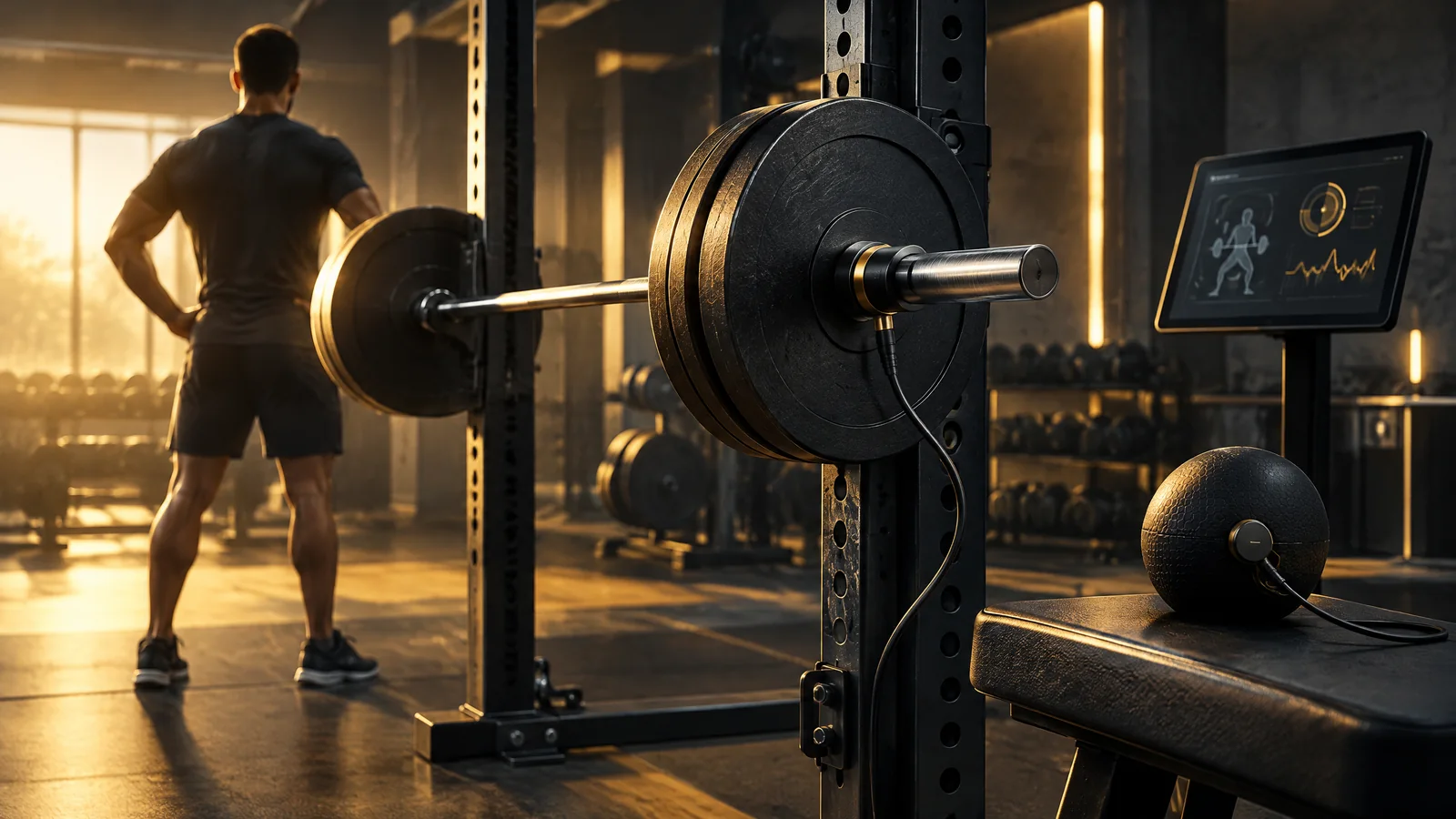
A smart barbell often means a conventional bar used with a cable encoder, not a bar containing electronics. A tether connects the sensor to the bar. As it extends and retracts, the device records displacement and software can show velocity, duration or a derived power value. GymAware’s published feature list is one documented example of this linear-position-transducer category.
A connected ball places sensing hardware inside the ball. In adidas’s documented 2022 World Cup example, a 500 Hz inertial-measurement sensor supplied touch-timing data to video match officials within a larger decision system. During training, a connected ball might instead record motion or contact. The direct signal is not tactical judgement, technical quality or a coaching instruction.
A smart sensor soccer ball can help answer a narrow question: when was the ball played, how fast did it travel, or how much did it spin? KINEXON’s connected-ball material also describes supplier examples such as passes, shots and ball circulation. That is not a promise that every ball, app or practice setup provides the same result. Video, task design and a coach’s observation supply the context outside the ball.
Athlete-worn inertial sensors use accelerometers, gyroscopes and sometimes magnetometers to record movement where they are attached. They are one smart sensor sports category, not a replacement for every measurement. The dedicated wearable technology in sports guide covers them in more detail.
How a bar-speed encoder creates a number
In encoder weightlifting, a retractable cable fixed to a moving load turns an electromechanical sensor. Pulses become displacement; the change in displacement over time yields velocity. The 2024 PLOS ONE comparison of linear position transducers explains that software can also display peak and mean velocity plus derived power measures. A calculation is only as comparable as the movement and processing rules beneath it.
For a linear position transducer gym setup, attachment point, cable angle, exercise variation, load, range of motion and the app’s start/end rule matter. The PLOS ONE study found that the tested device’s validity relative to its reference differed across measures and between free-weight and Smith-machine squats. Do not treat values from two devices—or two differently performed lifts—as interchangeable.
Make sessions comparable before looking for a trend
Keep a short record beside the data: device and firmware, attachment or placement, task, external load, target, range, date and any interruption. This is not paperwork for its own sake. The 2025 PLOS ONE wearable-sensor study used standardized placement, calibration, synchronization checks and drill-level feedback. Its controlled workflow shows why a dashboard alone is not a method.
When a value surprises you, first check practical causes: cable snag, loose attachment, altered depth, a changed ball, lost connection or a different task. A video clip or repeated attempt may clarify an outlier. Preserve the original record, so a coach can decide whether it is a data-quality exception or an observation worth discussing.
A hypothetical velocity comparison
Hypothetical example: an athlete completes the same planned barbell movement at the same external load and range on two dates with the same encoder. Mean concentric velocity is 0.62 m/s on the first date and 0.57 m/s on the second. The arithmetic difference is 0.05 m/s: 0.62 minus 0.57.
That result is a prompt to review, not an automatic instruction to alter training. Were the depth, effort cue, warm-up, attachment and software version alike? Is 0.05 m/s larger than normal variation for this device, movement and athlete? Only after that check can the value be considered in session context. For deeper smart velocity based training and training-load interpretation, see strength and conditioning analytics.
Turn feedback into a human decision
A useful feedback loop has four parts: set a question, collect a comparable observation, check its quality, then decide whether it changes the next conversation. A coach might ask whether an athlete met a pre-agreed movement-speed target in a familiar task. The encoder can supply a number; it cannot explain motivation, technical intent or what should be prescribed next.
Avoid making one score do too much. A leaderboard can add focus, but it can also encourage people to chase a number while changing the movement being measured. Keep conditions visible and explain who will see the data. Our performance technology in sports guide explains why a measurement is not itself an outcome.
Questions to ask before trusting the display
Ask what the device senses directly and what the app estimates. Then ask whether it has been evaluated for this movement, setting and population—not merely marketed for a similar one. Check where the data are stored and whether everyone understands the purpose of collection.
Keep the claim proportional. A bar-speed value describes that bar movement under stated conditions. A ball sensor describes a recorded ball action. Neither proves that equipment caused improvement, prevented a problem or will work the same way for every athlete. Good smart training equipment makes a coaching question clearer; it does not remove careful human judgement.
Sources
GymAware’s GymAware RS documentation supplied a named linear-position-transducer example. Ruiz-Alias and colleagues’ 2024 PLOS ONE study supplied device-validity and comparability limits. adidas’s 2022 connected-ball announcement and KINEXON’s What Data and Insights Does Connected Ball Technology Provide? supplied attributed connected-ball examples. Liang and colleagues’ 2025 PLOS ONE study supplied the sensor-placement, calibration and feedback-workflow example.