Motion capture turns movement into a model
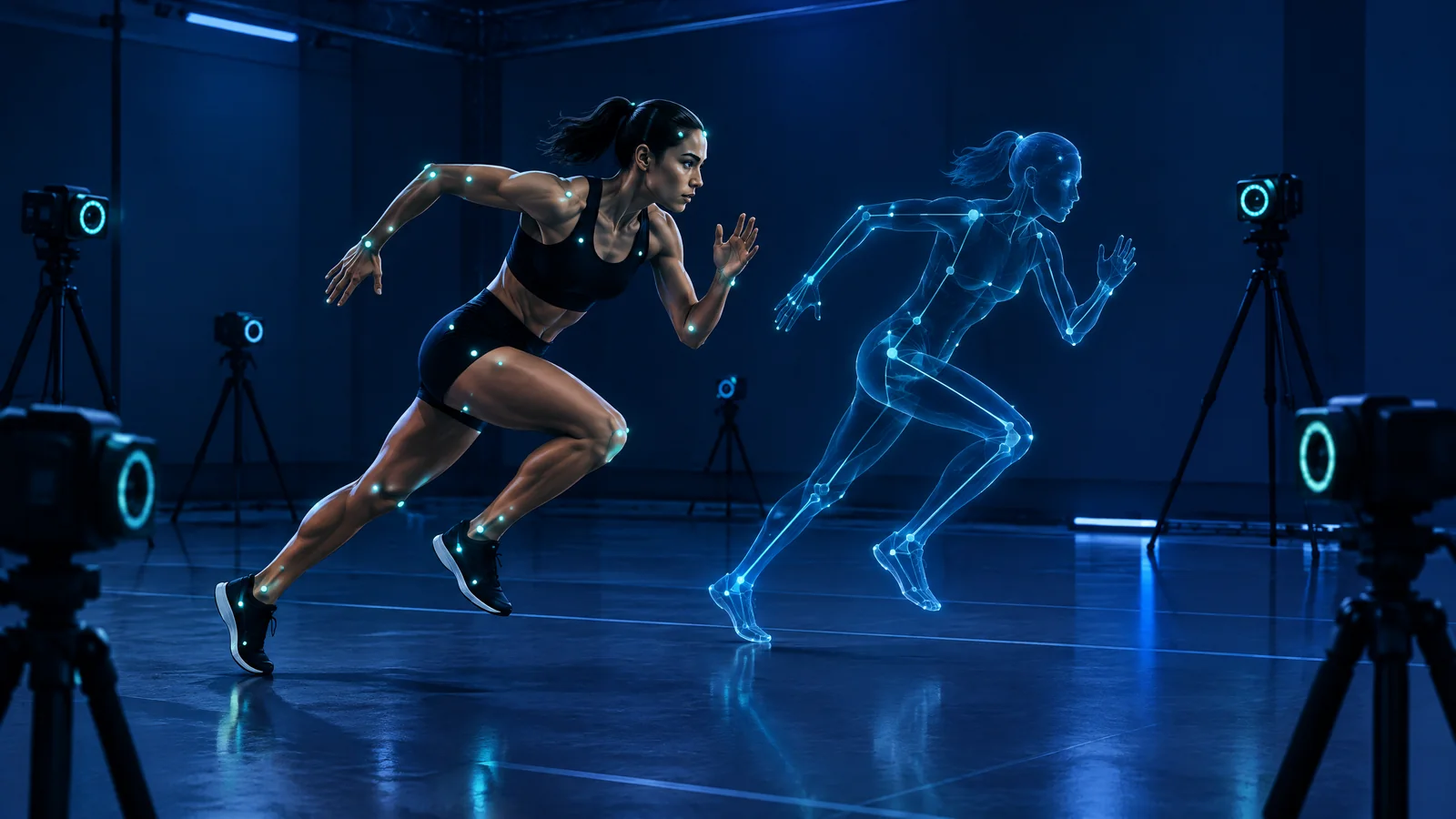
Motion capture in sports, often shortened to mocap, records observations of a movement over time and turns them into a digital representation. The observations may come from cameras, reflective markers or body-worn sensors. Software then estimates where body segments are, how they are oriented and, with a chosen body model, measures such as joint angles or segment speed. That makes motion capture technology more than ordinary video, but the final number is still an estimate produced by a particular setup.
The useful starting question is not “which system is best?” It is “what movement do we need to observe, in what place, and for which coaching or study question?” The sports science and training technology hub maps the wider field. This guide stays with the capture chain: observation, reconstruction, model and careful interpretation.
Optical motion capture uses a calibrated camera volume
In a traditional optical motion capture setup, cameras view small reflective markers placed at defined body locations. Calibration establishes where each camera sits relative to a shared 3D space. When several cameras see a marker at the same instant, software can reconstruct its position; a biomechanical model then estimates segment and joint movement. This controlled approach is often used when detailed 3D motion capture is needed.
Its apparent precision should not hide the preparation. Marker placement, camera calibration, lighting, marker visibility and movement of skin relative to bone can all affect a result. A marker hidden by a hand, bat or another athlete leaves the software less information. An angle reported to one decimal place is not automatically accurate to that level. Optical capture can be a strong method for a defined task, not a universal measurement truth.
Markerless motion capture estimates pose from video
Markerless motion capture uses one or more cameras and computer vision to identify body landmarks or a skeletal pose without attached optical markers. Synchronized, well-placed camera views can help turn 2D images into a 3D estimate. It can reduce preparation time and preserve a more natural-looking session, but it also makes image quality and visibility central to the evidence.
Occlusion is the key practical problem: a joint may be hidden as an athlete turns, crouches, crosses limbs or moves among teammates. Clothing, lighting, frame rate, camera angle, camera geometry and calibration can also change the output. More cameras can improve coverage, but only if their views are positioned and synchronized for the movement. For the later stages—detection, identity tracking and human review—see AI video analysis in sports. A familiar broadcast view alone is rarely a validated motion tracking system.
Inertial motion capture takes sensors with the athlete
Inertial motion capture uses wearable units containing sensors such as accelerometers and gyroscopes. A motion capture suit may place multiple units on body segments; software combines their signals with calibration and a body model to estimate orientation and motion. Because the sensors travel with the athlete, this approach can suit field, court or other spaces where a fixed camera volume is impractical.
Wearable capture has its own conditions. Sensor placement and attachment matter, as do the calibration pose, the model, the filtering method and whether the device shifts during activity. The resulting record should identify its system and settings rather than being merged casually with an optical series. A 2019 validation study found that IMU agreement with optical reference data depended on the movement and comparison method, including somewhat higher errors for a dynamic jump task.
Match the method to a defined observation
A coach who needs to discuss the visible sequence of a tennis serve may need reliable video first; a researcher studying a controlled joint-motion question may need a calibrated multi-camera or sensor protocol. A team looking at repeated outdoor movement may value a wearable workflow, provided it has been evaluated for that task. These are method matches, not device endorsements. The broader performance technology in sports guide explains how a decision should lead a measurement choice.
Hypothetical example: a student project compares the same athlete’s five controlled jump trials on two days. If the camera placement, calibration, footwear, task instructions and model version change between days, a 4-degree difference in a reported knee angle cannot be attributed cleanly to the athlete. The total difference could include genuine movement change plus setup and model effects. Preserve the original footage or sensor signal, record those conditions and decide beforehand what difference would trigger a review rather than a conclusion.
Validate the output before acting on it
Validation is task-specific. A system that agrees acceptably with a reference method for a controlled landing may not do so for a sprint, a golf swing, a contact drill, an outdoor session or a different group of athletes. Peer-reviewed comparisons of markerless systems have found better agreement for some larger sagittal-plane measures than for smaller frontal-plane or displacement measures. That does not make markerless output useless; it tells users to test the exact claim they want to make.
Read a derived angle as a prompt for a coaching or research conversation, not a diagnosis, injury prediction or ranking. Compare like with like, review unclear trials and retain a way to mark data as uncertain or missing. This distinction also helps separate athlete-body capture from sport-specific camera systems: Hawk-Eye ball and player tracking explains why tracking a ball, a player skeleton and replay video answer different questions.
Sources
This guide was informed by Vicon’s *Motion Capture Systems for Sports Science* and Xsens’s *Markerless motion capture vs. inertial mocap* documentation, plus peer-reviewed work by Adlou, Wilburn and Weimar in *Sensors*; Teufl and colleagues in *PLOS ONE*; and Mauntel and colleagues in the *Journal of Athletic Training*. Provider material describes system workflows; the peer-reviewed studies support the article’s task-specific validation limits.