Reaction-time training in sport: what it can show
Reaction-time training asks an athlete to notice a cue and make a valid response. A cue may be a light, a sound, a coach’s movement or a ball’s direction. In sport, the response also has to fit the situation. A defender who sees an opponent’s feint quickly but moves the wrong way has not solved the sporting problem. Treat it as one component of performance, alongside perception, choice, movement execution and tactics. This sports science and training technology hub provides the wider context.
What reaction lights and pods record
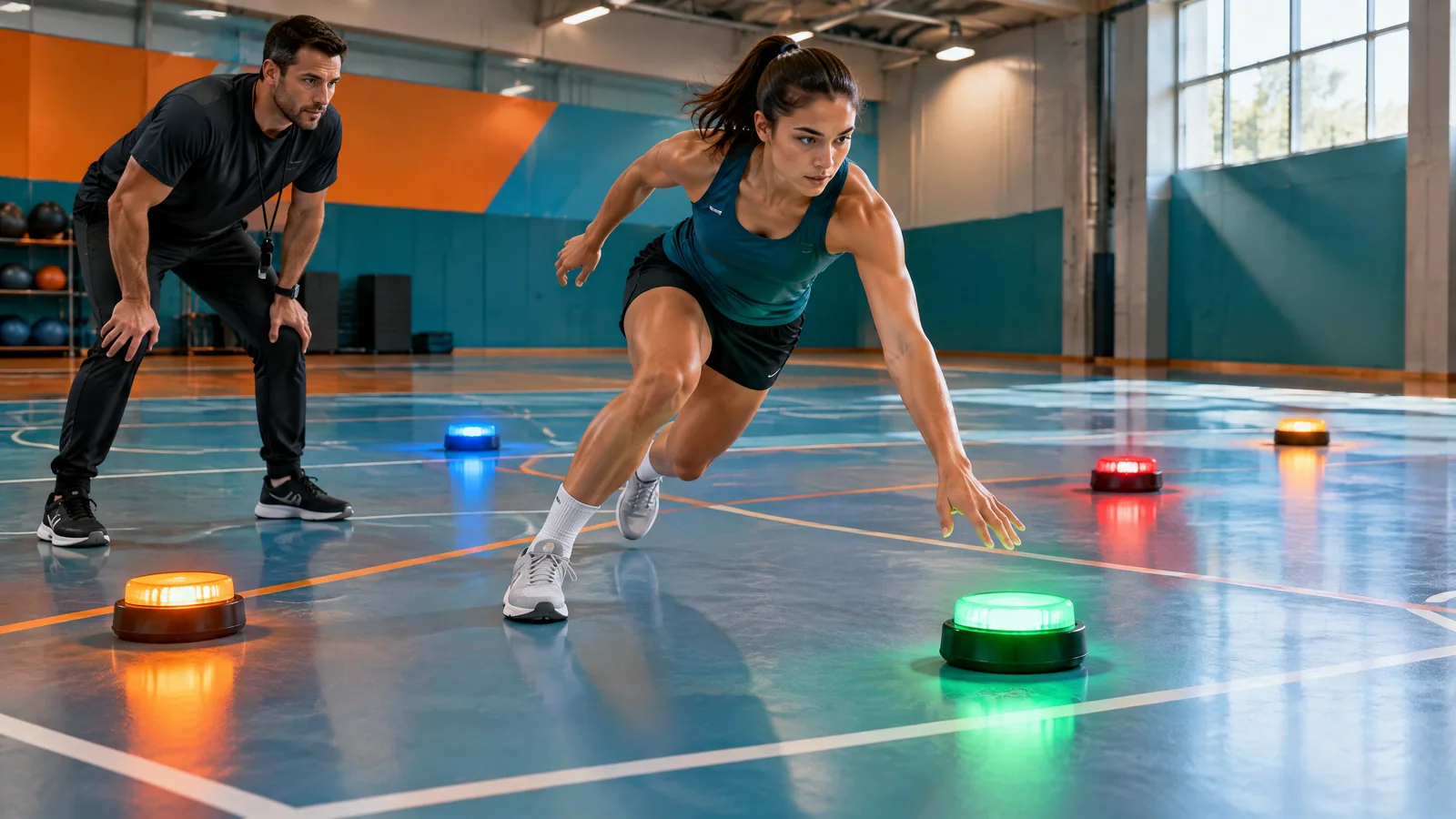
Reaction lights and reaction training pods are signal devices placed on a surface, wall or in the hand. Labels such as hand eye coordination light or reflex trainer light describe the cue device, not a diagnostic tool. A system can randomise which light appears, timestamp the cue and record when a permitted touch or movement is registered. Random timing limits sequence memorisation, but placement, distance, response rule, fatigue and system timing still affect a score.
Hypothetical calculation: if a light appears at 0.000 seconds and the system logs a valid touch at 0.410 seconds, the recorded cue-to-touch time is 410 milliseconds. That number includes detection, choice, movement and device registration. It is not a direct measurement of a person’s brain speed, nor does it show why a response was late. Repeated, comparable task scores are one observation; performance technology in sports likewise needs context before it informs a decision.
Planned direction changes are different from reactive agility
A planned change-of-direction drill tells the athlete where to run before the start. It can reveal braking, turning and re-acceleration under that defined route. Reactive agility adds an uncertain cue: the athlete must perceive it, decide and then move. A reactive agility light can provide the cue, while a live opponent or video can add richer sport information.
Neither version is automatically more valuable. The right question is whether the cue and response resemble the decision being examined. A tennis player responding to an opponent’s shoulder and racquet may need a different task from a goalkeeper responding to a ball trajectory. Wearable measurements can add a separate movement record in a change-of-direction session; our guide to inertial data for change-of-direction drills covers that measurement problem rather than light training itself.
Make the cue and response meaningful
A useful sports reaction drill connects three things: information an athlete actually encounters, a choice that matters, and an observable response. Consider a hypothetical football practice scenario. A coloured light could tell a player which of two gates to move toward, producing a repeatable cue-response task. It becomes more sport-like if the final direction is instead determined by a teammate’s pass or an opponent’s movement, but it also becomes harder to standardise. Each can be useful when its purpose is clear.
Cognitive reaction training is a broad label, not proof of “game intelligence.” A simple signal is useful for learning a setup or monitoring a constrained task. More representative cues introduce more variation. Record the task rule, cue, response definition and conditions when comparing sessions. For the wider device landscape, see smart training equipment in sports, rather than assuming a light system is a complete training solution.
Check transfer instead of assuming it
A faster score on the same light layout may show that someone has improved at that layout. It does not by itself establish a faster first step in competition, a better defensive choice or more successful plays. A practical evaluation separates the practice measure from a sport-relevant observation. For example, a team might compare a clearly defined light-task score with a separately coded small-sided-game decision outcome across the same period. If only the light score changes, the honest conclusion is task improvement.
The research supports this caution. In a 2022 randomized trial, Horváth and colleagues found improvements on some cognitive and reactive-agility measures after six weeks of light-stimulus training in 24 car-racing drivers. That specialised result cannot prove a benefit in every sport. In a 2022 youth-soccer study, Trecroci and colleagues documented BlazePod light sensors in the intervention, yet found no statistically significant between-group difference for most measures after six months. BlazePod is an attributed study example here, not a product recommendation.
What the broader evidence says
Zhu and colleagues’ 2024 systematic review and meta-analysis found perceptual-cognitive training gains were larger on task-specific measures than on-court transfer measures. In other words, practice can improve the practiced response more reliably than it improves a complex game outcome. Sport-specific stimuli and action responses make practice more representative.
A 2026 systematic review by Li and colleagues also found favourable pooled effects of speed, agility and quickness training for several outcomes, but the result for reactive agility was not statistically significant. Certainty was low or very low for key outcomes, and long-term retention and match transfer were unclear. That makes precise claims essential.
Sources
The evidence summary above draws on Horváth et al., Sports Medicine - Open (2022); Trecroci et al., Sensors (2022); Zhu et al., Behavioral Sciences (2024); and Li et al., Frontiers in Physiology (2026). These are named here for attribution; their full URLs, publication dates and claim support are retained in the article metadata and private research log.