A smart training sensor may look like one invention, yet its patent records can appear in several countries and under different names. Here’s how to research sports-tech patents in India and Asia without mistaking repeated filings for separate innovations.
Why a search-result total is not a sports-tech innovation total
A search-result total is a starting point, not a measure of sports-tech innovation. One inventive work can generate a PCT publication, national applications and grants; a search can also retrieve documents that mention sport without claiming a sport-specific function.
Begin with a question that can be answered consistently: Which published patent families with a material sport-specific function have an Indian filing or applicant-origin link, using a stated search date and scope codebook? This asks about disclosed records, not market size, commercial success or products in use.
Treat “Asia” as a geographic description, not a single patent system. A country panel is useful only after the same method is applied to every named jurisdiction. Adding national totals into one regional number can hide different coverage and repeat families.
This is research guidance, not legal advice. A public record does not establish legal validity or freedom to operate. Check formal status with the relevant office; seek advice for case-specific questions.
For the broader meaning of the technology, start with our definition of sports technology. This guide narrows that broad topic into a repeatable records-review method.
Define sports technology before searching for patents
Use a functional rule, not a loose keyword. For this guide, a candidate belongs in the core set only when its abstract or claims show that its central function supports sport being played, trained for, measured, officiated, operated, broadcast or accessed.
A sport-specific racket sensor, electronic timing method, player-tracking workflow or officiating tool may be core candidates if the record supports that role. A general camera, textile, network or machine-learning method is not automatically sports technology. Keep it as an adjacent record only when the document makes the sporting function material. Exclude an incidental mention when sport appears only in background text, a possible use or marketing language.
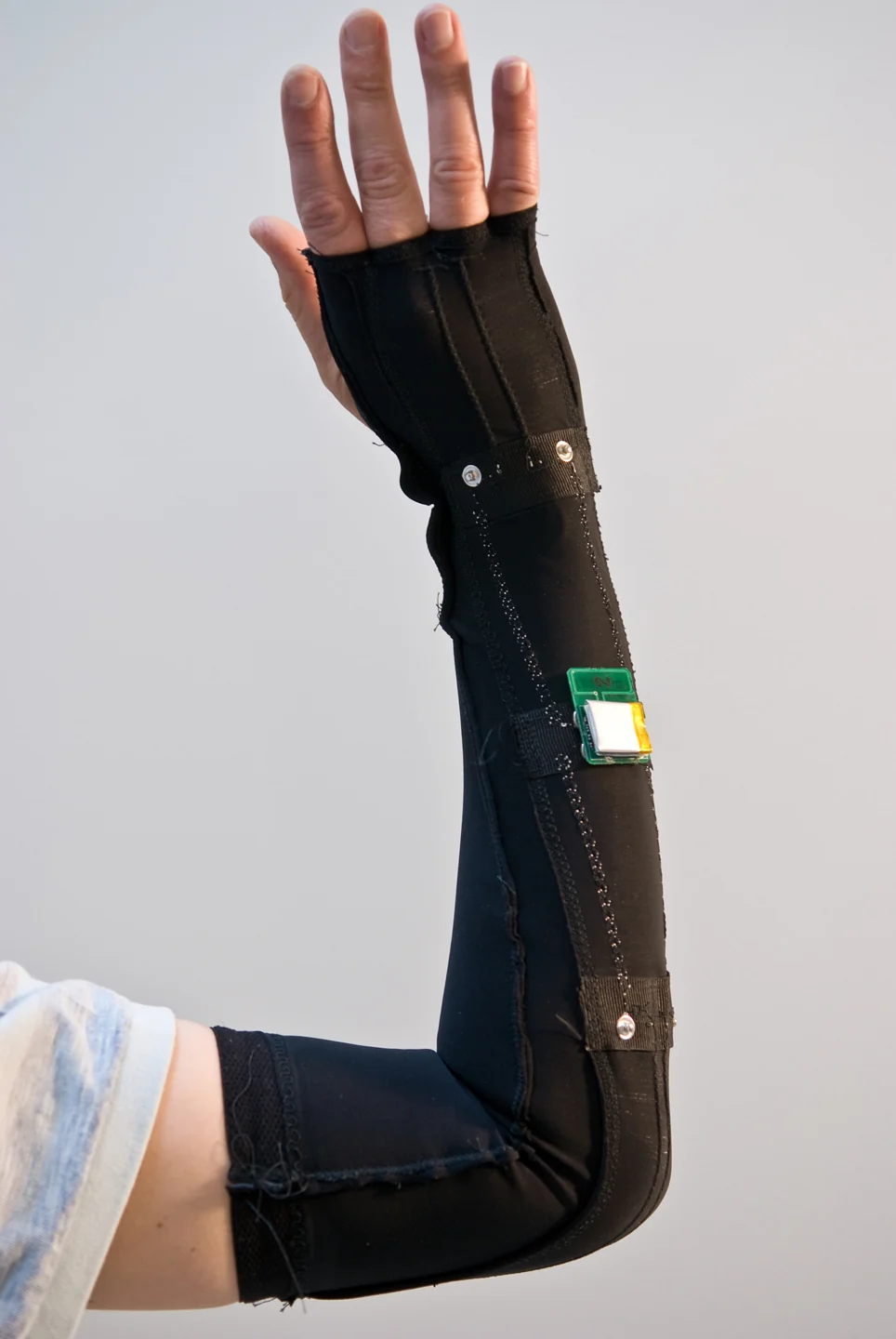
Illustrative historical wearable example only: CSIRO’s wearable body-mapping sleeve, photographed in Australia in 2008. It is not evidence of India or Asia patent activity, a patent’s status, current deployment, endorsement or a sporting outcome. Photo: [Nick Pitsas/CSIRO] [6], CC BY 3.0; adapted to WebP for this page.
The International Patent Classification (IPC) is a hierarchical, language-independent system for patent and utility-model classification. It can help create search seeds, but it does not supply a universal “sports-tech” category. Review the current hierarchy before treating an IPC code as a relevant filter.[3]
Write the inclusion reason beside every record. Useful categories include equipment and materials, wearable sensing, biomechanics and training, computer vision and tracking, timing and officiating, analytics and software, and venue or broadcast operations. Compare a candidate’s stated function with how wearable technology in sports works or what computer vision in sports can measure, rather than assuming that any sensor or camera belongs in scope.
Patent family, application, publication and grant: choose one unit
Choose one unit before you calculate anything. A patent application is a filing in a named office or procedure. A grant is an office decision and commonly reflects applications from earlier periods. A published patent document is a public record; it is not automatically a live, granted right.
A patent family groups related applications linked by priority and related procedures. WIPO’s family indicators use first-filing logic: the first filing starts a family, and later filings are added to it.[2] A family is often the better unit for describing a defined set of disclosed inventive activity because it reduces repeated filings, but it does not prove protection in every country where family members appear.
Log the earliest priority, named-office filing, PCT filing where relevant, publication, grant and status-check dates. Use one date basis throughout a time series. Filing-year applications and grant-year decisions are not the same annual cohort.
Hypothetical family record — example only, not a numbered patent filing: A reviewer links three candidate documents to an in-house family key after checking their stated priority relationship. The family sheet retains one earliest-priority year and links to each document row. A separate India row records its India filing date and the date its official status was checked. The reviewer counts one family in a family series, not three search hits.
How to search sports-tech patents in India with InPASS
For an India-first study, freeze the scope and period. Build a synonym bundle instead of relying on “sports technology patents” alone: sport*, named sports, athlete, player, ball, racket, cricket, training, wearable, motion capture, tracking, electronic timing and sport-specific officiating language. Add documented IPC seeds only after checking the classification.[3]
India’s Patent Office directs public-search users to InPASS and PATENTSCOPE, and provides an official application-status route.[4] Use InPASS for the India record check: search name variants and suitable title, abstract or claims terms, then open the individual record. Capture the URL, identifiers, applicant, dates, IPCs, documents and retrieval date.
The phrase “how to search patents in India” should include a status step. A search hit can be a useful candidate, but it is not a statement that a right is active or enforceable. Check formal status in the relevant office record as close as practical to the reporting date, and record exactly what was checked.
Hypothetical search record — example only, not a search result: On 17 October 2026, a reviewer searches a documented title-and-abstract term bundle in InPASS, then tests an applicant-name variation. The log records the exact terms, fields, filters, database, result-page date and why one reviewed document is coded “adjacent” rather than “core.” It reports no total until every retained candidate has been reviewed.
How to use WIPO PATENTSCOPE for international and family research
WIPO PATENTSCOPE covers published PCT applications and participating national and regional collections, including India. Its guide documents searchable front-page, full-text, English-text, ID/number, IPC, name and date fields, plus advanced search and family-information options.[1]
Use PATENTSCOPE to build an international candidate set and trace cross-border context. Save the query, fields, language, date filters, collection coverage, retrieval date and export. For each candidate, log publication details, applicants, inventors, stated priorities, IPCs, filing route and available family links.
PATENTSCOPE is not an exhaustive, Asia-wide register of current live rights. It is also not a substitute for checking a national office record when the question is whether a particular application or grant has a stated status in that jurisdiction. Keep that boundary visible in any public-facing comparison.
For readers mapping the technical terms in candidate abstracts, our motion-capture guide and AI video-analysis guide can help distinguish a claimed system description from a claim of real-world performance.
Compare India with selected Asian jurisdictions without double counting
A sound comparison names the jurisdictions, office-or-origin basis, date window, source coverage and counting unit before presenting a chart. “By office” asks where an application was filed. “By origin” asks about an applicant residence basis. Those are different reporting views, so do not merge them into one sentence or total.[2]
For a family view, keep a document sheet and a family sheet. Preserve every retrieved record; in the family sheet, select the identifier or transparent in-house key and the first filing under the frozen rule. Retain the links showing how documents were grouped.
Use a sensitivity view for adjacent technology. A comparison can show a core-only set and a separately labelled core-plus-adjacent set if both are useful, but it should never quietly change the scope to make a country look larger or smaller. A generic “Asia” league table should wait unless each named jurisdiction has comparable coverage, an identical date range, the same scope codebook and the same family de-duplication method.
Build an auditable dataset before describing change over time
The minimum fields are practical rather than glamorous: document ID; family ID or in-house key; title; country or office; earliest priority date; India filing date; publication and grant dates; applicant; inventors; IPC; source URL; status-check date; scope tier; category; inclusion or exclusion reason; reviewer; and notes.
Preserve raw exports or screenshots in a dated folder. Run duplicate and missing-date checks. Have another reviewer inspect included, excluded and borderline records. Keep an exclusion log; unexplained omissions are hard to audit.
Recent years need care. WIPO notes that family and technology indicators can change when underlying data are refreshed and may carry a lag of up to three years.[2] Mark the latest period as provisional if a family series could still be incomplete. Re-run the saved queries on a stated refresh date instead of quietly replacing the earlier extract.
Only then calculate. Put the unit, geography, date basis, query version, retrieval date, scope rule, family rule and exclusions beside every figure. Describe a defined record set, not market share, adoption, economic value or a forecast. Clear inputs and limits—also central to sports analytics—make a patent comparison more trustworthy.
What patent records can—and cannot—tell a sports-tech reader
Patent records can help map published technical disclosures within a stated method. They can reveal how a researcher classified functions, which filings were linked into a family and where office or applicant-origin views differ.
They cannot, by themselves, prove that a product exists, works in sport, was deployed, improved performance, owns a market, remains valid or can be used without infringing another right. A published application is not product evidence; a grant is not a claim about commercial success; and a family link is not a country-by-country legal-status conclusion.
State the scope before the result and keep the status check with the record. That makes a method reproducible and prevents a database search becoming a claim it cannot support.
Frequently asked questions
How can I find sports technology patents in India?
Define the sport-specific function first, search a documented synonym and classification set, review individual InPASS records, and log why each candidate is included or excluded. Use PATENTSCOPE to find relevant PCT and participating collection records, then verify India-specific details in the official India record.[1] [4]
What is the difference between a patent family and an application?
An application is one filing in a particular procedure or office. A patent family groups related applications through priority and related procedures. Count applications for office filing activity; count a defined first-filing family for a less repetitive inventive-activity view.[2]
Why cannot I add patents from several Asian countries?
You can compare selected countries only after standardising source coverage, geography, date basis, scope and de-duplication. Adding raw results across offices may count the same family more than once and may compare unlike database coverage.
Does a published patent application mean a product is protected?
No. Publication makes a document public; it does not by itself establish a current, enforceable right or that a product is on the market. Check formal status with the relevant office and obtain appropriate legal advice for a case-specific decision.
A reproducible next step
Start with a small, named panel rather than an all-Asia claim. Save the question, codebook and queries before the first search; preserve candidate and exclusion records; then publish only what the reviewed dataset can support. For the wider systems those records may describe, see the Sports Technology Guide.