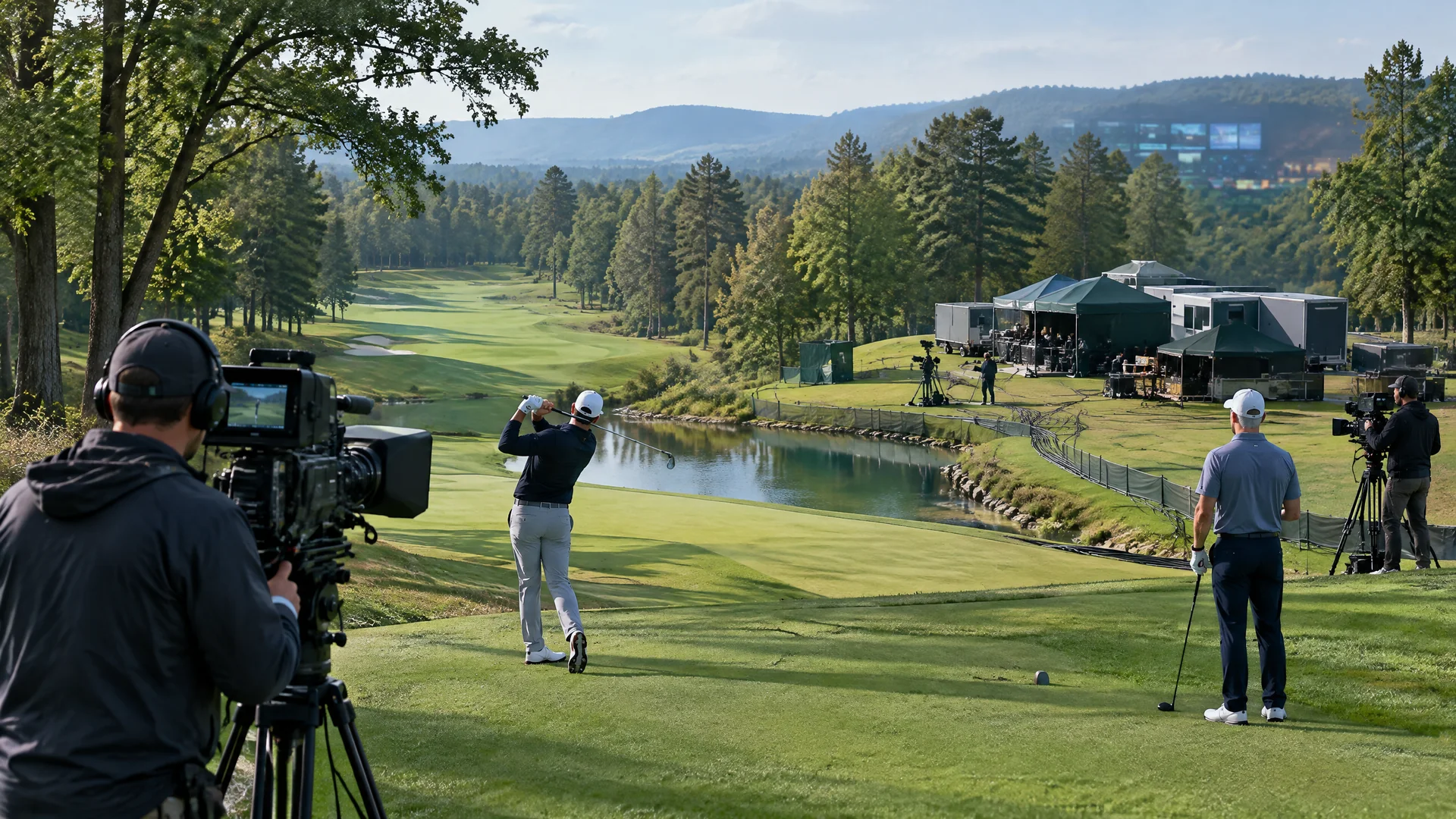
The event moved to a 1080p HDR workflow
The 2026 Presidents Cup was produced in 1080p HDR for the first time, according to the event operations account. NBC Sports handled the domestic program from an on-site compound at Medinah Country Club, while the PGA TOUR produced the international world feed from PGA TOUR Studios in Ponte Vedra Beach, Florida. The two operations shared much of the same source material but did not create one universal program. They made separate editorial decisions for different audiences. That split is the most useful part of the case: a modern live production can centralize selected roles and signals without collapsing every output into the same control room or presentation.
Medinah required a fresh course plan
Medinah is not a permanently pre-cabled television venue, so the production could not rely on a fixed broadcast network already waiting under the course. The match-play layout also differed from the 2012 Ryder Cup, including the placement of the finishing hole. Those changes affected where camera positions, cable routes, commentary locations and field operations needed to sit. Production planning therefore began with geography rather than a generic equipment list. A golf course stretches the signal path across trees, spectators and changing lines of play. The team had to create a temporary system that could follow several matches while preserving safe movement and predictable access. SportyTechs' sports broadcasting technology guide explains why capture is only the first stage; the physical route from each position to the production system is equally important.
Higher-density fibre carries more signals
NBC used higher-density TAC-24 and TAC-48 tactical fibre in the course build. Compared with smaller multi-strand assemblies, those cables can carry more paths through one planned route and reduce the number of separate runs needed between concentration points. The report does not publish a complete signal map, fibre distance or redundancy design, so the architecture should not be overstated. What it does establish is that the temporary course network was designed around dense fibre and wireless RF paths rather than a permanent venue backbone. The broader principle matches SportyTechs' analysis of remote production without losing venue control: remote capability depends on disciplined local routing, documented handoffs and a fallback when a field path fails.
More than 50 cameras cover a moving event
The source reports ten RF cameras and roughly forty hard or wired cameras across the course, plus two drones, including one used for shot tracing. That scale reflects the structure of match-play golf. Several pairings move simultaneously, and the editorial centre of attention can change with each shot. Wireless cameras provide mobility, while fixed and cabled positions offer repeatable coverage at key holes and compounds. Drones add geographic context and tracing support, but the report does not specify aircraft models, camera specifications, RF frequencies or how every trace is generated. Camera count alone is not a quality metric. The operating question is whether directors can find the relevant match, maintain orientation and recover when a position or path is unavailable.
NBC keeps domestic production on site
NBC's domestic show was based in NEP Group's SS54 mobile unit at Medinah. Keeping the main domestic control room on site places core production staff close to venue operations, talent and the physical course build. It can also simplify communication when weather, crowd movement or match timing changes the plan. The source describes a substantial compound and extensive shared resources, but it does not publish truck redundancy, staffing totals, power design or incident records. The on-site decision should therefore be read as an operating choice, not proof that local control is always superior. In other events, available connectivity, facility schedules or rights requirements may support a different balance.
The international feed is produced remotely
The PGA TOUR created the world feed from its studios in Florida. The named team included a five-person front bench, four-person graphics group, one ShotLink researcher, a three-person replay team and an audio mixer, with studio talent, walking commentators and unilateral camera operators supporting the program. The world feed was intended for distribution across 229 countries and territories in 26 languages. Those figures describe distribution scope supplied by the PGA TOUR source. They do not show simultaneous audience size, language-by-language staffing or the performance of every receiving broadcaster. Remote production here means that core international switching, replay, graphics and audio decisions were made away from Medinah while essential capture and commentary roles remained connected to the venue.
One camera pool supports two editorial products
The international operation could view NBC's program, cameras, replay and graphics sources while making its own selections. It also replaced domestic commercials and on-camera presentation with international elements. Sharing the source pool avoids rebuilding every capture position, yet the separate control room preserves a distinct editorial product. That distinction matters for rights holders considering centralized production. Signal access does not remove the need for scheduling, permissions, metadata, talkback, timing and a clear owner for each output. The prior SportyTechs analysis of ESPN's 4K HDR delivery workflow similarly separates the format reaching viewers from the decisions made inside production. The Presidents Cup adds a golf-specific example of shared acquisition serving two programs.
What the report does not establish
The operating account confirms 1080p HDR, a temporary high-density fibre build, a large camera plan and a split on-site/remote production model. It does not publish objective comparisons with the previous event, end-to-end latency, HDR monitoring tests, fault rates, recovery times, cost changes, energy use or audience response. It would be wrong to convert the format change into an automatic picture-quality claim or the remote world feed into a savings claim. A useful post-event review would compare planned and actual cable routes, RF coverage, missed shots, signal faults, replay availability, communication delays and workload in both control rooms. It should also ask whether international production had enough context to make independent choices when several matches changed at once. The strongest lesson is architectural: course design, temporary connectivity and audience-specific editorial control must be planned together.