A detailed report, not a verified opening-night result
Sports Video Group published its detailed account of ESPN’s 2026 Monday Night Football operation on 14 September at 16:21:43 UTC, or 21:51:43 IST. That report is the accountable development here. The opening game began after the research window used to assess it, so the record supports a pre-game account of a planned and continuing workflow, not a claim that the first production ran successfully.
The useful distinction is between components ESPN described as established, new, selective, or still to be tested. That boundary matters because a large weekly broadcast can change an integration point or distribution layer without becoming a wholly redesigned end-to-end production. For a wider primer on the production stack around live sport, see sports broadcasting technology.
The established Flagship base remains onsite
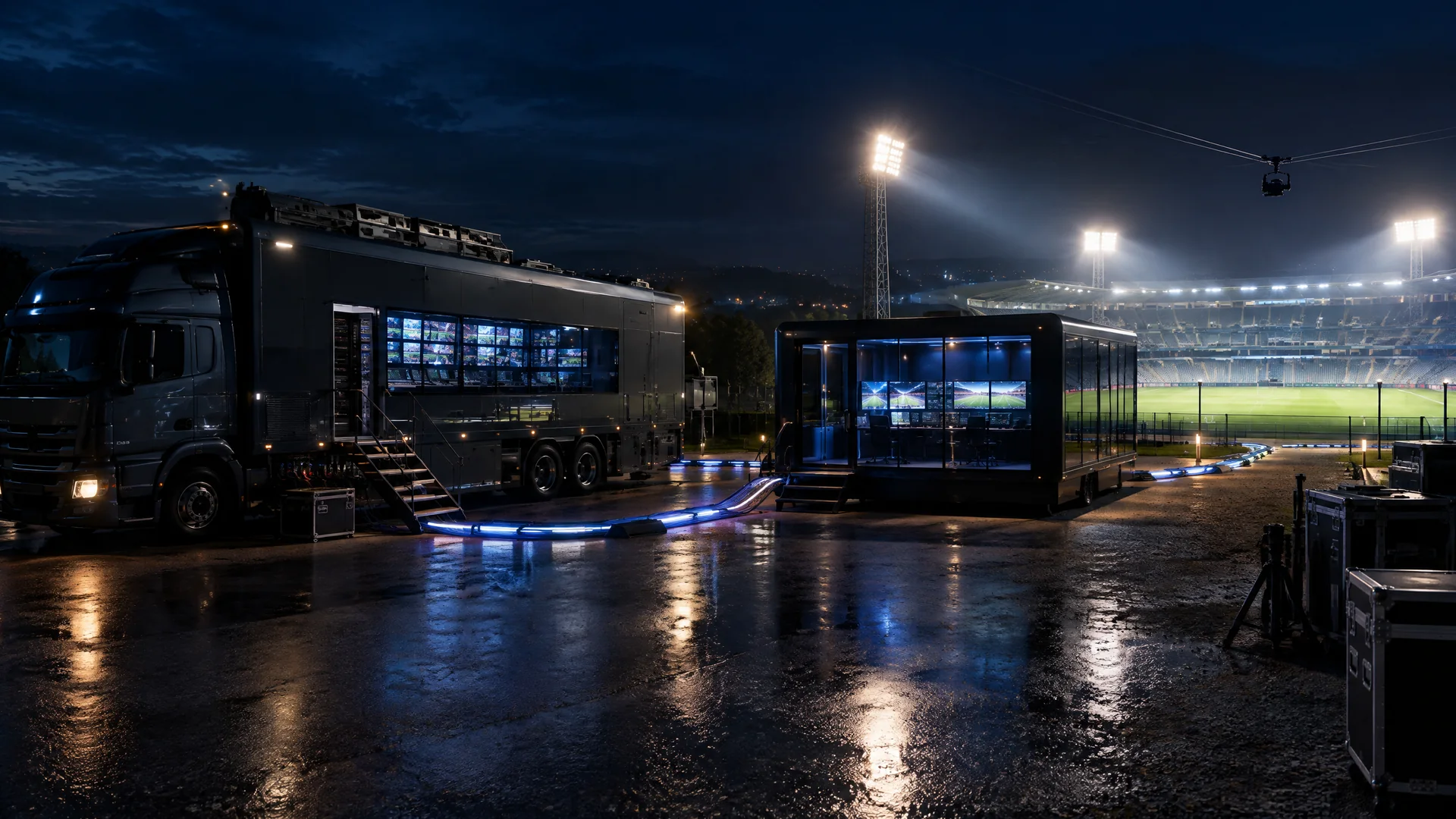
Game Creek Video’s Flagship fleet entered its second year as the foundation of the weekly game operation. ESPN described the primary game as a full onsite truck production, with support from central operations. The fleet itself is therefore not a 2026 debut, and the source does not describe its existing role as being replaced by a remote-only model.
That distinction helps separate this account from a general move toward facility-based workflows. A truck-centred production can still exchange signals, communications and operational responsibility with teams elsewhere. The relevant question is which hand-offs are introduced or changed, rather than whether a single production location determines the whole workflow. The context for that stadium-to-production transition is explored in IP broadcast systems.
Countdown adds a new coordination point
The new mobile unit for Monday Night Countdown is stated to integrate with Flagship. That is the material 2026 addition: a coordination boundary across a broad Monday programming footprint, not evidence of a measured efficiency gain. Integration requires the game and studio sides to align programme timing, shared resources, signal paths and editorial decisions while retaining clear ownership for each output.
The report identifies the capability to integrate, but it does not establish how often the configuration will be used, how quickly it can be reconfigured, or whether it changes staffing levels. It also does not document a completed operational test. Treating the truck as an added hand-off, rather than a new network-wide architecture, keeps the claim within the reported scope.
Onsite, Bristol, home replay and REMI have different roles
ESPN’s described model combines an onsite primary-game operation with Bristol support, replay operators working from home, and REMI production for ancillary or shoulder programming. These are related production modes, but they are not interchangeable labels. The onsite truck remains the reported base for the game; Bristol provides central support; home-based replay places a defined task with operators away from the venue; and REMI is used for reported ancillary programming.
This mixed model makes explicit hand-offs more important than a simple onsite-versus-remote label suggests. Signal routing, talkback, replay control and programme timing must remain understandable across locations. Those are workflow considerations, not reported ESPN latency, cost, staffing or reliability outcomes. Remote production workflows within venue control offers additional context on the operating choices involved.
Camera additions are selective and further tests remain plans
ESPN described High SkyCam for selected games, alongside upgrades to pylon and line-to-gain cameras. It also identified a returning audio feature and further tests across the season. The wording is consequential: selected use is not a commitment that every game will carry High SkyCam, and a test is not proof of a permanent production standard.
The source provides no post-game evidence about which components appeared in a particular production, how they performed, or whether they will carry into a later event. Nor does it establish completed Super Bowl readiness. Existing coverage of CBS’s NFL HDR rollout addresses a different staged HDR-crew story; it should not be used to fill the gaps in ESPN’s camera plan.
4K HDR distribution is not the same as native capture
The account separates capture from delivery. ESPN’s onsite operation has produced 1080p HDR for multiple seasons, while the 2026 4K HDR change was described primarily as a distribution-side expansion, with some upgraded 4K cameras. A viewer-facing 4K HDR offering can depend on a distribution path even when every source in a production is not natively captured in 4K.
ESPN’s public announcement of the 4K HDR rollout was dated 8 September, rather than 14 September. The later specialist report supplies more detail on the MNF workflow around that change; it does not turn the earlier rollout into a 14 September launch. It also does not establish availability on every platform or delivery to every viewer. The event-specific Netflix MCG NFL IP-broadcast case concerns a different topology and does not demonstrate ESPN’s distribution outcomes.
A mixed workflow needs named operating controls
For broadcast and venue teams, the practical value of this account is a bounded list of controls to clarify as integrations are implemented. Teams need a named owner for incoming and outgoing signals, a common understanding of HDR and 4K format handling, dependable communications paths, and clear replay hand-offs. They also need platform-availability checks, monitoring points, exception escalation and a rollback owner if a new path cannot be used.
These are implementation questions, not documented ESPN results. They are especially relevant when a truck-based game, a studio unit, central support and remote operators contribute to a single programming footprint. The planned fibre-linked remote-set layout in Fox Sports’ Wembley Big Noon production is another distinct model, not evidence that ESPN has adopted the same arrangement.
What the current record does not establish
No dated post-game engineering account is available here to confirm actual use of each component, platform-by-platform 4K HDR availability, latency, reliability, failure recovery, cost, staffing effects or viewer outcomes. The record also does not show universal High SkyCam use, universal native 4K capture, or a completed opening-night validation within the research window.
A later update should require a dated engineering post-mortem or similarly accountable operational record. Until then, the most supportable account is narrow: ESPN details a new Countdown-truck integration, continued mixed production models, selective camera plans and a distribution-layer 4K HDR expansion around an established 1080p HDR onsite operation.