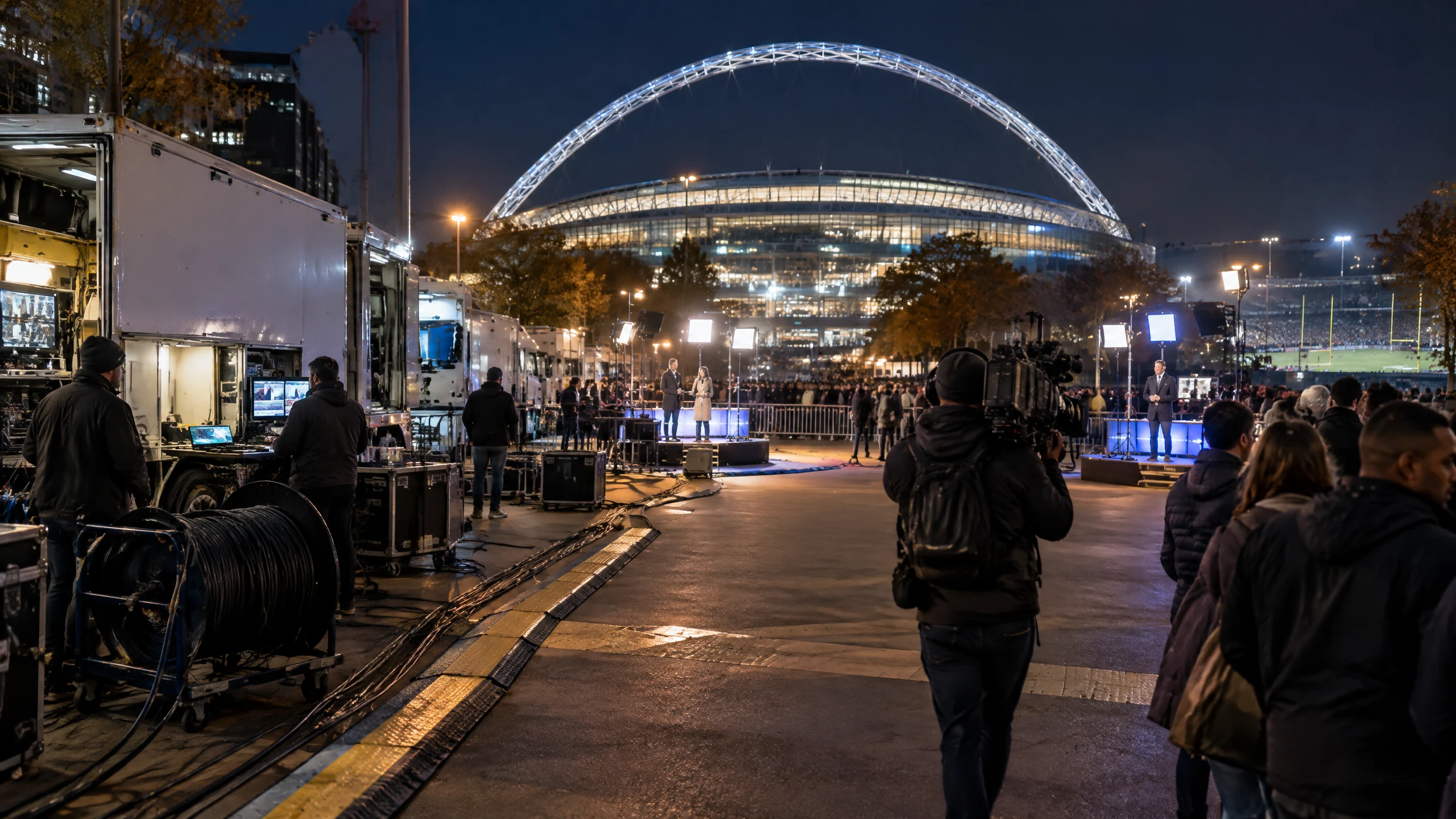
Fox Sports is planning a fibre-linked, semi-remote production arrangement for Big Noon Kickoff at Wembley Stadium on 19 September 2026, when the Kansas Jayhawks meet Arizona State in the Union Jack Classic. SVG Europe reports that the pre-game programme is expected to have a presence outside the stadium as part of the event-day presentation. The proposed approach keeps the outside-broadcast facilities in Wembley’s usual compound while extending production connectivity to two external set locations. This is a plan for a forthcoming event, not a completed result, and its operational effectiveness will only be testable during preparation and delivery.
The external footprint is planned around Samovar Square and Arena Square, both outside the stadium. Arena Square is expected to host a stage being built with NEP, with a Technocrane planned as another production element. The configuration distinguishes between the physical location of the production facilities and the places from which cameras and the public-facing presentation are intended to operate. Fibre is expected to connect the compound to the two sets, allowing the production to retain its core facilities at Wembley rather than positioning all technical functions beside each presentation area.
That layout puts compound-to-set paths at the centre of the operational plan. Production teams will need a defined view of each fibre route, including where paths enter and leave the compound, how they reach the squares, and which party owns each point of handover. Access arrangements are equally material: installation, testing, maintenance and any intervention during the show depend on routes that can be reached when required. The plan therefore creates a practical coordination task across venue operations, the production team and suppliers, particularly where set activity and public movement intersect. None of the available reporting discloses the network topology, capacity or redundancy designed for those paths.
The distinction between the compound and the two external sets also makes communications design a central question. Presenters, camera operators, stage teams and technical staff will require clear working relationships across separate locations, while the production must establish how communications are carried and monitored at each boundary. Operational planning needs to specify who can authorise changes, how issues are reported, and where escalation begins if a connection or an associated service requires attention. Those questions are not evidence of a problem; they are the normal ownership and decision-making considerations of a multi-location outside production.
SVG Europe reports that Big Noon Kickoff is expected to combine studio-style cameras with RF cameras roaming among the crowd. That camera mix is planned to support coverage beyond a fixed presentation desk. For the Wembley plan, the relevant operational issue is how RF camera positions, crew movement and access zones are coordinated around the two squares and the stadium approach. Frequency planning, camera routing, talkback and safe movement need to be treated as linked disciplines. The report does not disclose a camera count or spectrum plan, and it provides no basis to assume congestion-free RF performance in the live environment.
A split-site show also needs explicit camera hand-offs and recovery ownership. The compound and the two presentation areas have to agree which team controls each feed and communication path at a given moment, how an unexpected loss is identified, and who is authorised to switch to a contingency. A cable path, RF feed or talkback service can cross several operational boundaries before reaching the programme. The usefulness of the semi-remote design will therefore depend on the clarity of those boundaries as much as on the presence of fibre itself. The current account describes the intended arrangement but does not confirm that these coordination questions have been resolved.
Fox Sports is expected to have around 90 people working on the game, with about 35 travelling from the United States, according to SVG Europe. That planned staffing level gives scale to the logistical exercise without establishing an outcome. Semi-remote describes the intended separation and connection of the outside-broadcast facilities; it should not be read as a claim that the entire production will operate remotely. No public evidence yet establishes successful fibre operation, resilience, measured latency, RF reliability, picture quality, production cost, rights distribution, attendance, engagement or audience results. A meaningful follow-up requires separately timed post-event confirmation of what was actually deployed and how it performed.