The World Cup reaches your screen through more than match cameras: live production, tracking data and a central broadcast hub all have to work together. This FIFA World Cup 2026 case study follows that chain from the stadiums to Dallas and explains where connected-ball data, optical tracking and broadcast production fit.
That distinction makes this a useful World Cup broadcast technology case study rather than a catalogue of possible production tools. It covers the FIFA World Cup 2026, played across Canada, Mexico and the United States from 11 June to 19 July, and follows only what the supplied records attribute to FIFA, HBS or the named Lenovo/Lawo workflow. [1]
For the broader chain from cameras to viewer delivery, see our sports broadcasting technology guide. This article instead asks a tighter question: which 2026 systems are documented, who owned each layer, and what can a reader safely conclude from them?
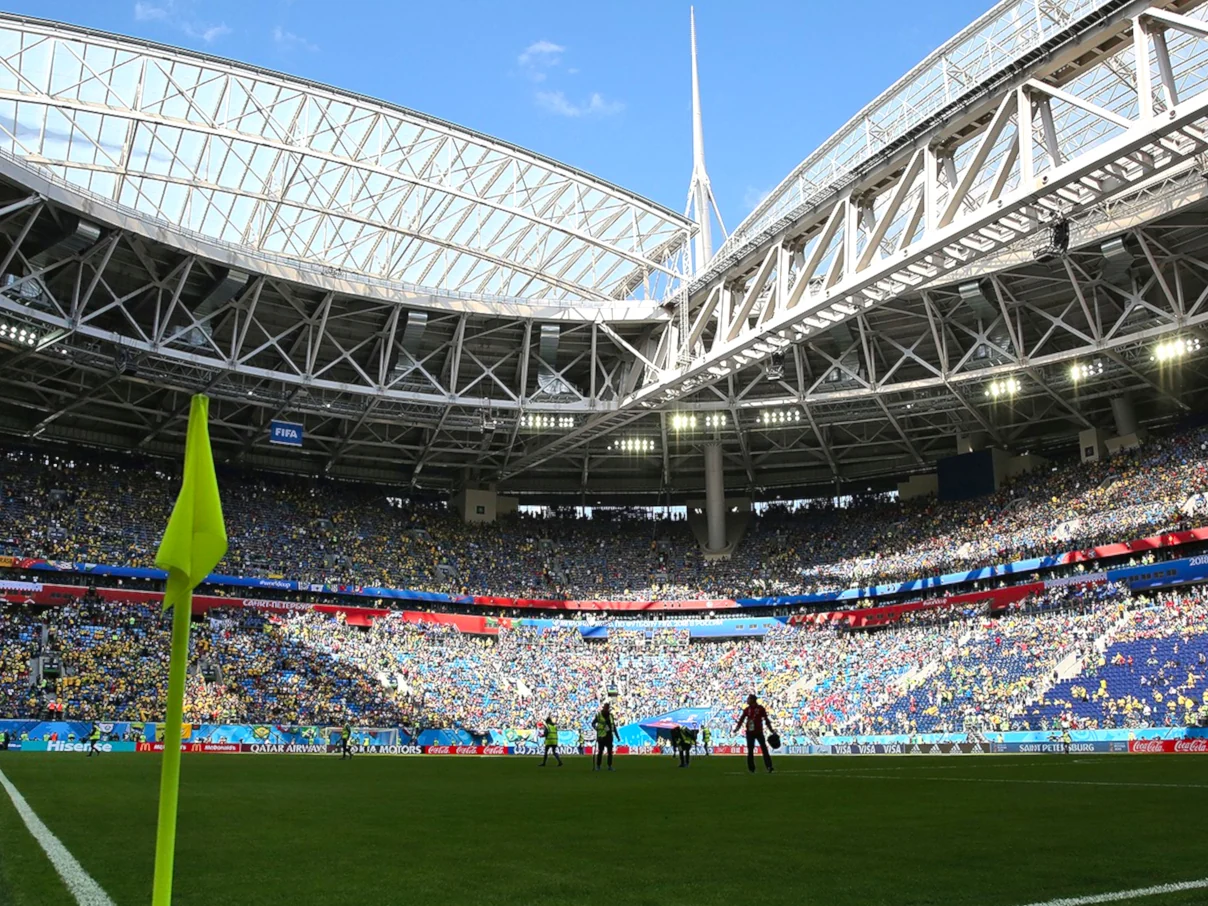
Illustrative only: Krestovsky Stadium during the 2018 FIFA World Cup, not the 2026 tournament or a verified 2026 technology installation. The original photograph was adapted as a WebP for this article. Credit: Cyril Venediktov via Wikimedia Commons, CC BY-SA 3.0. [6]
Which World Cup does this case study cover?
This case study is about the 2026 edition, not a generic “World Cup technology” stack. FIFA identifies the Kay Bailey Hutchison Convention Center in Dallas as a 45,000-square-metre International Broadcast Centre (IBC). It says the facility housed HBS, FIFA Media Partners, FIFA Video Content Production, FIFA Football Technology and Innovation, and the VAR room. [1]
The sources support three connected but different layers:
- FIFA/HBS host broadcast: the IBC and venue broadcast infrastructure, including camera positions, studios, the broadcast compound and media areas.
- FIFA officiating and data: optical tracking, the connected ball, Advanced semi-automated offside technology (SAOT), VAR access and 3D reconstructions used in defined checks.
- Broadcaster-specific production and distribution: local commentary, studio shows, graphics, accessibility choices, apps, streaming platforms and editorial selection.
The first two are documented here. The third is deliberately not filled in with guesses. A host feed or a FIFA data output can make a treatment possible; it does not show that a named outlet used it. That is also why this article should be read alongside, rather than as a replacement for, our guide to how live cricket streaming works: a delivery chain is general, while the consumer product remains provider-specific.
How the Dallas International Broadcast Centre connected the operation
The IBC was the documented coordination point, not proof of one uniform broadcast experience. FIFA says HBS was the host broadcaster and that broadcaster infrastructure was integrated into stadium projects. The record names camera positions, interview positions, mixed zones, studios, media tribunes, the broadcast compound and press-conference rooms. [1]
That establishes the physical and operational setting for a central host-broadcast operation. It does not establish the number of programme feeds a particular rights holder took, the cameras it chose for its own coverage, or the design of its on-air graphics.
A separate source adds a named technology-provider view. Lenovo’s 2026 case study says its ThinkSystem SR635 V3 servers, together with Lawo HOME Apps, supported real-time video processing, signal routing, FIFA IPTV and media workflows across the IBC. [4] Treat that precisely: it is a vendor account of a specified workflow with HBS and Lawo, not an independent specification of the complete HBS estate or every broadcaster’s equipment.
The timing figures also need their source boundaries. FIFA says ThinkSystem servers powered ten FIFA IPTV channels to more than 1,000 screens at FIFA venues and says latency inside that IPTV infrastructure was under five seconds. [1] Lenovo’s case study describes a reduction from approximately 40 seconds to five seconds. [4] Neither statement measures a fan’s TV, mobile or web-stream delay. Consumer distribution begins after other editorial, platform and network choices that these records do not describe.
For a different production model, our explanation of REMI sports broadcasting separates a remote role from an on-site role. The FIFA and Lenovo records reviewed here do not, on their own, prove an end-to-end REMI design for this tournament.
What was confirmed at the stadiums: optical tracking and connected-ball data
FIFA assigns the stadium tracking system first to competition data and officiating support, with defined routes into media outputs. It says 16 optical tracking cameras were installed in each of the 16 stadiums, producing more than 150 million tracking data points per match. FIFA says the data can recreate the match in 3D, make a feed available to VAR and support checks such as potential goalkeeper-view interference and whether the ball crossed the touchline before a goal. [2]
The same official account says media partners can use the data to show highlights or entire matches in 3D. That is a permission or capability in FIFA’s account—not evidence that a particular broadcaster aired a particular 3D replay in a named match. It also does not identify the tracking provider. Do not infer Hawk-Eye or SkeleTRACK deployment from the generic technology description; our Hawk-Eye ball and player tracking explainer covers the different tracking concepts without establishing a 2026 World Cup installation.
TRIONDA sits beside the camera system as another data input. FIFA says the 2026 official match ball contains a 500 Hz motion-sensor chip that sends real-time ball-movement data to the VAR system to support match officials, including on offside incidents. [3] Calling this connected ball technology is accurate. Calling it a generic broadcast sensor, a proof of a broadcaster’s graphics package, or evidence of a particular highlight feature is not.
The useful technical sequence is therefore simple: cameras and the ball capture information; FIFA systems use defined information for officiating and reconstruction; a viewer-facing 3D treatment or referee-camera clip is a presentation output. The presentation is not the decision itself. For a wider explanation of the camera-analysis layer, see computer vision in sports.
How Advanced SAOT became a broadcast explanation, not an automated referee
In 2026, FIFA describes Advanced SAOT as a limited automation for clear positional offsides. Unlike the Qatar 2022 workflow, where information went to VAR, FIFA says clear offsides can be sent directly to match officials on the pitch so assistant referees can flag positional offsides sooner. [2]
The scope matters as much as the speed claim. FIFA explicitly says the system does not determine interference in play for an offside-positioned player who does not touch the ball. Its 3D reconstruction can be available to VAR for that kind of question, such as whether an attacker blocked the goalkeeper’s view. [2]
Every participating player was to be 3D-scanned, with digital avatars incorporated into the system. FIFA says those avatars support officiating and make broadcast 3D replays more recognisable by showing players more like themselves. [2] The visual replay can explain a completed workflow to an audience. It is not a referee, and it does not prove that the graphic made the call.
It is tempting to carry over the familiar Qatar 2022 account that video match officials manually checked the kick point and offside line. Do not do that here as a universal description of 2026. The 2022 source documents that validation sequence for its own alert-to-video-officials workflow; the 2026 source instead defines direct alerts for clear positional offsides and explicitly leaves interference outside that automatic function. [2] [5]
For the rules and review roles around a decision, use our VAR technology guide. It is the better owner for how a check or review works; this case study is the edition-specific systems map.
TRIONDA in 2026 versus Al Rihla in Qatar 2022
The two editions share a 500 Hz ball-data figure, but they are not the same documented setup. The number alone does not prove identical camera configuration, alert routing, validation workflow or broadcast use.
| Element | FIFA World Cup 2026 | FIFA World Cup Qatar 2022 |
|---|---|---|
| Ball and data rate | TRIONDA; 500 Hz motion-sensor chip sends real-time data to VAR. [3] | Al Rihla; central IMU sensor sent ball data to the video operation room 500 times per second. [5] |
| Optical tracking record | 16 optical tracking cameras per stadium; FIFA says more than 150 million tracking data points per match. [2] | 12 dedicated roof-mounted cameras; up to 29 player data points at 50 times per second. [5] |
| Stated offside route | Clear positional offsides can go directly to match officials on the pitch; interference in play remains outside that function. [2] | Automated alert went to video match officials, who checked the selected kick point and created line before the referee was informed. [5] |
| Viewer-facing explanation | 3D player avatars can make broadcast 3D replays more recognisable. [2] | FIFA made a 3D animation available after the decision workflow to explain positional data. [5] |
The comparison is a guardrail, not a scorecard. FIFA’s 2022 release attaches the 12-camera, 29-point and 50 Hz details to Qatar, while its 2026 release attaches 16 optical cameras, player avatars and the new alert scope to 2026. [2] [5] A source-led account should keep those labels attached.
A similar caution applies to certification. A system’s certification record, where one exists, does not by itself prove it ran in a particular match. Our FIFA EPTS certification guide explains why a record and a deployment claim are different questions.
What the sources do not establish about broadcaster-specific tools
The reviewed records do not document an individual rightsholder’s complete production or distribution stack. They do not prove a named broadcaster used a particular AI highlight tool, virtual-graphics engine, automated-commentary product, app feature, home-stream latency, viewer number or cost saving.
This is not a minor editorial caveat. FIFA’s IBC article establishes shared infrastructure and host-broadcast coordination. Its innovation article describes data and possible media-partner 3D use. Lenovo describes an IBC processing and routing workflow involving its servers and Lawo HOME Apps. [1] [2] [4] None of those sources turns an enabling layer into evidence of a specific broadcaster decision.
The same boundary protects readers from another common leap: a higher-quality referee-camera perspective does not show that every clip was live, that every outlet carried it, or that it appeared in a named match sequence. FIFA says Lenovo-developed software reduced motion blur in referee-camera footage and describes the result as a first-person perspective for audiences. [1] [2] That is the supported claim.
The practical lesson from the 2026 system map
The 2026 case is best understood as a layered operation with clear evidence boundaries. FIFA documents a Dallas-based host-broadcast hub around HBS, a separate competition-data and officiating layer, and selected audience-facing explanations. Lenovo documents a named IBC infrastructure case study with Lawo. Those are useful facts precisely because they do not pretend to answer every broadcaster-specific question. [1] [2] [4]
When reading a World Cup technology claim, use four checks:
- Name the edition. A 2022 configuration is historical context, not proof of a 2026 configuration.
- Name the owner. Is the claim about FIFA/HBS host broadcast, FIFA officiating and data, a vendor case study, or a specific broadcaster?
- Name the job. Does the system capture, process, route, assist an officiating workflow, visualise an outcome or distribute a programme?
- Ask for deployment evidence. A capability or planned output is not proof of use by a named outlet or in a named match.
That method keeps the technology understandable without turning an IBC, a data feed or a replay into more than the source supports. It also makes room for future reporting: a broadcaster-specific claim can be added when that broadcaster or a primary production source documents it.
Sources
- [1] FIFA World Cup 2026 International Broadcast Centre opens in Dallas
- [2] Faster offside decisions, more stable referee body cams and more analysis opportunities for teams
- [3] The FIFA World Cup 26's Official Match Ball: TRIONDA
- [4] Broadcasting the Beautiful Game — with HBS and Lawo
- [5] Semi-automated offside technology to be used at FIFA World Cup 2022
- [6] Krestovsky Stadium, 2018 FIFA World Cup