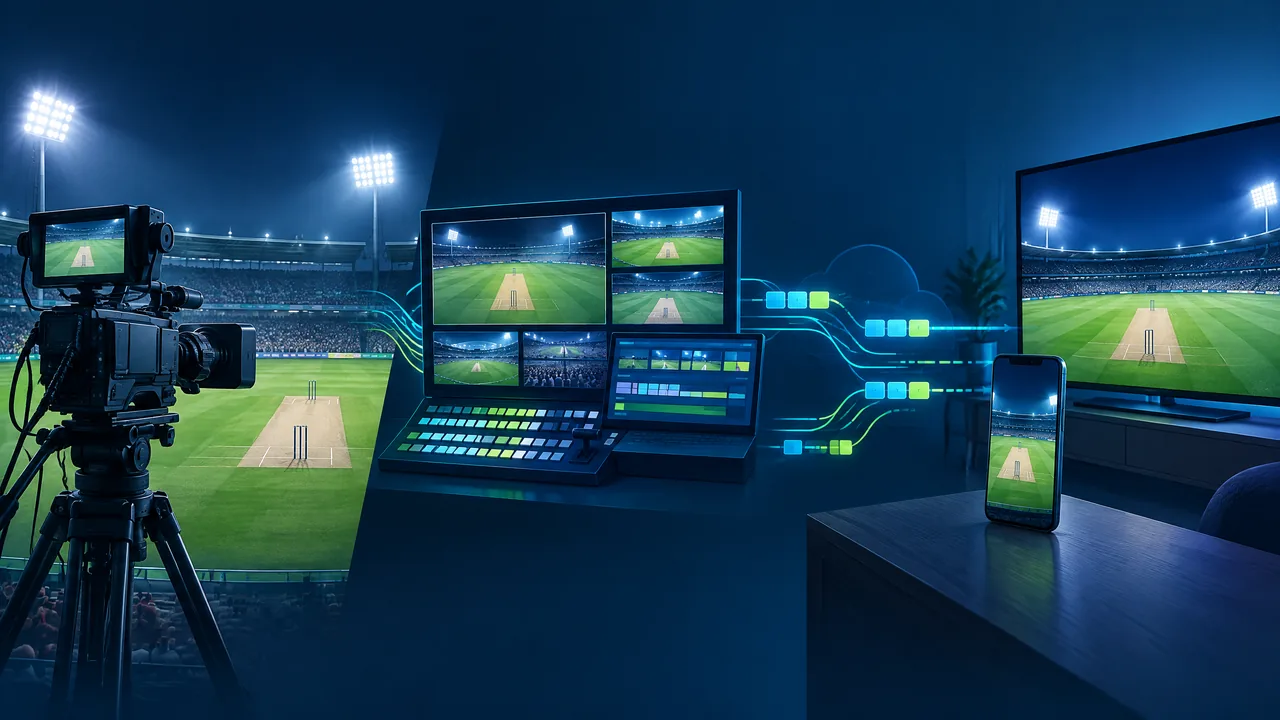
Start at the ground: pictures, sound and match information
A live cricket stream begins with more than a single camera pointed at the pitch. A host production can combine wide coverage of the field, tighter player angles, crowd and presentation shots, ambient microphones, commentary and the score data used on-screen. The director and vision team choose the programme shot while play is live; a replay team can prepare an earlier moment without replacing the live action until the producer calls for it. In cricket, the delivery, outcome, umpire signal, replay and revised score must make sense in sequence.
The scale is not universal. As one explicitly tournament-specific example, ICC TV announced that every match of the 2026 ICC Women’s T20 World Cup would use 35–41 cameras across seven venues, alongside a mobile-first vertical live stream. That announcement describes that World Cup only. It does not establish a camera count, vertical feed, replay system or production plan for an Asian Games fixture or any other cricket match. For the broader vocabulary of capture and production, see our sports broadcasting technology guide.
Contribution feed is not the same as the produced programme
A camera signal has to travel from the ground into the production workflow. In broadcast operations, contribution means moving source feeds or a high-quality programme feed between the venue and the people or facilities that need to make the show. The route is an operational detail that should not be guessed from a viewing app.
The produced feed is the editorially finished programme: selected pictures, mixed audio, commentary, graphics and replay decisions combined into one output. Some crews work at the ground; some workflows place parts of production at a remote hub. That division is often called remote integration or REMI, but REMI is a possible model, not a default for every stream. Our REMI sports broadcasting explainer shows why a camera can be at the stadium while some production roles are elsewhere.
Replays, scoring and graphics follow their own live workflow
The clean score bar on a cricket screen is the result of an operational hand-off, not merely a decorative overlay. Production staff receive and check scoring inputs, graphics operators update the programme display, and the producer decides when a statistic or lower-third should appear. A replay operator locates a useful recording, marks an in and out point, and readies it at the requested speed or angle. A replay can explain a wicket or boundary, but it is an editorial presentation device; it is not, by itself, evidence of an officiating review system or a particular tracking vendor.
A control room balances replay context against the risk of missing the next ball. For another perspective on replay preparation and remote production, read our WNBA replay-production article; its sport-specific examples should not be treated as a documented cricket configuration.
Encoding creates versions that different connections can play
Once the programme feed is ready for digital distribution, an encoder compresses it into a set of versions, often called a rendition ladder. The versions trade picture detail and data rate so a well-connected large screen can request a higher-quality version while a constrained mobile connection can request a lighter one. Audio and accessibility tracks may also be packaged.
Those files are then divided into short media pieces and described by a playlist or manifest. Apple’s HTTP Live Streaming overview explains the protocol at a general level: HLS uses ordinary HTTP servers and content delivery networks, and is designed to adapt playback to changing network conditions. This guide uses HLS to explain a common delivery pattern; it does not claim that Sony LIV, an Asian Games broadcaster or a named cricket service uses HLS.
Segments, CDNs and the player complete the delivery path
When a viewer presses play, the app or browser fetches the stream description and the current media pieces over HTTP. A content delivery network (CDN) can serve those pieces from infrastructure closer to the viewer than the production origin, reducing the load on one central location. The player monitors conditions and can move between available renditions as throughput changes. A downgrade in sharpness may therefore be adaptive playback protecting continuity, rather than proof that the match feed has changed.
A player also keeps a buffer of future media before showing it. The buffer smooths disruption but places the display behind the ground. The result is an end-to-end chain: capture, production, encoding, packaging, CDN delivery, player buffering and display. No named service’s exact chain can be inferred solely from its rights listing.
Why “live” has delay, and why lower delay has a trade-off
Every stage can add time: camera processing, directing, replay and graphics, encoding, segment availability, network travel and player buffering. Two people watching the same over may consequently see the wicket at different moments, especially if one uses linear television and the other uses an internet player. There is no meaningful universal number of seconds for live-cricket delay without measuring a specific feed and device.
Reducing delay generally means reducing how much content waits in the player buffer or how quickly delivery pieces become available. That can make the experience feel nearer to real time, but it leaves less room to absorb a slow connection, so stalls or quality switches can become more noticeable. Low latency is a design balance, not an automatic upgrade that every rights holder deploys. If the question is whether a particular India–Pakistan Asian Games listing is available in a region, our final viewing guide addresses that separate, time-sensitive question.
Rights, accessibility and a practical failure check
A technically healthy stream still may not be playable everywhere. Rights are commonly assigned by territory and platform; a service can require a subscription, account entitlement or location check before it returns playable media. Captioning, language options, audio description and vertical presentation are likewise service and event choices, not guaranteed features of every cricket stream.
If a stream fails, diagnose the layer before assuming the ground cameras are at fault. A widespread outage may be an app, entitlement, CDN or programme issue. A problem on one device can point to its connection, software or available bandwidth. Repeated buffering often prompts the player to choose a lower rendition; a long delay can be normal buffering rather than a missing feed. Check the provider’s current status and rights notice, then test another permitted connection. This is an evergreen workflow guide, not a live-service availability claim.