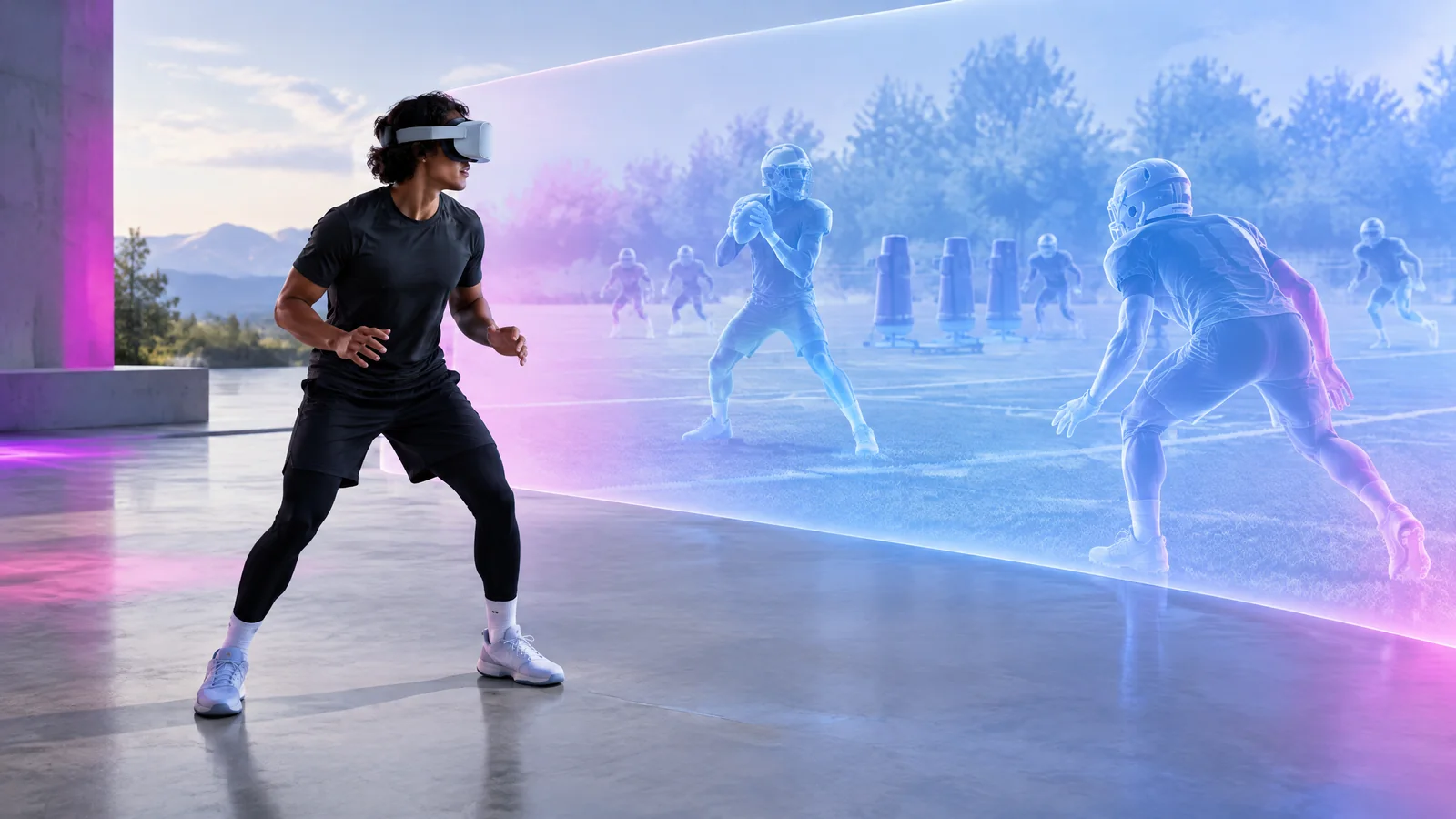
Virtual training environments in sport
A virtual training environment puts sport-relevant sights, sounds and choices into a digital scene. In virtual reality sports training, a headset may track head movement and a controller, hand tracker or sport attachment may register an input. The software then presents a scenario, records a defined response and may vary the next scenario. It is not one fixed technology: a VR sports simulator can be a visual decision task, a golf scene or a goalie read, depending on the system.
Its useful question is narrower than “can VR replace practice?” A coach, athlete or student can ask which cue and decision the virtual task represents, then decide whether that is worth rehearsing away from the field, court or rink. This guide sits within our sports science and training technology hub; it does not rate products or supply an individual programme.
From scenario to recorded response
A virtual scene is built from assets, rules and inputs. A baseball application might show a pitch release and ask the hitter to take or swing. A virtual reality goalie trainer might present a shooter, passing option and release point. In each case, the application has to define what counts as the correct response before it can calculate accuracy or timing.
The hardware does not automatically know every physical detail. Headsets commonly estimate headset and controller motion, but a particular system may not measure force, full-body mechanics, real ball contact, teammate communication or surface conditions. Those are different questions from the camera- and sensor-led methods explained in motion capture in sports. Read a score as a result within that application’s rules, not as a complete account of athletic ability.
What virtual practice can rehearse
A well-designed virtual athletic environment can repeat a perceptual task without needing a full team session. The target might be spotting an early visual cue, scanning choices, selecting a pass option or deciding whether to swing. Repetition lets an instructor hold one variable steady or change it deliberately: speed, viewing angle, number of options, or how long a cue remains visible. That is why VR baseball training is often framed around pitch recognition and swing decisions rather than a claim that a headset reproduces batting in full.
Current vendor examples show the range, not proof of outcomes. Sense Arena documents VR cognitive environments for hockey and tennis, while WIN Reality documents a baseball/softball product focused on pitch recognition and swing decisions. A virtual golf simulator or VR soccer simulator may use different equipment and rules again. Product documentation can establish a stated feature; it cannot by itself establish that users perform better in competition.
Why realism and transfer matter
A scene can look convincing while missing information that changes a real decision. An on-field player also responds to body position, physical effort, equipment feel, opponents, teammates and consequences that may be simplified in VR. The closer the cue, timing, choice and required movement are to the target task, the more sensible it is to test for transfer. It is still a test, not an assumption.
The 2025 Connolly review found that only six of 25 VR decision-making papers assessed real-world transfer. The 2023 Richlan review found promising intervention results but also major differences among sports, systems, protocols and participants. Together, those findings support using VR as a defined practice environment and checking the target sport separately, rather than calling every in-headset gain a match gain.
A hypothetical score, interpreted carefully
Hypothetical example: a virtual task presents 48 clearly defined passing scenarios. The learner selects the pre-defined option in 36 scenarios. The session’s scenario accuracy is 36 ÷ 48 × 100 = 75%. That number can help compare the same task on another day if the scenario set, scoring rule and response method are recorded.
It does not reveal why the other 12 choices differed, whether the learner saw every cue, or whether the same choices would work in a live game. A more difficult next block could have shorter viewing time or more options, but its percentage should not be compared casually with the easier block. For related ideas about defining and measuring a response, see reaction-time training in sport.
Build a transfer check around the real task
Start by naming one practical question: for example, can a player recognise a particular passing lane sooner, or can a hitter classify a pitch cue more consistently? Record the virtual measure and conditions. Then use a comparable, safely supervised on-field, court or practice observation selected by the coach or teacher. Compare like with like over time, and ask whether the intended cue and decision appeared there too.
This workflow makes the virtual measure one input, not a verdict. It also prevents a dashboard from hiding changes in scenario difficulty, setup or scoring logic. The broader performance technology in sports guide explains the same decision-first habit across other tools: choose the question before treating a measurement as an outcome.
Limits, comfort and responsible use
VR can be a supplement to sport practice, not a promise of transfer or a substitute for every physical component. Some people experience discomfort, disorientation or motion sickness in immersive systems; stop when that happens and follow the device’s safety guidance. Use a clear physical area and respect the system’s age, account and privacy settings.
Before adopting any virtual sports training tech, document the exact scenario, input device, scoring rule and intended decision. Ask what the system omits and what external observation would count as meaningful transfer. That clarity is more useful than a generic claim that an interactive sports simulator makes someone better.
Sources
Evidence and limits in this guide draw on Richlan et al. in *Frontiers in Psychology* (2023) and Connolly et al. in the *Journal of Sports Sciences* (2025). Current product examples are attributed to the official Sense Arena and WIN Reality documentation, checked 9 October 2026. These named sources support the explanations above; vendor material is not treated as independent proof of athletic outcomes.