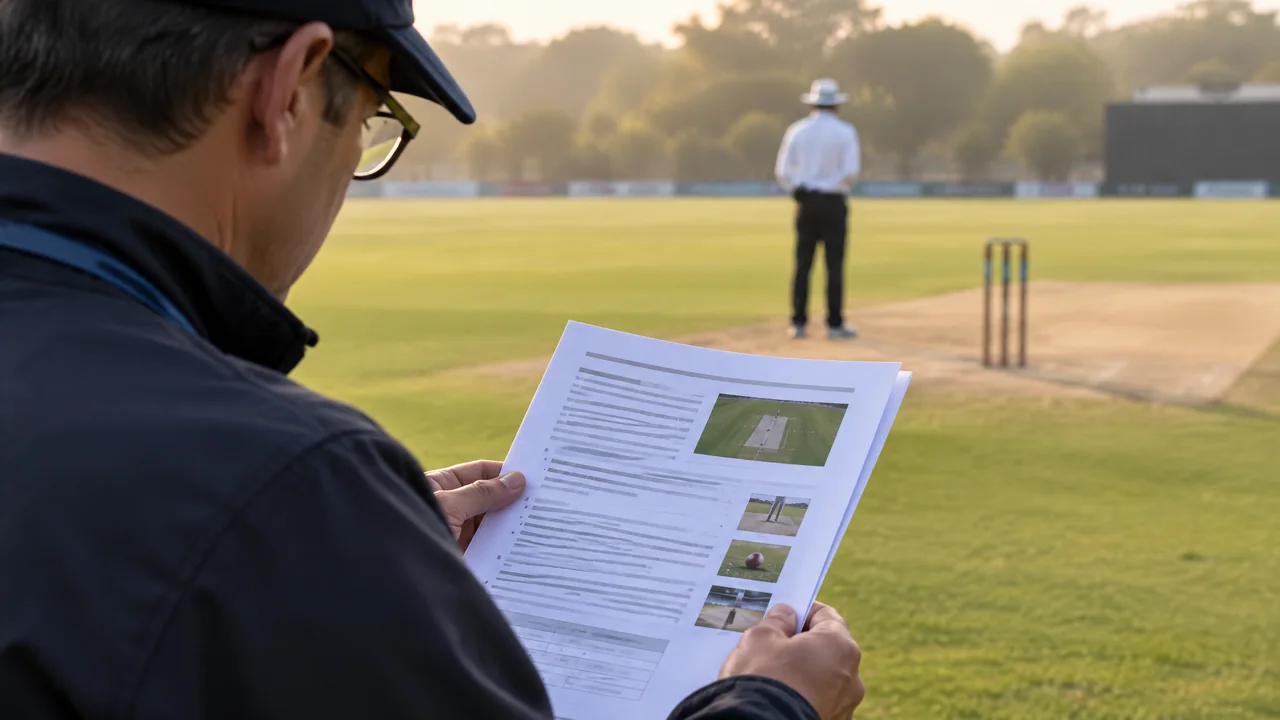
Start with the exact match identity
A TV umpire, replay or familiar-looking graphic is not enough to report that DRS was available. Establish whether Player Review was available for the specific competition, series or match—or accurately say the record does not confirm it.
Last checked: 6 October 2026.
Write down the teams, format, competition or series, date and venue before searching for review evidence. Use an organiser, governing-body or official fixture record. A shorthand match name can point to several games, while a playing-conditions document may apply only to one format, tournament or season. “DRS was available in the series” and “Player Review was available in this match” are different claims; do not turn series proof into match proof unless the document covers every match.
Read the competition playing conditions first
The International Cricket Council’s general DRS page distinguishes an Umpire Review, started by the on-field umpires, from a Player Review, requested by a player. It directs readers to each competition’s playing-condition appendices for the full third-umpire protocols. Start with the applicable competition document, not a generic explainer.
Look for the named competition, its effective date and the appendix or section covering the third umpire and DRS. An explicit provision that DRS will be used in all matches is strong rule-level evidence when the match is in scope. A silent, wrong-format or generic document is not enough.
The review procedure after availability is established is a separate question. Readers who need that process can use the DRS timer guide; it should not be used to prove that a particular match offered Player Review.
Read conditional rules as conditional
The ICC Men’s T20I Playing Conditions checked on 6 October 2026 show why this distinction matters. After the minimum requirements are satisfied, both participating Boards may agree to employ DRS for a T20I. That wording describes a possible adoption route, not a blanket confirmation for every T20I.
The same appendix separates two arrangements. In a non-DRS setup, a third umpire can use broadcast replays for Umpire Reviews. Under DRS, the jurisdiction includes both Umpire Reviews and Player Reviews; the DRS column also lists approved ball-tracking and sound-based edge-detection technology.
So a replay-assisted third-umpire decision can be real without proving Player Review was available. Do not use a TV umpire, replay or graphic to fill the gap. This fixture-specific evidence guide applies the same discipline.
Find an adoption record that resolves the rule
Next, search the competition organiser, host board or series documentation for an explicit adoption record. The most useful forms are a competition notice, an addendum to the playing conditions, a technical bulletin, an official match note, or a release that states DRS or Player Review will be used.
This matters where conditions say “may,” “subject to agreement” or “where available.” The adoption record turns an optional framework into a documented series- or match-level conclusion. Preserve its title, date if stated, URL and scope wording.
If no adoption record is public, do not substitute an expectation. “Player Review unconfirmed in the official records checked” is a useful finding.
Use match-official appointments as corroboration
Official appointment pages can confirm a TV or third umpire, the fixture, venue and other officials. They corroborate a review role and help identify the right match.
They are not an adoption record. The ICC appointments page checked lists a TV umpire in provisional appointment tables, but does not label matches as DRS fixtures or state that Player Reviews are available. An appointment alone cannot prove Board agreement or Player Review availability.
Treat explicit post-match wording as match confirmation
An official scorecard, match report or results page can provide the strongest match-level confirmation when it explicitly records a Player Review, DRS referral or DRS outcome. Quote it narrowly: the record establishes use in that match.
An unlabelled replay, commentary clip or score graphic does not meet the same standard. Nor does a missing review line prove DRS was unavailable. Return to the conditions and adoption evidence, then state what remains unknown.
For broader context on why a published graphic and an officiating record are not interchangeable, see the Asian Games cricket technology analysis.
Publish one of four evidence labels
Use wording that matches the strongest record you actually hold:
- “Player Review/DRS is confirmed by the competition playing conditions” when an in-scope rule makes use mandatory or explicit.
- “Player Review/DRS is confirmed for this series or match” when an official adoption notice or explicit post-match record supplies that scope.
- “A TV/third umpire is confirmed; Player Review is unconfirmed” when appointments establish only the role.
- “Player Review/DRS is not documented in the official records checked” when the source trail never resolves the question.
Add source URLs, access date and exact document version to your working record. This checklist does not claim every televised match used DRS.
Sources and checking notes
Sources checked: the International Cricket Council’s Decision Review System page, ICC Men’s T20I Playing Conditions, ICC match-official appointments page, and a Board of Control for Cricket in India fixture page. No named-fixture technology deployment is asserted here.