What is confirmed for Sri Lanka vs Bangladesh?
The ICC match centre lists Bangladesh versus Sri Lanka as the Asian Games Men’s T20I, 2026 third-place play-off at Korogi Sports Park, Nisshin, on 3 October. That establishes the fixture, event, venue and date. This page does not report a final result or infer a camera plan, Decision Review System, tracking supplier, replay routing or streaming delay from the fixture listing. Olympics.com’s final preview also places Sri Lanka and Bangladesh on the bronze-match path, but it does not add production specifications. This is the bronze match, not the India–Pakistan final. For the wider event context, use the Asian Games 2026 technology guide.
Start with the broadcast pictures, not assumptions
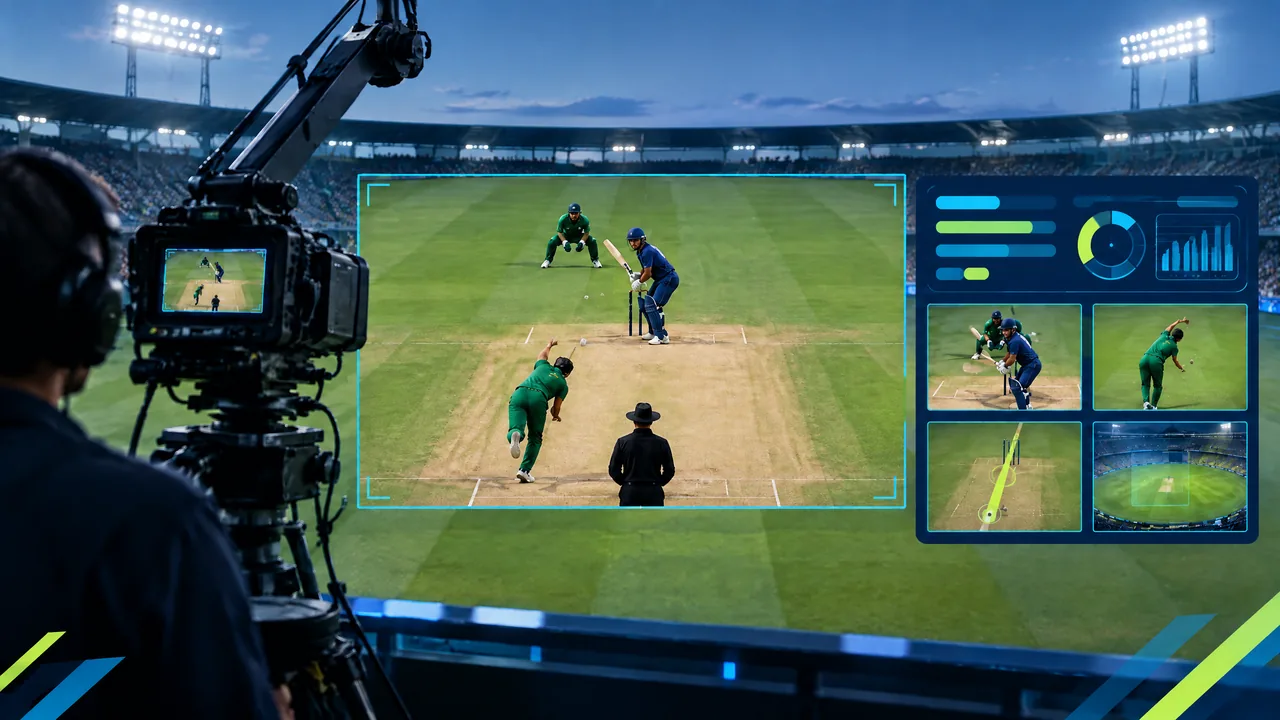
A useful match-technology assessment begins with what the finished programme actually shows. Note the stable live angle for a delivery, the angles used for fielding action, and whether replay shots are clearly labelled as replay. That evidence can describe the viewer-facing programme without turning an attractive shot into a claimed equipment inventory. A single high angle, a close-up, or slow motion shows that a picture reached the production output; it does not reveal how many cameras were available, where they were positioned, or who supplied them. The sports broadcasting technology guide sets out the wider capture-to-screen chain.
Read the score graphic as a published record
The on-screen score graphic is the most immediate data layer viewers can inspect. Compare team names, innings state, runs, wickets, overs, target and player details against the official match record when one is available. If the display changes, distinguish a normal correction from a delayed refresh by checking the next legal delivery rather than treating one frame as final proof. A graphic can be editorially accurate and still be separate from the scoring system used for official administration. Conversely, a familiar graphic design says nothing about a specific data vendor or venue network.
Treat timing as an observation, not a latency claim
Timing can be evaluated without inventing a millisecond figure. On one screen, watch the interval from live action to the associated graphic, replay or commentary reference. Across two screens, compare the same visible event and record which presentation arrives first. Device buffering, feed hand-offs, adaptive playback and local connectivity can all create differences. Those observations support a limited statement about the presentations being compared, not a universal verdict on the match broadcast. No primary match-specific source reviewed for this fixture supplies a measured end-to-end delay.
Separate replay evidence from officiating evidence
A replay selected for viewers is an editorial tool: it may clarify a run-out, boundary, catch or contact moment, but it is not by itself proof that officials consulted it. For an officiating claim, look for an explicit review signal, an umpire referral, an official decision sequence, or a competition confirmation. A ball-path animation, zoomed replay or edge-style graphic may be informative presentation, yet none confirms DRS or Hawk-Eye deployment. The DRS timer in cricket guide explains the separate review-request timing concept; it does not certify that this third-place play-off used it.
Use a disciplined on-screen evidence log
For each notable incident, log the clock shown by the feed, the visible live angle, replay label, score change and any formal review cue. Keep observations in three columns mentally: seen in the programme, stated by an organizer or official record, and not verified. This avoids a common error—promoting a broadcast convention into a technical fact. If a delivery is replayed from several angles, the supportable conclusion is that several viewer-facing angles were aired for that incident. It is not a licence to assign a total camera count or production architecture.
How to judge the match experience fairly
The strongest conclusion will be narrow: the confirmed third-place fixture had a particular venue and event record, while any display, replay and timing observations belong to the version of coverage actually watched. Compare live pictures, score continuity, replay labelling and explicit officiating signals before naming technology. Keep distribution separate from production: a viewing destination or channel listing does not prove the cameras, review tools or delivery protocol behind it. Readers seeking the distinct final-viewing question can consult India vs Pakistan Asian Games 2026 final viewing. This framework protects the record from guessed scorelines, claimed systems and unsupported technical certainty.