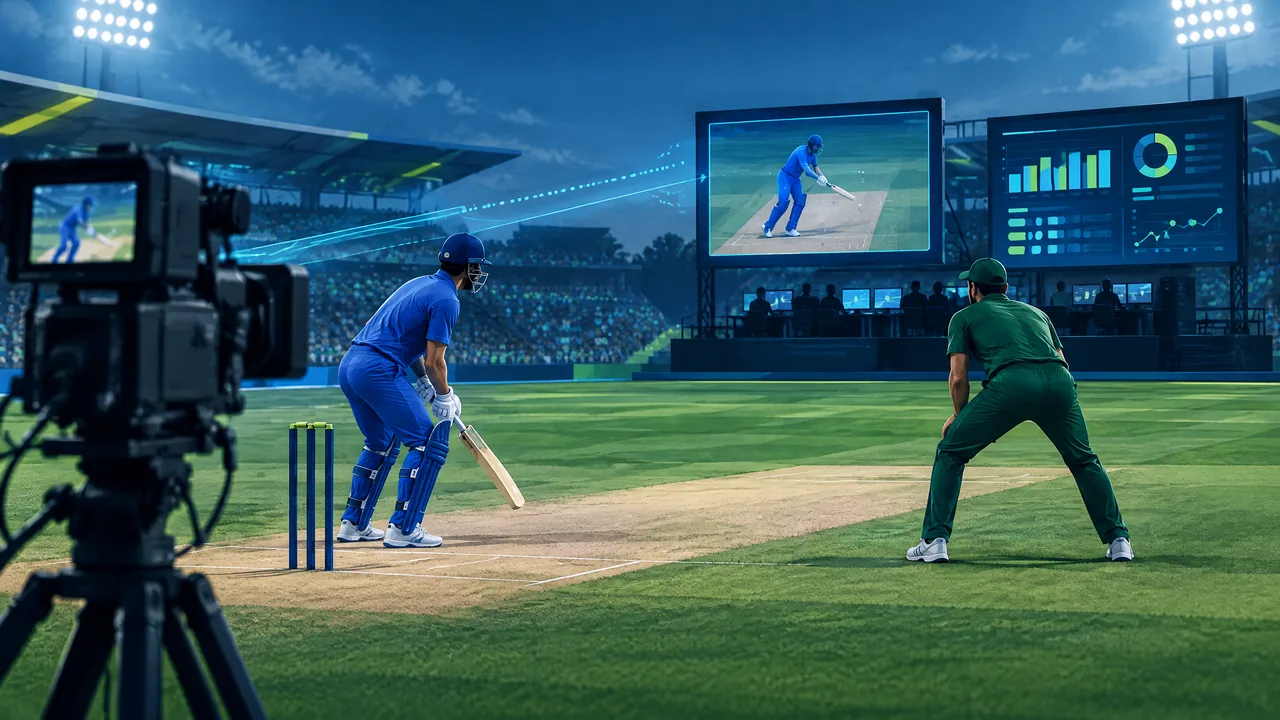
The confirmed final and India viewing distribution
ICC and Olympics.com listings identify the Asian Games 2026 men’s cricket final between India and Pakistan at Korogi Sports Park in Nisshin, Japan, on Saturday, 3 October. Olympics.com lists a 10:00 AM IST start. For viewers in India, it lists Sony LIV for live streaming, Sony Sports 1 for television, Sony Sports 3 for Hindi coverage and Sony Sports 4 for Tamil, Telugu and Kannada coverage. The ICC match centre identifies the fixture as the Asian Games Men’s T20I final at Korogi Sports Park. This is a technology explainer, not a live score or post-match report.
This is the Asian Games final, not an India–Pakistan match from the September 2026 Asia Cup. It is also separate from the Sri Lanka–Bangladesh third-place play-off. The established final viewing guide addresses access; this page uses the fixture as a careful framework for interpreting technology around a live match.
A score graphic is not the official score
The score strip on a broadcast is a useful, rapid display of runs, wickets, overs and target information. It is still a programme graphic: data has to be received, formatted and placed on screen. A correction can reach the graphic after an umpire decision, a scorer update or a production check. That does not make every temporary difference a technology failure.
For a score, result or statistical correction, the authoritative reference is the competition’s appointed scoring and official match record, not a screenshot, clipped replay or social post. The same rule applies when comparing an app notification with the television graphic. This article does not report a score or result for the final.
A broadcast replay is different from an officiating review
A replay selected for viewers is an editorial decision. The director may show a slow-motion angle to explain a boundary, catch or run-out, but that sequence is made for the programme. It may be delayed, shortened or chosen because it tells the story clearly. A convincing viewer replay is not proof that the match officials saw that angle or used it in a decision.
An officiating review follows the competition’s procedures and whatever accredited technical resources are formally available. The review team may use particular feeds, timing controls and communications that are not identical to the broadcast output. The DRS timer explainer discusses the player-review request window in general terms; it does not establish that a review system is active in this final.
Footage needs usable, time-aligned pictures
Multi-angle analysis only works when pictures can be matched to the same moment of play. In a production environment, that means the replay operator needs identifiable, time-aligned footage and enough image quality to inspect the relevant action. A cut from one camera to another can make a moment easier to understand, but it cannot create an angle that was never captured.
Viewers should also separate a broadcast’s finished programme feed from original camera material. Commentary, graphics, replays and edits can change how an incident is presented without changing the underlying on-field sequence. The sports broadcasting technology guide provides the wider capture-to-distribution context. It is not evidence of the final’s camera plan, replay routing or production location.
Why a stream and a television may not match
A television channel and an online stream can show the same match at different points in time. Each delivery path may add its own processing, distribution and playback buffering. Internet players may also adapt to a connection condition, while television reception follows a different chain. A wicket notification, a neighbour’s TV and a phone stream therefore need not arrive together.
There is no verified, event-specific measurement for the delay of this final, so no number of seconds should be attached to it. Nor is there evidence here for a particular codec, streaming protocol or encoding configuration. Difference in arrival time alone does not show that a feed is incomplete or that a stadium camera is late.
What would confirm DRS or Hawk-Eye
A claim that DRS is available for this final would need more than a ball-path graphic or a commentator’s shorthand. It would require official playing conditions or tournament documentation that authorises reviews, together with event-specific confirmation from the organiser, match officials or another authorised source that the system is enabled for this fixture.
A claim that Hawk-Eye is the provider would need a named, event-specific technical confirmation from the provider, organiser, governing body or official host-production information. Documentation would also need to identify what functions are available before anyone could infer ball tracking, edge detection or other review tools. None of that confirmation is established by the fixture listing or India viewing distribution. The Asian Games technology guide offers competition-level context without turning general technology into proof for a single match.
A disciplined way to read the coverage
Start with the confirmed fixture and the listed viewing services. Then treat score graphics as fast editorial displays, replays as broadcast storytelling, and official review decisions as a separate governed process. Ask whether a claim names a source, a match and a capability; if one of those is missing, it remains unconfirmed for this final.
That discipline matters because a high-profile fixture can make assumptions feel plausible. It does not justify transferring a setup from the Asia Cup, another cricket event or the Sri Lanka–Bangladesh bronze match to India–Pakistan. The cover image is conceptual, and this analysis intentionally makes no claim about camera count, DRS availability, Hawk-Eye use, actual latency, codec or match outcome.