The opening and the operating report are different events
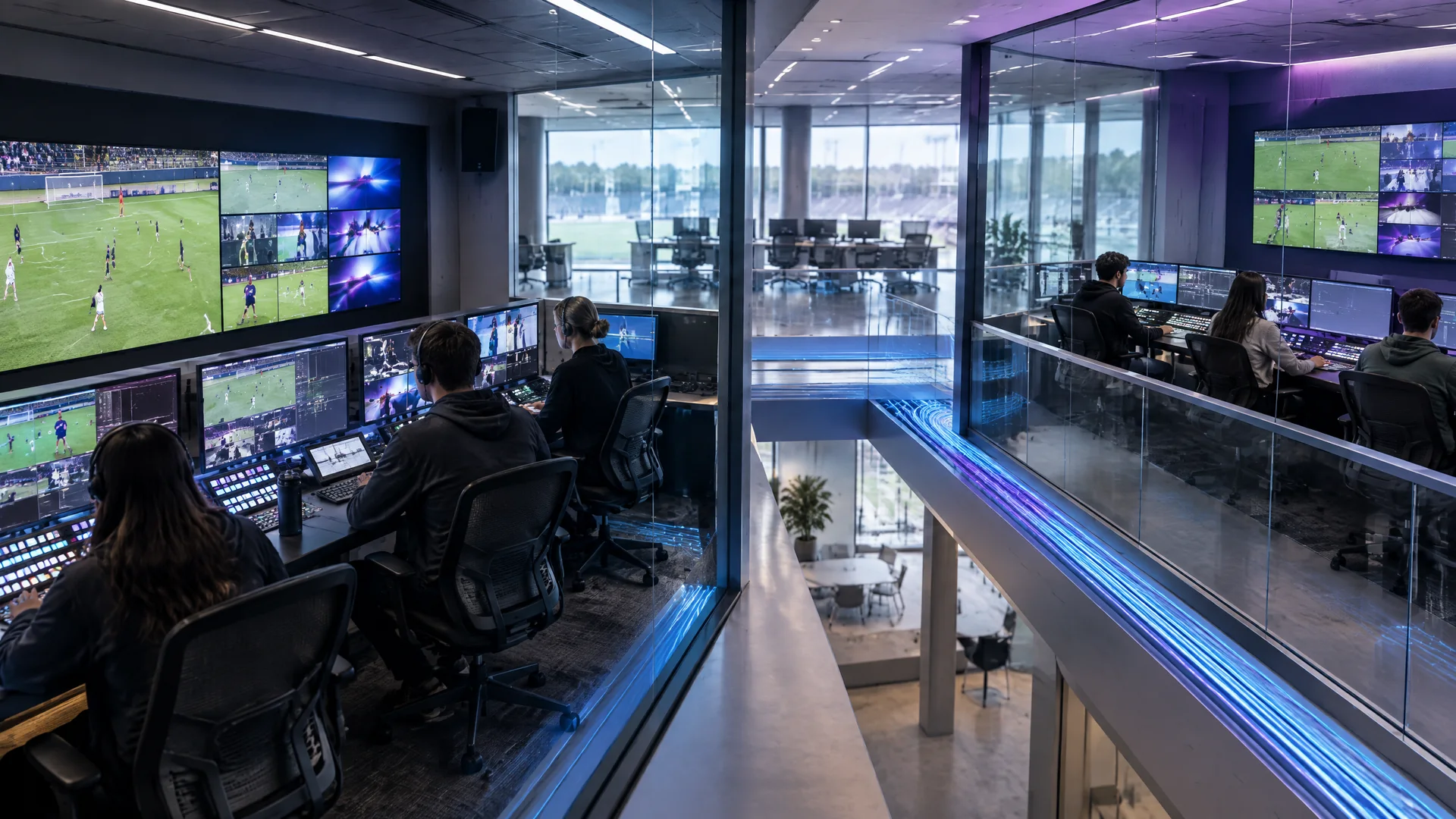
The University of Washington announced Sundodger Studios on 10 September as a new broadcast, production and content facility. Most of the major architecture was public then: four SMPTE ST 2110 control rooms, replay and playback positions, production switchers, cameras, audio rooms, a studio and a multipurpose event space. The report published on 23 September adds a different kind of evidence. Washington staff said the operation had completed approximately 30 events from the new space, that the first was a student-produced women’s soccer stream on 12 August, and that two of the four control rooms were initially in use. The timely development is therefore an early-operations account, not another opening announcement.
Four control rooms define capacity, not current utilisation
Sundodger Studios was designed around four IP control rooms, including two rooms with dedicated audio control. Its published system inventory includes centralized distribution and orchestration, six replay positions, playback and logging positions, two production switchers and ten cameras. That equipment establishes the scale of the installed plant, but the operating report’s two-room detail prevents a common error: installed capacity should not be described as fully active capacity. A facility may have four rooms while staffing, testing, scheduling and programme demand bring them online in stages. The distinction is useful for other universities considering an IP broadcast transition inside a stadium, because commissioning ends only when workflows, people and exception handling operate together, not when equipment is placed in racks.
About 30 events provide an early-use marker
Washington’s staff reported roughly 30 productions by the time of the specialist interview. The first was a women’s soccer match against Portland on 12 August, produced by students for the Big Ten’s streaming service. That count shows that the building was in real use before the public announcement, but it is not an independent performance measure. The public material does not list every production, distinguish broadcast from videoboard shows, record defects or provide system availability. It also does not say that all productions used the same room or technical path. The defensible conclusion is that the facility had entered an operational phase and accumulated a meaningful early workload while activation remained staged. A later audit would need an event ledger, room utilisation, incident records and output-specific quality controls.
ST 2110 changes how resources move through the plant
SMPTE ST 2110 allows professional video, audio and associated data to move as separate flows across an IP network. In a production facility, that can make sources and processing resources available across rooms without tying every function to a fixed point-to-point cable. It also creates responsibilities that are easy to hide behind the word flexibility: addressing, timing, orchestration, access, bandwidth, monitoring and recovery all have to be designed and operated. Sundodger’s system description shows a networked production approach, but it publishes no packet-loss, latency, failover or availability record. SportyTechs’ guide to remote production without losing venue control frames the same issue: moving a signal is only one part of deciding who owns it, how it is observed and what happens when a path fails.
The storage change is a workflow change
Washington’s staff described the previous practice of moving material on SD cards and loading files into individual systems. The new operation is working toward a shared-storage model for live, creative, historical video and photography assets. That change can reduce repeated copying and make one asset available to more than one team, but it also changes the control surface. File names, versions, rights, retention, access permissions and approval status must remain understandable when broadcast, videoboard and creative teams work from a common pool. The report describes the transition as work in progress, so it should not be presented as a completed media-asset-management programme. SportyTechs’ article on video tagging that keeps up with the week provides the durable context: discoverability and provenance matter as much as storage capacity.
Broadcast, videoboard and creative teams now share boundaries
The facility brings live production, in-venue presentation and creative work into one building. Washington produces approximately 90 to 100 conference streams and more than 120 videoboard shows each year, while its creative group handles additional content. A shared plant can allow material and technical resources to cross those workflows, but it does not eliminate editorial or operational boundaries. A live feed, a videoboard element and a social cut require different timing, rights, approval and fallback decisions. The broader sports broadcasting guide and stadium operating-system framework help explain why convergence needs named owners. The new facility creates a common environment; it does not prove that every hand-off is already standardized or error-free.
Students gain access, not guaranteed outcomes
Washington is also introducing a for-credit live sports television production class inside the facility. Students can learn on systems used for conference events, and the early women’s soccer production shows that student crews are part of the operating model. Those are meaningful access and training facts, but they do not establish learning quality, job placement, retention or equitable participation. Nor does the presence of professional equipment remove the need for supervision, permissions and documented role progression. A responsible assessment would track which duties students perform, how technical and editorial decisions are reviewed, how mistakes are handled and whether participants can demonstrate skills over time. The current evidence supports a hands-on opportunity, not a promise that the facility will produce a particular career result.
What the first 30 events do not prove
Sundodger Studios has crossed the line from installed project to active production facility, but its early count leaves important questions open. There is no public evidence for uptime, packet loss, end-to-end latency, room utilisation, staffing efficiency, production defects, accessibility output, storage completeness, cost performance, energy use, student outcomes or external-production revenue. A project consultant has promoted a ten-year saving estimate for the IP architecture, yet the comparison model is not public and cannot be treated as a measured result. Future updates should be tied to documented four-room activation, shared-storage completion, a production audit, incident and recovery records, accessibility practice or independently reviewable cost evidence. For now, the useful lesson is disciplined staging: four rooms define potential capacity, two-room operation and about 30 events describe the reported early state, and the gap between them is where commissioning evidence belongs.