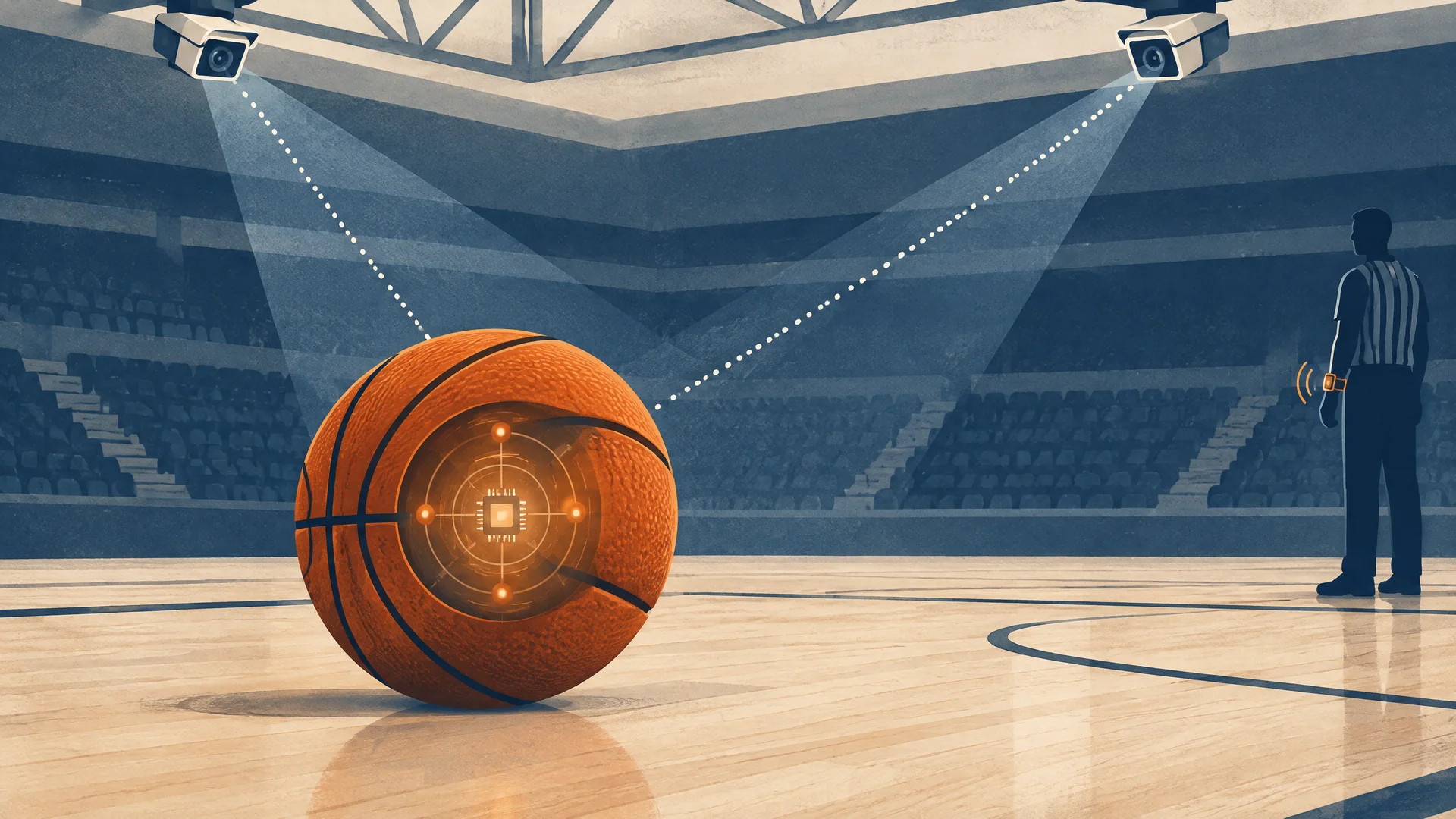
Three systems, three different jobs
When you see an NBA score or a replay, it is tempting to picture one intelligent ball producing every number and making the call. The league's October 2026 update says something narrower. Selected preseason games are being used to research a connected basketball and test a referee communication device. Separately, the NBA announced 3D optical player-and-ball tracking starting in 2023–24. Read those as different tools, with different evidence behind each one. Nothing here establishes that a named October 8 match used the new ball or wristband.
| System | Stated job | What is confirmed | What you should not assume |
|---|---|---|---|
| Connected basketball | Collect sensor data in selected preseason games | Wilson-developed ball with a Bluetooth sensor; research only | It made a call or was used in every game |
| Official wrist wearable | Let officials communicate with the Replay Center | Selected games and designated review, scoring-change or clock situations | It independently decides a review |
| 3D optical tracking | Record player and ball movement | NBA and Sony Hawk-Eye rollout announced from 2023–24 | Every public box-score stat or decision came from those cameras |
What does the NBA smart basketball do in preseason?
The NBA's 5 October report describes a Wilson-developed ball containing a Bluetooth sensor. The league wants to study data that could eventually inform real-time officiating. For the selected preseason tests, the NBA specifically says the data is for research and will not affect calls made during those games. That distinction matters: an interesting sensor does not become an AI referee because a camera sees the same play. The league has not named the six games on the 8 October NBA preseason schedule and India-time snapshot as connected-ball trials. We cannot infer which player touched such a ball from a public score.
How do the referee wrist wearables fit into replay?
Officials in selected preseason games will use wrist wearables to contact the Replay Center in designated situations: replay reviews, scoring changes and clock malfunctions. The device is a communication path, not a published decision algorithm. The NBA said the wearables had a summer-league pilot and will not extend into the regular season. For readers wondering about NBA referee technology, that means the October report concerns coordination around a human review process. It does not say a wrist device can detect goaltending or overturn a call by itself. Our auditable-replay guide explains why the incident, reviewer and evidence should be traceable.
Where do NBA tracking cameras and player data differ?
The NBA announced a partnership with Sony's Hawk-Eye in 2023 to capture the ball and players in three dimensions at low latency, beginning in the 2023–24 season. This is optical tracking around the court; it is separate from the Bluetooth basketball pilot. The NBA described applications for analysis and potential future officiating improvements, including automated out-of-bounds or goaltending calls in future seasons. A future opportunity is not proof that such automated calls already occur. The underlying idea is easier to follow in our computer vision in sports guide: collect observations, identify players and ball, then test whether a derived measure answers the question you actually asked.
Do NBA player stats require AI, wearables or a connected ball?
No single technology claim follows from a box-score row. If a team has 124 points and a player has 15, those published numbers tell you about that game's recorded result and player line; they do not identify the device, sensor or human workflow that produced the official record. NBA analytics can draw on additional optical movement data to study spacing or trajectories. But the league's connected-ball announcement did not say that every existing box-score number now comes from its experimental sensor. In a dated preseason scores and player-stat example, keeping the player and game together is more helpful than attributing a stat to technology without evidence.
Are AI technology and camera technology making calls for referees?
The 2023 NBA tracking announcement talked about automated calls as a future possibility; the October 2026 ball announcement explicitly rules out its research data changing decisions in the selected preseason games. So the accurate answer is limited: NBA camera technology can create tracking data, and a referee's wristband can carry a message. Neither fact proves that an October 8 decision was machine-made. For wearable technology in sports, the same rule applies: explain a device's validated purpose before assigning it a result.
What should a fan check when technology is mentioned with a score?
Start with the competition, date and game status, then find the specific league statement about the system. Is it deployed, tested in selected games, merely proposed or not documented for that fixture? The October 8 U.S.-date slate is preseason; the NBA's key dates list the regular-season start as October 20. Do not use preseason experiments to explain NBA Finals or playoff decisions. If you are looking for NBA live streaming or highlights, rights and availability are a different subject; this explainer does not offer a stream or reproduce match footage. See the sports analytics guide for a deeper way to judge what a measured number can and cannot tell you.