Football Video Support vs VAR: the quick answer
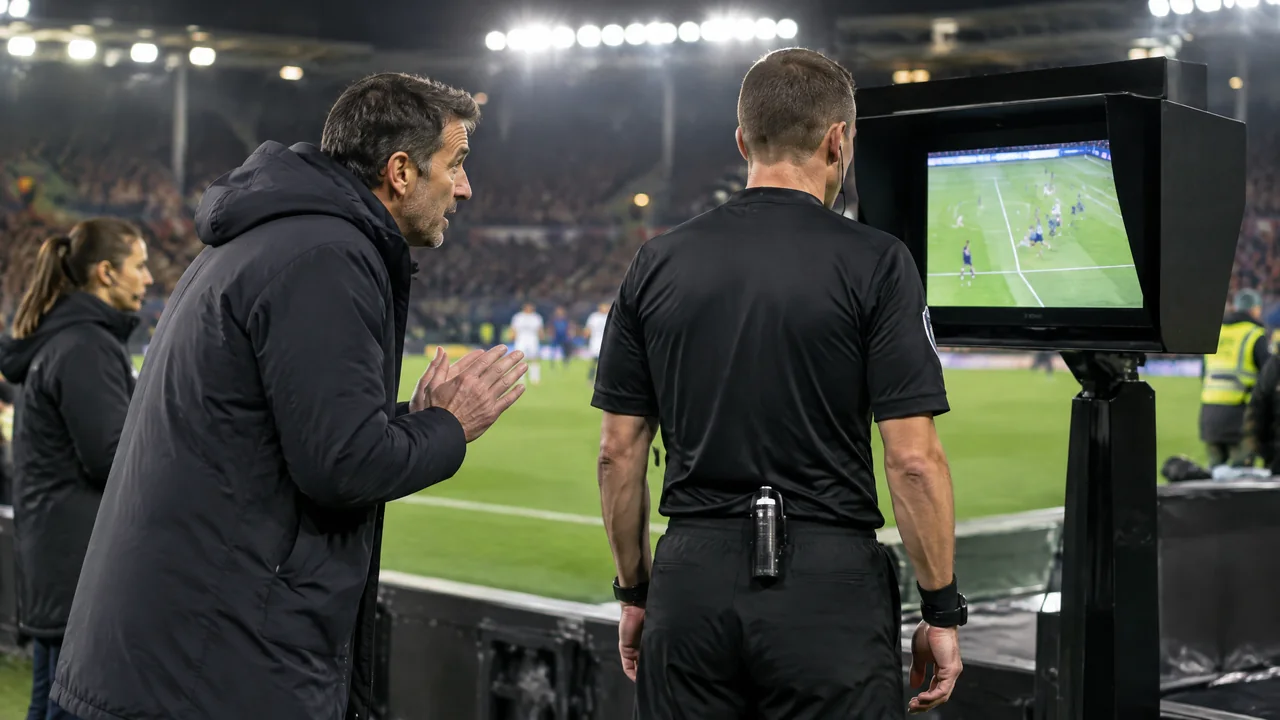
Can a football team ask for a replay? It depends on the review system the competition has actually adopted. Under VAR, a video team automatically checks defined incidents and only the referee can initiate a formal review. Under Football Video Support (FVS), a team’s head coach can request a review after the referee’s initial decision. A broadcast replay or referee screen does not establish which system is in operation. Last checked 6 October 2026.
VAR and FVS are different workflows, not two labels for the same service. VAR uses video match officials who monitor eligible incidents. They can recommend a review, but the referee alone starts it and makes the final decision.
FVS is designed around a team-initiated request. FIFA’s published FVS process has no video match officials watching every qualifying incident. Instead, the head coach, or the senior official in the technical area if the head coach is absent, takes responsibility for requesting a review immediately after an incident. The referee still makes the final decision.
In an FVS trial, a coach may have a defined request route; a coach cannot demand a VAR review. FVS is not a replacement for VAR. The IFAB described it as an ongoing FIFA-led trial when last checked.
Who starts a review: automatic check or team request?
With VAR, the check begins in the background. The VAR automatically examines incidents within the protocol’s scope. If footage indicates a possible clear and obvious error or serious missed incident, the VAR can communicate with the referee, who decides whether to initiate a review. Teams do not need to request a check.
With FVS, the referee must first make a decision; allowing play to continue counts. The eligible official then requests a review immediately through the fourth official. FIFA’s published trial explanation describes a finger-twirl gesture and a review-request card.
For the full VAR vocabulary, see How VAR Technology Works in Football. The key distinction is simple: VAR is checked by video officials; FVS puts the trigger with the team official.
What happens after a coach asks for Football Video Support?
A valid FVS request is not an automatic reversal. The fourth official informs the referee. If play has stopped without restarting, the referee can go to the review area. If play has continued, the referee waits for a neutral situation before reviewing footage.
A review operator assists the referee by presenting available replay material, such as different angles or speeds. The referee then decides whether the footage shows a clear and obvious error or a serious missed incident. If it does not, the original decision stands.
Timing matters because a decision generally cannot be changed once play has restarted after a stoppage. A player seeking a review should communicate through the authorised team official, not argue from a television signal.
Which decisions can each system look at?
Neither system is a route to re-litigate every throw-in, foul or disagreement. FIFA’s FVS explanation limits the system to possible clear and obvious errors or serious missed incidents involving goal/no goal, penalty/no penalty, direct red cards rather than second cautions, and mistaken identity.
VAR is likewise restricted to defined match-changing situations. Its current protocol also has narrowly stated additional provisions, including a competition option for an immediately correctable, clearly wrongly awarded corner. Do not assume a category in one process applies in the other.
In both cases, footage supports the referee’s decision; it does not hand decision-making to a coach, a player, a broadcaster or the replay operator.
Why one replay angle may not change the referee’s call
An angle on a broadcast can make a decision look obvious, but the referee may have different or incomplete footage. Under FVS, FIFA says the system may in principle use one to four human-operated or automated cameras. With few cameras, replay evidence will often be inconclusive.
In FVS, the original decision changes only when replay clearly establishes a clear and obvious error or serious missed incident. A tight crop, slow-motion post or single viewpoint may omit relevant contact, positioning or prior action.
Camera coverage and officiating authority are separate questions. Sports Broadcasting Technology: Capture to Accessible Delivery explains why pictures made for viewers and material used in an officiating process should not be treated as interchangeable evidence.
How to check whether a particular match really has VAR or FVS
Start with the organiser’s regulations or match information. Then look for official match documentation that identifies the review system, video officials or FVS procedure. A referee appointment or governing-body announcement helps only when it explicitly states the technology used.
Separate a rule from a deployment. The IFAB protocol says an organiser must meet VAR Handbook requirements and receive written FIFA permission. That does not prove VAR operated at a particular fixture; FIFA’s FVS trial material does not prove FVS was available at every match.
If the official record does not say which system was used, report it as “not confirmed” or “not documented in the sources checked.” Do not fill the gap with a broadcast graphic, social post or generic explainer. How Field Hockey Video Referrals Work shows why who starts a referral is rule-specific.
What a broadcast replay, referee screen or social clip cannot prove
A televised replay shows that a producer had footage. A referee screen can show that some replay process occurred. Neither alone identifies VAR, FVS, a video operation room, camera count, officials or the governing rule.
Treat on-screen evidence as a prompt to check official documentation, not confirmation. That prevents a familiar gesture or compelling clip becoming an unsupported technology claim.
Sources and editorial method
Last checked 6 October 2026. Sources are the current IFAB Video Assistant Referee Protocol; FIFA’s FVS explainer (18 May 2024) and update (1 October 2025); and the IFAB AGM update (28 February 2026). This explains published rules and FVS trials, not technology at a named fixture.