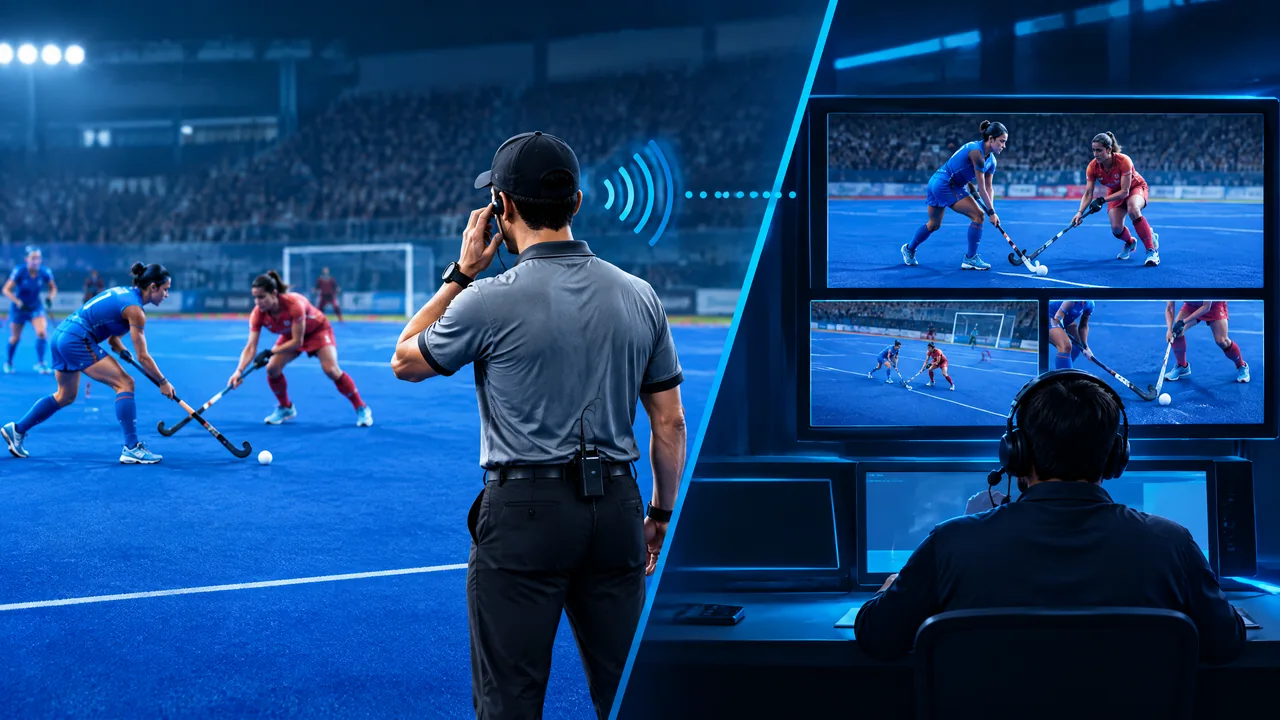
What is a field hockey video referral?
A field hockey video referral is a request for a video umpire to review a defined on-field decision using available camera footage. At events with a working review setup, a match umpire can initiate a permitted check, or a player can ask for a team referral under that competition's regulations. The video umpire reviews the available angles and advises; the on-field umpire retains the final decision. This guide uses Appendix 9 of the FIH Hockey World Cup 2026 regulations as a concrete example. It does not claim the same allowance applies to every league or Asian Games match.
Team referral vs umpire referral: who starts it?
The distinction is who asks and what can be checked. In the World Cup protocol, the match umpire may refer specific goal, penalty-stroke or serious-misconduct questions directly. A team can instead request a review through an on-field player, who signals immediately to the match umpire. The player does not contact the video room or stop the game independently. Under the same protocol, team referrals concern decisions within the 23-metre areas about a goal, penalty stroke or penalty corner; a shoot-out can have its own re-take question. A personal card is not a team-referral topic. The World Cup provisions are a useful reference, but the regulations for the actual competition must be checked before stating its entitlement.
How does a team ask for a video review?
The World Cup rules require an on-field player to signal 'T' and confirm the request verbally immediately after the incident or decision. The player then tells the umpire the exact question within a maximum of 20 seconds; if no question is supplied, the protocol specifies a default question about the last eligible decision or non-decision. The on-field umpire relays the request by radio and signals to the video umpire. A team has one request during regulation play and one in a shoot-out, subject to the provisions that let a successful or inconclusive review retain the right. That is an entitlement in the cited World Cup regulation, not a rule we can automatically assign to school hockey or another tournament.
What footage does the video umpire actually use?
The video umpire can ask for as many replays from available camera angles as needed. One wide shot may show where players stood; a closer angle may help with a touch near the goal line. No camera promises to see through a player or record a ball that leaves its frame. The video official communicates advice to the match umpire—such as Goal, No Goal, Penalty Corner or No Advice Possible, depending on the referral. The footage is evidence for the specified question, not an automatic scorer or a model that predicts what would have happened. This is why the sports broadcasting guide distinguishes a camera feed from a decision workflow.
What if the replay is inconclusive?
Suppose an attacker and defender converge near the shooting circle, but every camera loses sight of the ball at the key moment. 'No Advice Possible' is a real outcome, not a hidden decision against either side. Under the cited World Cup umpire-referral process, an existing on-field call stands when the footage cannot provide advice. Under its team-referral process, an inconclusive review lets the team retain its referral right. An upheld team referral also retains the right; if there is no clear reason to change the original call, the team loses it. The example is hypothetical, not a report of a particular match incident.
Who makes the final decision?
Appendix 9 says the final decision, including interpretation, remains with the on-field umpire. The video umpire's job is to assess the permitted question and communicate what the footage supports. The protocol also prevents substitutions during the review stoppage. This matters because a television graphic saying 'review' can make it look as though software or a remote official has taken over. The on-field umpire is still accountable for the call. Review footage and computer vision in sports are related technologies, but this process does not require an AI system to generate its decision.
Is video review available at every hockey match?
No. The FIH's 2026 Rules of Hockey note that video umpires at FIH events depend on contracted full television coverage and facilities that support a viable system. Tournament regulations set the actual referral procedure where one is used. Local matches and competitions without the necessary production may use the standard on-field umpire process. The India–Pakistan men's hockey semifinal at the 2026 Asian Games finished 4–3 according to Olympics.com; that match result does not, on its own, prove a specific video referral occurred or that the World Cup protocol governed it. Hockey training on changing turf covers a separate player-performance question rather than an officiating rule.
What to check before sharing a disputed clip
Identify the event and its applicable regulations, the original umpire decision, who made the referral, the question actually put to the video umpire and whether the relevant angle was available. Then distinguish advice from the final on-field call. A short clip without the preceding play may omit the initial infringement; a screenshot may omit what the umpire asked. Our source for the procedure is the July 2026 FIH Hockey World Cup tournament regulation, alongside the 2026 Rules of Hockey for the availability caveat. It is not an official ruling on any Asian Games incident. The cover image is an original conceptual illustration of field hockey and a review room, not a photograph or record of a real review.