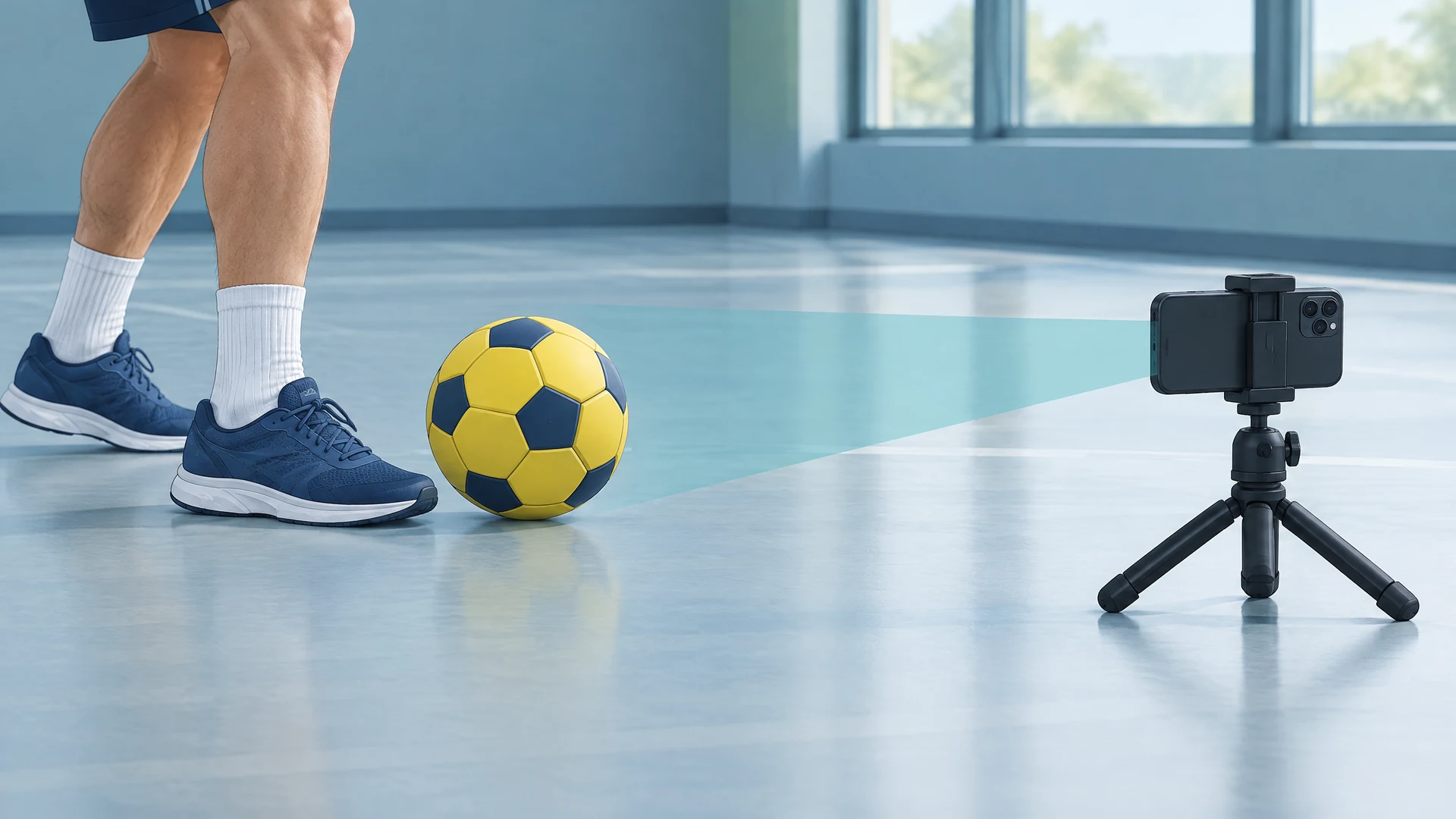
The DribbleUp Smart Soccer Ball combines a specially designed football, a phone or tablet camera and an interactive training app. Players follow an on-screen coach and move the ball through guided exercises. The camera observes the ball, allowing the app to connect physical practice with digital targets and feedback. The important detail is that the ball itself does not contain the tracking sensors people often expect from a “smart” product.
According to DribbleUp’s official Smart Soccer Setup & Use guide, the ball uses neither sensors nor Bluetooth. Its movement is recognized visually through the device camera. That makes this a useful example of camera-based soccer training rather than a battery-powered ball broadcasting movement data. The technology can organize practice, but it should not be confused with a complete assessment of a player's football ability.
If you are considering this system for yourself or a young player, the practical questions are straightforward: can your device see the ball clearly, are the exercises suitable, and will the ongoing membership make sense for your household? This guide explains the published technology, how to interpret the feedback and where human coaching still matters. It is based on official documentation checked on 14 October 2026, not a hands-on product test. For the wider technology behind visual tracking, see our computer vision in sports guide.
The main things to understand
The ball’s visual design and your device camera work together. The manufacturer describes computer vision, on-screen targets and repetitions counted when the ball reaches targets. It does not publish enough implementation detail in the sources reviewed here to establish the exact model architecture or an independently verified accuracy rate.
Guided practice and app feedback are the central functions. They can give a player a clearer activity to follow than an unstructured session, but an app count is not automatically a count of technically excellent touches. Football also requires decisions, communication and movement that a close-control drill cannot fully represent.
The app download and access to training content are different things. DribbleUp says most live and on-demand sessions require its All-Access Membership. Camera position, lighting, safe training space and current device compatibility should be checked alongside that recurring cost.
What makes the DribbleUp soccer ball smart?
The “smart” part comes from the relationship between the ball and the app, not from a miniature tracking computer inside the ball. In its official explainer, What is a Smart Soccer Ball?, DribbleUp says the ball’s distinctive colouring and design allow the mobile app to recognize it. The same explainer says there is no need for batteries or a Wi-Fi connection to the ball.
That distinction matters when setting expectations. You do not charge the ball to power its tracking or pair it as a Bluetooth accessory. Your phone or tablet supplies the camera, screen and computing environment for the training experience. The app and any online classes may have their own connectivity requirements; a ball that does not connect to Wi-Fi does not establish that all app functions work offline.
The manufacturer also describes the ball as usable for ordinary play. Its interactive features, however, depend on the compatible app setup. A football moving around the garden without an app session is still simply a football. The wider category includes very different technologies, so our smart training equipment guide explains why a digital training aid should be judged by its actual measurement method rather than its name.
How the camera turns ball movement into feedback
A training session begins with the device positioned so the camera can see the feet and ball. The player opens the app and follows its prompts to scan the ball. DribbleUp’s support instructions say the entire ball should stay within the on-screen circle during scanning. This is a visual recognition step, not a wireless connection to an electronic transmitter.
The manufacturer’s technology explainer describes live camera video with targets placed on the screen. The player moves the ball towards those targets during the exercise. It says reaching a target counts as a repetition and contributes points. The current support guide also describes real-time tracking and feedback during guided drills. These are documented product functions, not a claim that SportyTechs verified every movement the system recognizes.
Computer vision is the broad technology used to interpret images. In this setup, visual information allows the app to associate ball movement with the selected activity. The public descriptions do not reveal every detection, tracking or scoring step. It would be misleading to invent a particular neural network, a three-dimensional ball sensor or a biomechanical assessment pipeline from those descriptions alone.
Is DribbleUp an AI football coach?
Computer vision sits within the broad field of artificial intelligence, but calling a product “AI” does not tell you how much it understands. Recognizing a ball in an image is one task. Explaining why a player loses possession under pressure is a much larger task. The sources reviewed confirm camera-based computer vision; they do not disclose enough detail to identify the exact trained models or claim a fully autonomous football coach.
DribbleUp’s support material describes personalized class suggestions based on ability. That supports saying the service can suggest classes, not assuming that it performs a detailed tactical diagnosis or creates a scientifically validated training plan for each athlete. Content selection, movement recognition and coaching judgment should be described separately, even when a product groups them within one experience.
The on-screen coach also matters. Guided lessons can contain demonstrations and instruction from people, while software supports tracking and interaction. A human-led class delivered through an app is not the same thing as an AI system inventing every instruction. Our AI video analysis in sports guide explains the broader distinction between detecting an event and verifying what it means.
Setting up a session that the camera can see
Start with a clear, safe practice area and a stable device position. DribbleUp’s setup guide asks for good lighting and at least six feet of space, described there as approximately two metres. Treat that as the manufacturer’s baseline guidance, not a promise that every room or every exercise is safe within a fixed rectangle. Leave enough clearance for the movement required by the selected drill.
Angle the camera towards the feet and ball rather than assuming a normal eye-level video-call position will work. Keep the full ball visible during scanning and avoid putting a bright window directly behind the player. The company specifically advises avoiding glare and shadows that can affect tracking. A smooth, appropriate surface and suitable footwear are as important as making the app recognize the equipment.
Use a secure stand, tripod or another genuinely stable surface. Official support says the branded stand is recommended but not required. Do not balance a valuable device where a moving ball could knock it over. If training is cast to a larger screen, the camera device still needs a useful view of the exercise; enlarging the display does not improve an obstructed camera view.
Device compatibility and the training app
At the time of this research, official support listed iOS 13 or later, Android 12 or later and Fire OS 8 or later as minimum software requirements. Check the current app listing on your own device before relying on those figures. Operating-system minimums can change, and meeting a listed minimum does not guarantee identical camera performance on every model.
A compatible phone or tablet is necessary because it provides the camera-based interaction. The app is also required for the guided training sessions. An old phone that runs the software but has an unreliable camera or struggles to keep the session responsive may not provide the experience you expect. No device-by-device performance test was conducted for this article.
The company says sessions can be displayed on a television through supported casting or connection methods. That can make demonstrations easier to follow, but it does not make the ball a television-connected sensor. Keep the distinction clear: the screen shows the lesson, the camera observes the practice and the physical ball supplies the object used in the exercise.
What a repetition count can and cannot tell you
A repetition count is useful when it is interpreted as a result from a particular exercise and setup. The manufacturer’s explainer describes reps associated with hitting digital targets. A higher count can indicate that the player completed more recognized target movements in that session. It does not, by itself, establish that every contact used the best technique.
A camera-based target system may observe where the ball appears without capturing everything a coach would want to assess. Balance, body orientation, the choice of contact surface and whether the player looks up at the right moment can matter. The reviewed product descriptions do not justify claiming that every one of these details receives a validated automatic assessment.
Compare sessions cautiously. Different drills, target arrangements, camera positions or durations can make totals difficult to compare. If feedback seems inconsistent, check the setup before deciding the player has suddenly become worse. The most useful interpretation combines the app record with what the player and an observing adult or coach can actually see.
A simple example of using feedback sensibly
Imagine a player following an on-screen sole-roll exercise. The player scans the ball, watches the demonstration and then moves it through the displayed targets. This is a hypothetical teaching example, not a record of a DribbleUp user or a claim about a particular class layout. Its purpose is to show how digital and human feedback can work together.
Suppose the screen indicates that a target movement was completed, but the player had to lean awkwardly or repeatedly look down to make it happen. The digital result answers one question: did the software register the movement required by its exercise? A coach or observing adult can ask another: was the action controlled, comfortable and suitable for the player? Those answers need not be identical.
The next step is not automatically to chase a higher score. It may be to improve the camera position, understand the demonstration better or select a more suitable exercise. For a child, an adult can help keep the experience encouraging rather than treating every missed target as failure. The app provides structure; thoughtful interpretation keeps the structure useful.
Benefits without promises of match improvement
The clearest potential benefit is a more organized practice routine. A player can select a lesson, see an example and repeat a defined movement rather than wondering what to do next. The support guide lists drills such as L pulls, V-rolls, step overs and roll taps. Its documented focus fits close control and footwork practice, rather than a full simulation of a football match.
Digital targets, progress records and session badges may make that routine more engaging for some players. The useful question is whether the player actually wants to return to appropriate practice, not whether a marketing page has a large customer count. Interest varies, and a young player who dislikes screen-led exercises should not be assumed to benefit simply because the equipment is labelled smart.
Better scores do not guarantee better performance against defenders. Match play includes scanning, passing choices, movement without the ball and reactions to other players. This article does not establish a measured training benefit, because no independent effectiveness study or controlled product trial was reviewed. Guided individual practice is best understood as one possible part of development alongside team training, coaching and ordinary play.
Camera limitations and practical troubleshooting
Camera tracking depends on visible information. Poor lighting, glare, strong shadows or a blocked view can make recognition more difficult; these conditions are also addressed in the manufacturer’s setup advice. A foot briefly hiding the ball is not proof of a faulty product, but it is a reason to interpret the feedback with care.
If scanning fails, start with the basics described by official support: show the whole ball within the scan area, provide an unobstructed view and check the lighting and device position. Do not assume that a disappointing count diagnoses bad technique. A measurement problem and a movement problem are different issues, and it helps the player to separate them.
There are also limits to the type of activity being observed. A camera watching close-control practice cannot automatically describe a whole pitch or understand every tactical situation. We have not verified tracking latency, every-touch accuracy, camera-frame-rate thresholds or recognition across every surface. Claims of professional-level performance analytics would go beyond the evidence gathered for this explainer.
The ball price and membership are separate
DribbleUp says the app download is free, but most live and on-demand training sessions require All-Access Membership. Its official smart-ball explainer describes limited content without membership. Do not confuse downloading the app at no charge with receiving the entire class library at no recurring cost.
On 14 October 2026, the official product page listed a membership renewal price of US$19.99 per month plus tax, separate from the ball purchase, with automatic monthly renewal until cancelled. This is a dated statement about the displayed U.S.-dollar offer, not a guaranteed price for every customer. Promotional ball prices and introductory offers change, so they are deliberately not treated as permanent prices here.
For readers in India or elsewhere outside the advertised market, a U.S.-dollar listing is not a delivered local-price quote. Confirm availability, relevant charges, app access and current subscription terms before making a decision. This guide does not verify Indian shipping or import costs, offer a retailer link, or make a purchase recommendation.
Privacy, local video processing and children
DribbleUp’s privacy policy says the video images displayed during training activities are processed locally on the device during the activity and are not transmitted to or processed remotely by DribbleUp. That is a specific statement from the company’s policy checked for this article. It is not an independent inspection of network traffic or a guarantee about every future feature.
The same policy says the service collects activity data and training metrics, along with other information described in the policy. Local processing of training video therefore does not mean the service collects no data. Parents should distinguish the camera image, the account record and any training activity associated with the account.
The policy’s children section also describes usernames and training activity, including information appearing within app features such as leaderboards. Consider an appropriate non-identifying username and review the current parental controls and information choices. Avoid filming other people or revealing unnecessary details in the practice area. These are sensible privacy considerations, not a statement that the product has passed a particular country's child-data compliance assessment.
Choosing between ordinary practice and app-guided practice
An ordinary football can already support useful ball-control practice. The extra value of the DribbleUp setup is the documented combination of visual recognition, guided lessons and digital feedback. If you already follow suitable drills with a coach and enjoy that routine, the additional screen-led experience may or may not solve a problem for you.
If the challenge is deciding what to practise or staying engaged with a clear exercise, app-guided practice may be worth considering. Evaluate the setup as a whole: the ball, compatible device, safe space, camera view and ongoing access to suitable sessions. This is a better question than assuming “smart” equipment must be superior for every player.
Neither choice needs to replace human support. An adult or coach can help a young player understand the task, avoid frustration and connect individual practice with real football situations. Technology is most useful when it makes an appropriate activity clearer, not when its score becomes the only measure of progress.
Questions players and parents often ask
Does the DribbleUp soccer ball use Bluetooth or built-in sensors?
No, according to the official Smart Soccer Setup & Use guide. The ball is recognized visually through the phone or tablet camera. The manufacturer's explainer also says the ball does not require batteries or a Wi-Fi connection. App connectivity should be checked separately.
Can any ordinary soccer ball provide the same app tracking?
The documented system uses the DribbleUp Smart Soccer Ball, whose colouring and design the manufacturer says enable visual recognition. We have not verified equivalent tracking with an ordinary football. Do not assume a substitute is supported simply because it has a similar size or colour.
Is the app completely free to use?
The app download is free, but DribbleUp says most live and on-demand sessions require All-Access Membership. Its explainer describes limited content without membership. Check the current content access and subscription terms rather than relying on an old price or promotion.
Does DribbleUp replace a football coach?
No. It supplies guided practice and documented app feedback, but those functions are not evidence of complete tactical, technical or developmental assessment. A coach can interpret movements in context and help connect practice with match decisions. No guaranteed performance improvement is established by this article.
Explore the technology behind your training
For a broader understanding of connected practice equipment, continue with our smart training equipment explainer. To understand how software interprets movement, read how AI video analysis works in sports. Coaches comparing more extensive footage-review tools can also use our football video analysis software comparison.
Page metadata and source notes
SEO title: DribbleUp Smart Soccer Ball: How Its Training Technology Works.
Meta description: Learn how the DribbleUp Smart Soccer Ball uses camera tracking, app-guided drills and feedback, with setup, membership, privacy and coaching limitations.
Editorial sources checked on 14 October 2026: DribbleUp Help Center, Smart Soccer Setup & Use and What’s Needed to Use Dribbleup?; DribbleUp Academy, What is a Smart Soccer Ball?; the official Smart Soccer Ball product listing; and the DribbleUp Privacy Policy. These provide manufacturer descriptions and current disclosed terms, not independent proof of training gains. Official source URLs are retained in the private research record. This publication keeps reader navigation on SportyTechs and includes no affiliate or shopping links.