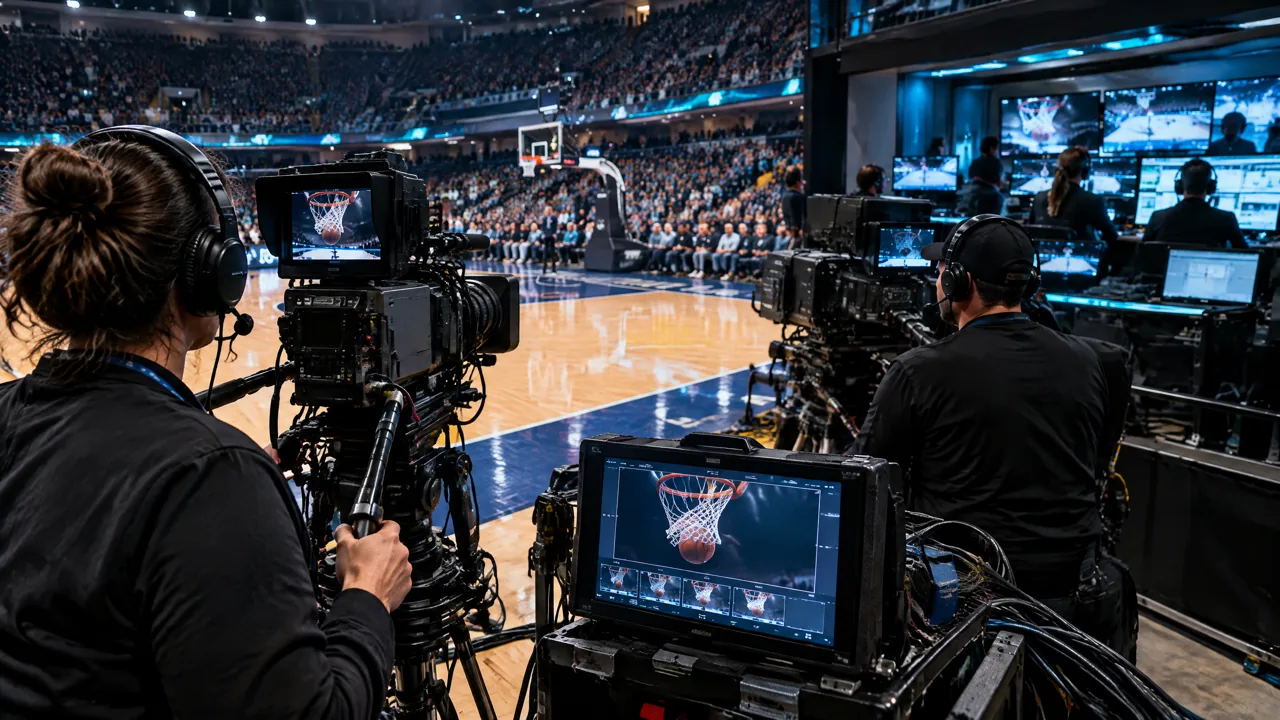
What USA Sports said about its playoff broadcast plan
The technology behind a playoff telecast is not one bigger camera package. In a 1 October 2026 interview with Sports Video Group, USA Sports remote technical operations director Matt Hogencamp described how crews, trucks and equipment had to move quickly as WNBA matchups became known. The report concerns USA Sports' coverage, not ESPN's separate WNBA playoff operation. Its most useful detail is how replay, graphics, microphones and local capture were divided between a mobile unit at the arena and functions elsewhere. The account identifies a production design; it does not publish independent picture-quality, latency, audience or reliability measurements.
Where the arena and Denver workflows meet
Mobile TV Group remained the mobile-unit provider, according to the specialist report. During the regular season, the team used Viz Engine graphics systems at the Mountain Mobile Center in Denver, with operators controlling them from the on-site truck; an on-site scorebug server was operated from the center. These locations matter because a graphic that appears local on a viewer's screen may depend on a remote system, a control path and a return path. For every graphics element, engineers need to identify where it is rendered, where commands originate and which component supplies the score. The interview does not disclose the full transport topology, synchronisation budget or fallback procedure, so the diagram should not be mistaken for a verified end-to-end signal map. Our REMI sports broadcasting guide explains the general venue-to-hub and return-path questions.
What changed in the playoff camera plan
The report says USA Sports added isolated hard cameras, point-of-view positions and a radio-frequency Steadicam to support its on-site studio presence. It lists seven hard cameras, five handhelds, two robotic above-the-rim cameras, a Steadicam and at least seven POV cameras for game productions. These are reported production positions and equipment categories, not a promise that every angle appeared in every programme. An ISO camera gives replay staff an independently recordable angle; a POV can provide a fixed perspective; a roaming RF camera adds movement but also makes spectrum coordination and return monitoring important. The exact usefulness of a position depends on where it is placed, what action it can actually see and whether its signal remains available to the replay team.
Why six super-slow-motion views are not six decisions
Additional EVS XT-VIA replay servers were installed in the truck, and the report describes a total of six super-slow-motion cameras. This gives the production more capture choices, but the number alone does not tell a viewer how fast clips can be selected, how angles are time-aligned or whether a particular play was captured clearly. An operator still has to compare the right views and cue an editorially relevant sequence. Replay for television explanation is also different from an officiating review: the source does not say these feeds changed any league decision process. The distinction matters when coverage markets a technical expansion as an automatic improvement. The sports broadcasting technology guide places replay between acquisition and the final audience output.
Player microphones require an editorial gate
USA Sports had used player microphones for selected regular-season games; the October report says it intended to use them for every playoff game. That statement is a deployment plan at the reporting date, not proof of an uninterrupted microphone feed in every later game. Capturing conversation is only the first step. A responsible live workflow needs agreement about who is mic'd, a listen-and-delay process where applicable, a route for withholding sensitive exchanges, and a clear account of who has access to isolated audio. Neither consent terms nor the detailed editorial-review procedure are published in the report. Sports audio coverage has to protect context and participant dignity even when the technology can record more.
Finals expansion was still prospective
At the time of the interview, USA Sports planned additional cameras, EVS and RF coverage for the Finals, with two more EVS operators working from the Mountain Mobile Center to control machines on site. That is a forward-looking plan, not a claim that the Finals package was installed or that it produced a measured outcome. Before treating the plan as a completed case, check the actual finals venue, equipment deployment, operator positions, programme output and any changed responsibilities. Separating what was already in the playoff truck from what was proposed for later rounds protects the reader from conflating an announcement with operational proof.
A practical production checklist for operators
First map each camera and microphone to an owner, physical position and record path. Then distinguish the on-site scorebug server, Denver graphics processing and on-site operating controls in a signal list. Confirm that replay machines receive the intended ISO and super-slow-motion feeds with known time references. Test the RF path and decide how coverage continues if a mobile camera drops out. Assign an editorial owner to player audio and record what is permitted for air. Finally rehearse one graphics, replay and communications fault before the first live show. These are transferable questions drawn from the reported architecture, not a claim that USA Sports used this exact checklist. For a separate example of uncertainty in playoff logistics, see ESPN's WNBA production contingency case.
What remains unverified
The named operations source and specialist trade report support the listed camera, replay, mic and graphics plan. The WNBA team's official game preview independently confirms the Fever–Aces Game 3 matchup, 1 October date and USA/CNBC broadcast, but does not verify the technical package. The trade article was first published at 18:18:55 UTC on 1 October, inside this research window, then modified after the window at 21:52:57 UTC. Its precise editorial additions are not versioned publicly. We therefore attribute equipment details to the current trade report, avoid claiming they all appeared in its original pre-window-close version, and do not invent a successful on-air result. A later production postmortem or official engineering record would be required for stronger conclusions.