A tournament stream is a live programme
Esports broadcasting turns several live sources into one story for viewers. Those sources can include a permitted in-game spectator view, player or stage cameras, commentators, walk-on video and match information. A producer and technical crew decide what reaches the programme feed at each moment, then an encoder prepares versions that a streaming platform can deliver to different devices. It is more than putting one competitor’s screen online.
The exact tournament stream technology depends on the game, rights holder, venue and platform. Some events are online; others add an arena stage and many physical cameras. The broad chain is useful: capture the action, select and mix it, add context, encode it and deliver it. For the wider sports version of that path, see our sports broadcasting technology guide. This page focuses on the esports-specific choices around the game view and spectator information.
The observer chooses a view, not a winner
An in-game observer is often a virtual camera operator. Using the game’s approved spectator tools, the observer can move through the map, follow a player, choose a wide view or show a key interaction. Sports Video Group describes the job as building a coherent narrative from fast and expansive competition. The broadcast director or producer then decides when that observer feed, a player camera or another source becomes the programme shot.
The observer UI in esports may reveal information that a competitor could not normally see, such as both teams’ positions or a wider map state. That is why it is not simply a player’s live display. What an observer can access varies by game and tournament permissions. A production should not assume every title exposes the same camera controls, telemetry or delay settings.
From game and cameras to the control room
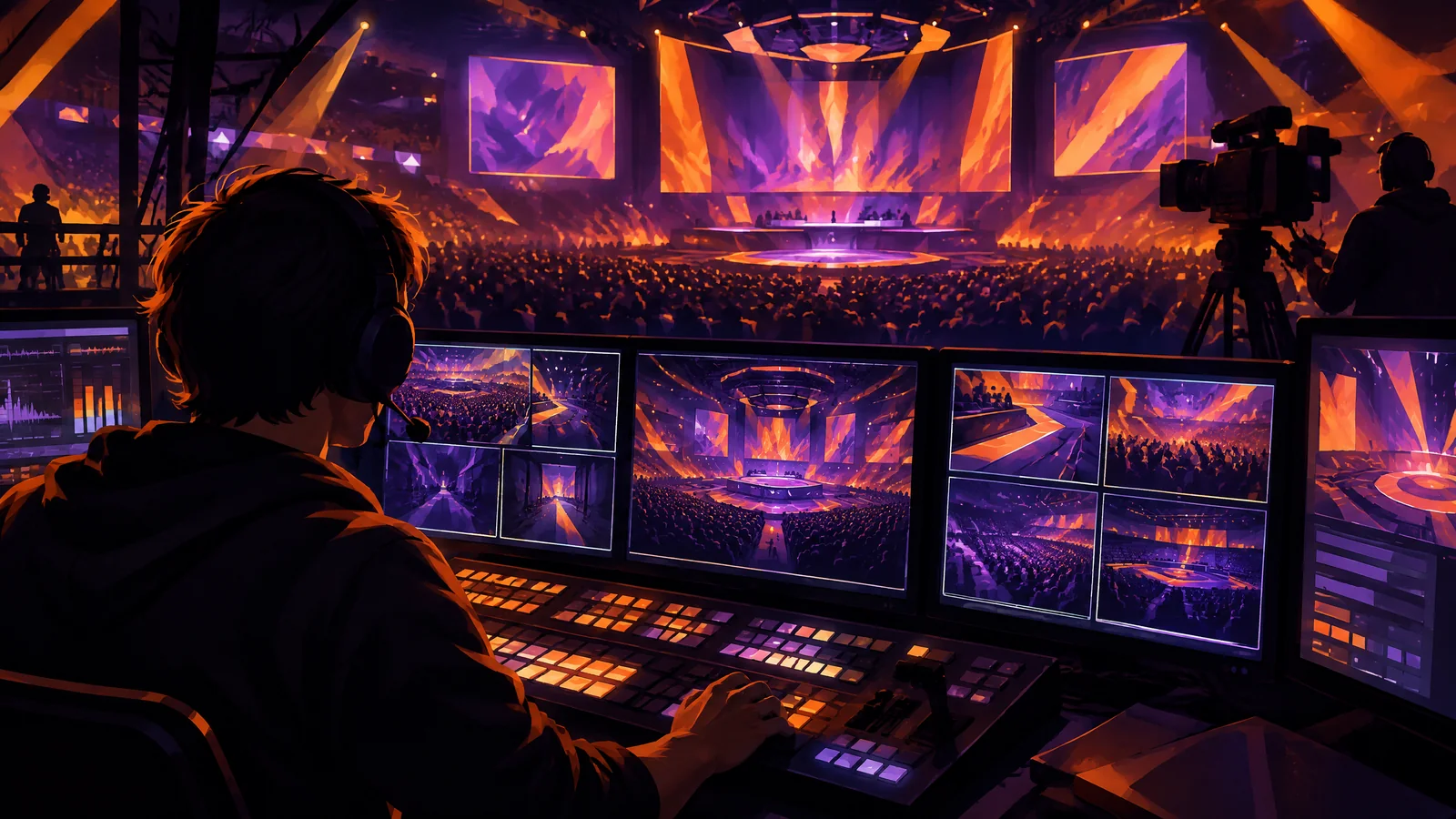
In a multi-cam esports production, in-game feeds sit beside cameras of players, casters and the stage. A control room, truck or remote production facility receives, labels and monitors those sources. The technical director switches among them while the producer follows a rundown and calls the next story beat. Commentary, crowd sound and music also need deliberate mixing; the sound sent to an arena may not be the same mix sent to a stream.
IP links can move feeds between systems rather than relying only on dedicated video cabling. NDI is one documented example of a standard that can send video, audio and metadata over IP within a production environment. That does not mean an NDI esports production pipeline is used at every event, or that it is the protocol a viewer receives. An event may also move selected roles away from the venue; our REMI sports broadcasting guide explains that remote-production model.
Graphics turn selected data into context
A broadcast graphics engine can add team names, series score, player labels, timers, maps and other context to the programme picture. An esports telemetry overlay may draw from a permitted game feed, a tournament scoring system or production-entered information. It is presentation, not automatic proof: the data source, operator checks and game rules determine what can appear and when.
Research on esports spectator interfaces distinguishes in-game spectator panels from overlays added outside the game. That difference matters when viewers see a minimap, player webcam or full-screen statistic. More information can clarify a complicated moment, but it can also crowd a small screen or reveal too much too early. For a confirmed result, check the organizer’s official record rather than a graphic alone.
Replay makes a moment reviewable
An instant replay system in esports records selected live sources so a replay operator can find, mark and play back a relevant clip. The producer may use it after a decisive round, during a pause or while casters explain why a play mattered. A replay needs clear labelling and context: it may show an earlier moment, a different observer angle or a slowed view.
Replay for a viewer is not the same as a competition official’s review process. It helps tell the broadcast story; it does not by itself establish a ruling or prove that all available perspectives were shown. British Esports lists replay operators alongside in-game observers and technical staff, which underlines that it is a distinct live role.
Why the stream can trail the match
Low latency tournament streaming involves trade-offs at more than one stage. A contribution link may use a protocol such as SRT, whose configured buffer gives late packets time to be recovered but adds delay. Downstream, the encoder, delivery network, player buffer and a platform’s latency mode each affect when a viewer sees the programme. Twitch, for example, offers low- and normal-latency modes and notes that users can choose differently if quality suffers.
Hypothetical calculation: if contribution and production processing total 1.4 seconds, encoding adds 0.8 seconds, and delivery plus player buffering adds 3.5 seconds, the viewer delay is about 5.7 seconds. Those figures illustrate, not measure or target performance. A score can therefore appear before a particular video player updates without proving that either feed is false; use our esports score-ahead timing check for that specific situation.
A useful way to watch the technology
When a tournament looks polished, separate the game state from the programme around it. Ask which view the observer had permission to use, which information is being added as graphics, whether a replay is live or earlier, and where the stream may have been buffered. That approach makes the workflow easier to understand without inventing the equipment behind a named event.
For the larger map of gaming systems—from permitted game data to delivery—return to esports technology explained. Tournament broadcasts are one spoke in that system: they select and communicate competition for an audience. They do not change the underlying result or replace the organizer’s rules and official records.
Sources
Sources checked for this guide include British Esports’ *Esports Broadcast & Production* overview; Sports Video Group’s report on the observer role; the Chalmers University of Technology study *Designing Spectator Interfaces for Competitive Video Games*; *The SRT Protocol* specification; NDI documentation; and Twitch Help’s *Low Latency Video* guidance.
These sources support a general workflow and documented capabilities. They do not identify the equipment, data permissions or latency of a particular tournament.