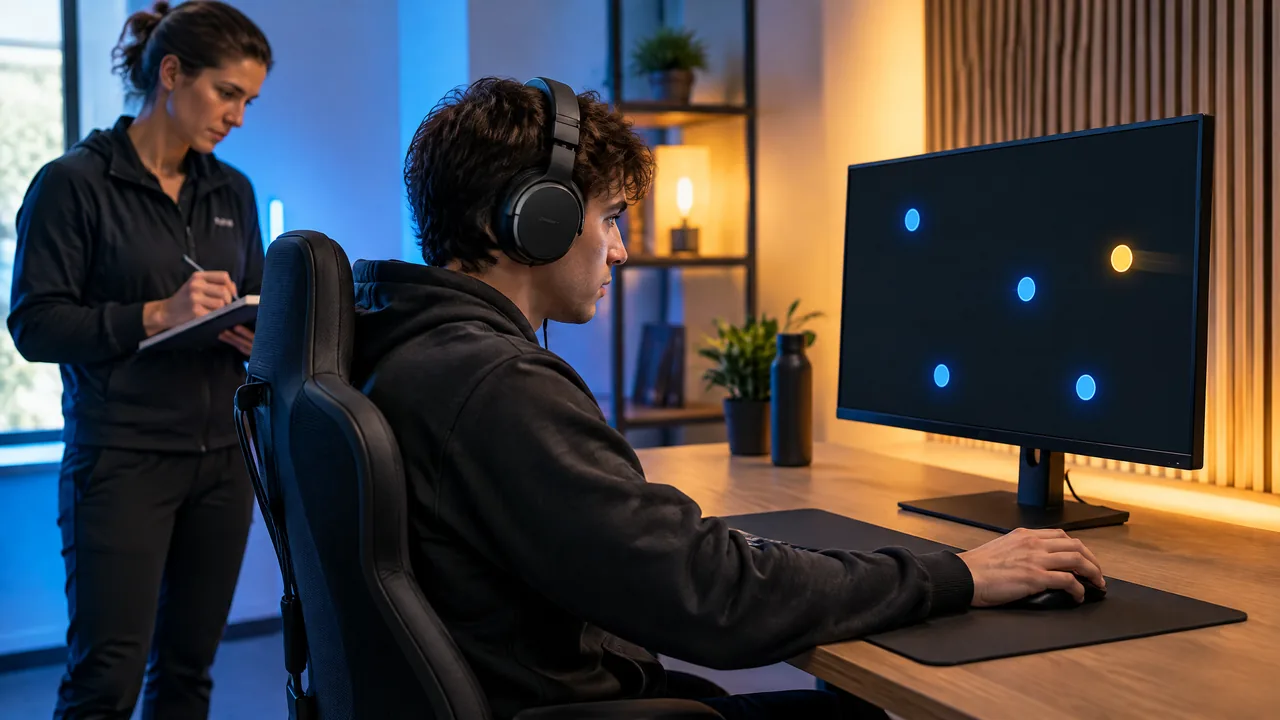
Start with the problem you want to practise
You can finish an hour of aim drills and still lose the next match. That is not proof that practice is pointless; it may mean the exercise measured a different skill from the one the game demanded. An AI esports training tool can help sort practice results and suggest a new drill, but it cannot choose the right move for you during competition or guarantee a higher rank.
Think of a useful training loop as baseline → one weakness → a short drill → a fresh test → a review in the actual game. This article covers practice and after-match reflection, not live assistance or a general survey of sports analytics. Players, coaches and parents should be able to tell exactly what was measured and what remains an educated guess.
What can an adaptive aim trainer measure?
In a practice task, a tool can record target hits, misses, speed of acquisition, tracking continuity or how performance changes as targets become harder. A vendor may use these observations to adjust difficulty or recommend the next exercise. Aimlabs, for example, describes personalised tasks, aim analysis and adaptive practice features on its official product site. Those are product descriptions, not independent proof that a particular user will perform better in a tournament.
A player might improve at following a moving practice target while still taking poor positions in a match. That's why a good review asks whether the task resembles the game situation, whether input sensitivity and screen settings stayed consistent, and whether the player made fewer of the same mistakes during play. For the bigger question of what data a training product may collect and use, read our AI in esports data guide.
Reaction time is not the same as decision speed
A simple click test measures one stimulus and one response. Esports play adds multiple possible actions, visual clutter, timing pressure, teammates and opponent behaviour. A slow network connection, display lag or changed mouse settings can shift a test score without any change in the player. Compare like with like on the same setup, and look for sustained improvement rather than celebrating one record attempt.
University of Sheffield researchers reported in February 2025 that more experienced Counter-Strike players were quicker than novices on laboratory decision tasks. That is a difference associated with experience in the studied sample—not evidence that an AI aim trainer caused it. The point for a reader is to separate what a test measures from the complex choice made in a round. Our performance technology guide explains why measurement quality comes before conclusions.
Can AI improve tactical choices in a game?
An after-match tool might tag repeated situations: an early peek, a late rotation or a missed opportunity to support a teammate. It may cluster similar clips and suggest what to review next. But an “incorrect” decision label can be wrong if it misses voice communication, an opponent's previous play or a role-specific objective. A coach and player can use the clips as discussion prompts and agree on one decision rule to test in the next practice session.
A 2026 BMC Psychology trial studied an individualized psycho-physical training programme with competitive esports participants. The programme combined physical and cognitive self-regulation elements; it did not test a commercial AI aim coach. Its measured cognitive-task outcomes cannot be used to promise improved match rank, aiming or tournament wins from a product. If you see that study used as an AI-tool testimonial, the evidence has been stretched.
A repeatable practice session without magic numbers
Choose one narrow aim or decision problem from a recent replay, not five at once. Take a short baseline on the same hardware and game settings, complete a brief focused practice block, then record the result and how tired you feel. Review a later game or scrim for the same error in a comparable situation. An illustrative goal might be fewer rushed first shots after a reposition; this is a coaching observation, not a guaranteed improvement target.
If the practice score rises but the in-game error stays, change the drill or look for a decision issue rather than doubling the hours. Rest, eye comfort and breaks matter too; a tool should not pressure a young player into a punishing schedule. We discuss broader interpretation and human override in responsible AI for player decision support.
Where is the fair-play line?
A practice environment and a competitive match are not the same permission space. Riot Games' VALORANT developer policy permits opt-in tools for reviewing match history and aggregate statistics, but rejects overlays using real-time data to tell a player how to act immediately. Publisher and competition rules differ, so check the current rules for the specific game and event before using a tool during play.
Do not confuse an adaptive drill with an aimbot, recoil script, hidden-information overlay or automated input. None is recommended here. Keep account credentials with the real publisher, understand what training data a provider stores, and ask whether a coach can see or delete it. A product that cannot explain its permissions or capture method is not a sensible basis for an important team decision.
Sources, limitations and the practical takeaway
SportyTechs checked Riot's VALORANT developer policy, the official Aimlabs product description, the University of Sheffield's 18 February 2025 research summary and the 2026 BMC Psychology training trial on 5 October 2026. The Sheffield result compares studied experience levels; the BMC programme was not an AI aim-product trial; vendor feature claims are attributed to the vendor. No universal reaction-time benefit, causal aim improvement, game-specific rank increase or live-match permission is claimed. The cover is conceptual practice photography, not a product screenshot or named team's programme.
Use a training score to decide what to review next, then check whether the skill transfers to actual play. That is a more useful measure than believing every new dashboard or repeating drills because an algorithm says so.