What a gaming reaction-time score actually measures
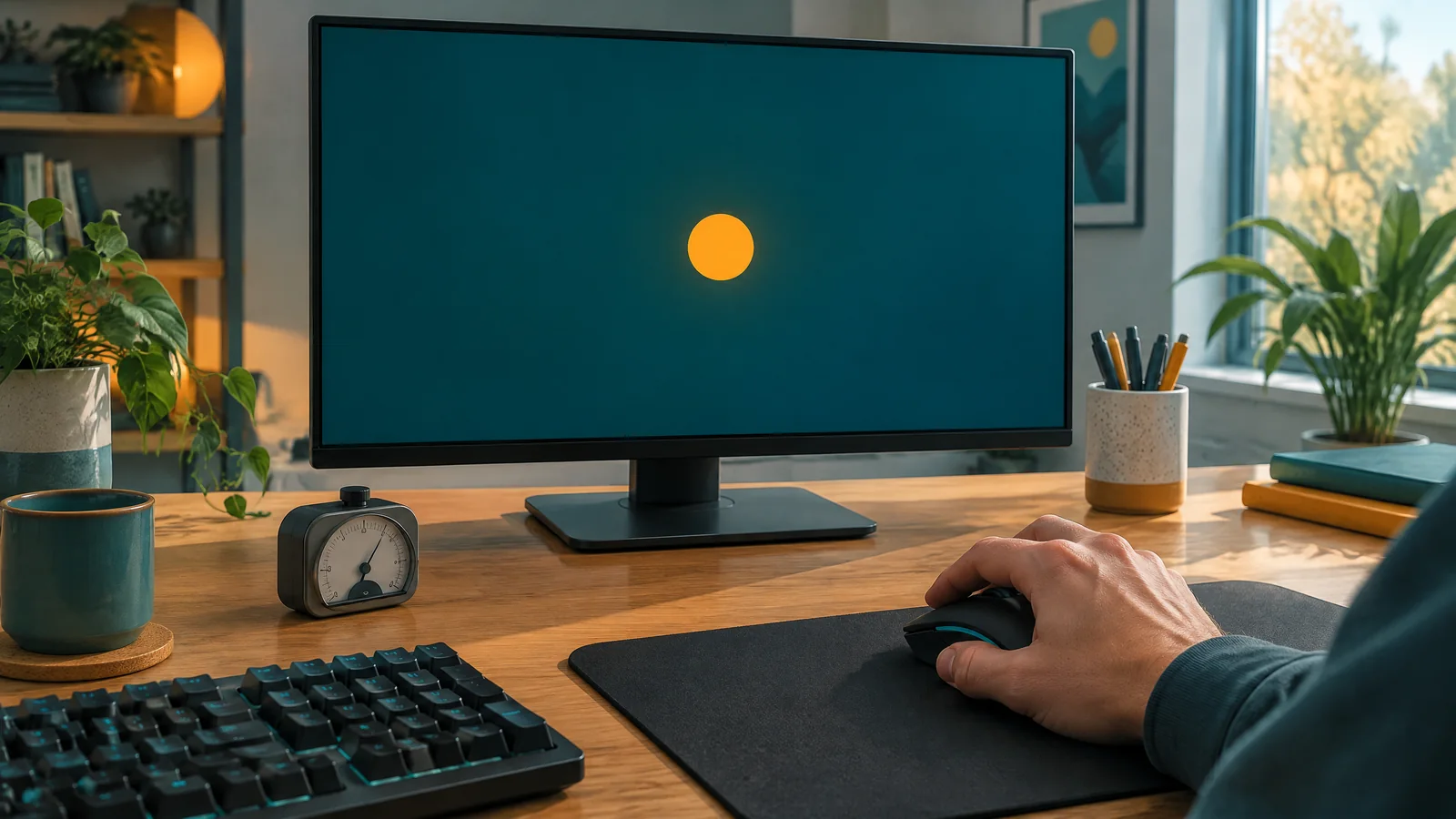
A reaction time test asks for a response after a signal. In a common visual version, a colour changes and you click. The number in milliseconds is useful, but it is not a direct reading of a gamer’s brain or a complete measure of competitive skill. It is the recorded time for one task on one setup.
That total can include when the image becomes visible, noticing it, choosing a response, moving or pressing the input, and how the browser records the event. Human Benchmark describes its red-to-green click task as a simple reaction measure and warns that computer and monitor latency affect the score. Its published 273-ms median is a statistic from that site’s collected data, not an average gamer reaction time or a professional standard. For the broader context around gaming systems, start with our esports technology overview.
Separate simple reaction, aiming, decisions and click speed
A simple visual reaction task has one known response: see the signal, then click. A choice-reaction task adds a rule, such as pressing a different key for a left or right cue. An aim task adds cursor travel, stopping and accuracy. Human Benchmark’s Aim Trainer, for example, scores the time to click 30 targets, so its result combines response and hand-eye coordination. It should not be compared directly with a single-click result.
A CPS test or click speed test is different again. It counts repeated inputs over a short interval; it does not tell you how quickly you responded to an unexpected signal. An audio reaction time test also answers a different question, and web timing research finds that precise audio onset is especially difficult online. Game decisions add opponent movement, recognition, prediction and game rules. A low number on a gaming reflex test online cannot certify those skills.
Why browser, display and input timing are part of the number
Online timing studies show that browser, operating system, device and testing platform can change both timing delay and variation. That does not make every online test useless. It means a browser score is most defensible as a comparison with your own results under matching conditions, rather than as a precise cross-person ranking.
Here is a hypothetical illustration, not a calibration result: a visible signal might add 16.7 ms of display timing, detection and response might take 210 ms, an input path 15 ms, and recording 8 ms. The shown total would be 249.7 ms. Changing one part can change the total even if the person responds identically. A reaction test therefore cannot separately measure end-to-end input latency. Network delay and server timing are a different problem; see esports servers, ping and tick rate. Display refresh and input delay also deserve their own explanation in our high-refresh esports monitor guide.
Build a repeatable personal baseline
Choose one task and keep its conditions stable: the same site, browser, computer, display mode, input device and roughly similar environment. Record the task type and date beside the result. Run several valid trials rather than treating the first attempt as a verdict. A median is often more informative than the single fastest click because it is less pulled by one unusually quick or distracted response.
For example, a hypothetical five-trial session of 238, 244, 241, 310 and 239 ms has a median of 241 ms. The 310-ms result may reflect a pause or interruption, but it should be noted rather than silently erased. If the next session uses a television, trackpad or different browser, label it as a different setup. You can still learn from it, but do not claim a 10-ms change proves a personal ability change. This page does not run a reaction-time test, CPS test, input-latency measurement or AI workout generator.
Read reaction-time benchmarks without assigning a rank
Searches for “reaction time benchmark,” “average gamer reaction time,” and “professional gamer reaction speed” invite a misleading shortcut: one number, one label. The evidence does not support a universal cut-off for a good gamer or a professional player. The public Human Benchmark median has a particular task, self-selected population and varied hardware. A laboratory choice task can take much longer because it adds a decision. An aim score has movement in it.
Gaming research is also more cautious than the stereotype. A pre-registered 2022 study found no overall gamer/non-gamer group effect on its choice-reaction task, and questionnaire timing changed performance patterns in another task. A separate small cross-sectional esports study found visual and aim differences between groups defined by existing gaming hours, but that cannot show that hours caused the difference. Treat a score as a personal measurement to track, not evidence that someone belongs above or below another player.
Sources
Human Benchmark’s *Reaction Time Test* and *Aim Trainer* provide the documented task examples and setup caveat used here. The online-timing evidence comes from Anwyl-Irvine and colleagues in *Behavior Research Methods* and Bridges and colleagues in *PeerJ*. Gaming-study limits are drawn from Ziv, Lidor and Levin in *Scientific Reports* and Ersin and colleagues in *Kinesiology*. The live-assistance boundary uses Riot Games’ *Addressing Cheating in VALORANT* support guidance. These named sources are listed with publication or checked dates in this article’s research metadata.