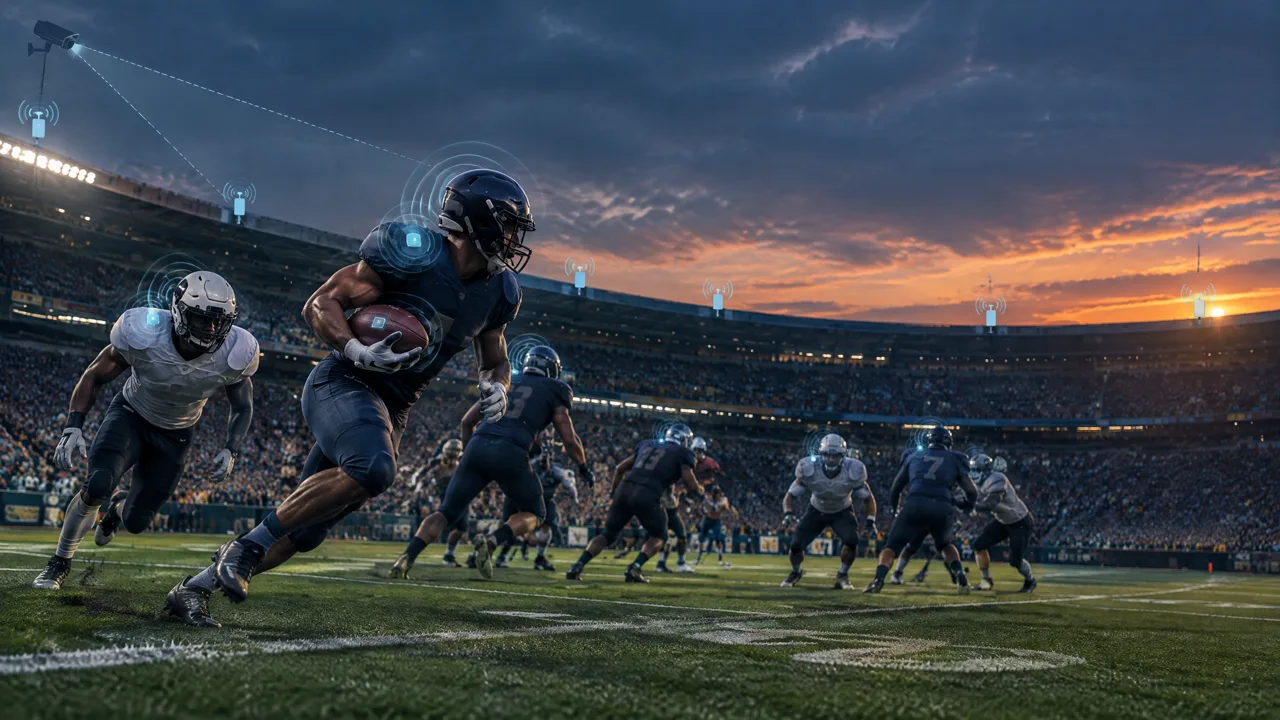
The short answer: tags locate players, models explain plays
How does NFL player tracking technology work? Sensors around a stadium locate radio tags in players' shoulder pads and the football. The NFL calls the resulting system Next Gen Stats (NGS). It records where players move; event markers and statistical models help turn those positions into useful football information. Cameras can add body-position detail, but they are a separate layer. A tagged ball doesn't make an officiating decision on its own.
If you've seen a speed graphic during a game, it's tempting to imagine a camera or a chip doing all the work. The chain is less magical—and more useful to understand: tagged object, stadium receiver, location record, football event, then a published metric. Each step can answer a different question.
What hardware tracks NFL players and the ball?
The NFL says its tracking installation is present at every NFL venue. It lists 20–30 ultra-wideband (UWB) receivers, two or three radio-frequency identification (RFID) tags in each player's shoulder pads, plus tags on officials, some field equipment and the ball. It estimates roughly 250 devices at a venue on game day and says three operators check that the tracking systems are functioning. These are the NFL's league-wide operating descriptions, not an inspection of one specific fixture.
Think of the receivers as fixed reference points around the ground and the tags as identified objects whose changing positions can be recorded. NFL Operations says the system captures player location, speed, distance travelled and acceleration ten times a second. Amazon Science's February 2026 account says player coordinates arrive at 10 Hz and ball coordinates at 25 Hz. Those rates describe samples, not a guaranteed delay before a fan sees a graphic. This is RFID/UWB location tracking, **not GPS**. For a broader look at how athlete tracking should inform decisions, see our athlete performance tracking guide.
How do coordinates become Next Gen Stats?
A moving dot isn't automatically a football stat. The NFL's product FAQ says raw tracking is combined with events such as the snap, the forward pass and the pass arrival. A model can then ask a defined question: how far did a receiver separate, how fast did a runner travel, or how likely was a completion given the circumstances? NFL Operations lists direct measures such as maximum speed and time on field, classifications such as routes and coverage, and derived metrics such as completion probability and expected rushing yards.
The distinction matters when you read a number. Speed is tied closely to measured position over time; a probability is a modelled estimate that depends on event alignment, definitions and assumptions. Neither reveals a player's intent or proves why a play succeeded. The sports analytics guide explains what to ask before treating any sports metric as evidence.
Does the sensor inside the football call first downs?
No. NFL Operations documents a tag inside the ball and says Wilson, the league and quarterbacks tested tracking devices so the chip would not change its flight. That helps capture ball position; it does not let a tag alone rule on possession, a touchdown or the exact spot after a play. The official's spot is a separate decision.
Sony Hawk-Eye's virtual line-to-gain measurement is another separate system. In its 2025 announcement, the NFL described six 8K cameras measuring the distance **from the officially spotted ball** to the line to gain, with the chain crew retained as backup. It's an officiating measurement workflow, not the NGS RFID receiver network. Our Hawk-Eye ball and player tracking guide keeps those optical uses distinct too.
Where do NFL cameras and AI enter the picture?
Amazon Science's February 2026 account describes an additional optical-pose system using 16 4K camera angles. It reports three-dimensional positions for 29 body parts at 60 samples per second. The partner says the capture layer was installed across games, but the pose data **remained internal while it was validated and structured**. Do not read that as a statement that every public NGS metric already uses those camera coordinates, or that a named team used them in a particular game.
A two-dimensional player location can tell you where someone moved, but not whether a ball passed over a shoulder or between players' legs. Body-pose analysis could help with that missing geometry; crowding and occlusion still need careful handling. For the general camera/identity problem, read computer vision in sports and tracking identities through crowded play. The model uses data; the radio tag itself isn't “AI.”
How real-time is NFL player data?
“Real-time” depends on which clock you're asking about. NFL/Amazon report 10 Hz player coordinates and 25 Hz ball coordinates. Amazon reports an under-one-second processing path for the **optical-pose pipeline**, including on-site processing and cloud analysis. That is a dated partner description of one pipeline, not a published end-to-end latency guarantee for every RFID record, broadcast graphic or website update.
The NFL's consumer FAQ says box scores and play-by-play update live, while NGS in its NFL Pro product is available the day after a game. So a near-live broadcast analysis and a day-after consumer stat can coexist. Before promising a live feed, ask whether the number is a sensor sample, a model result, a televised graphic or a product release.
What can teams and readers safely conclude?
The league says clubs can use tracking data to help plan games and that football operations and media can study or explain plays. Those are possible applications; they don't reveal every club's model, training decision or access policy. The reviewed public sources do not publish a universal calibration tolerance, raw-data schema, complete correction history or player-by-player consent terms. A tracking metric is a measurement or inference with a scope, not a diagnosis of fatigue or a prediction of injury. For the general governance question, read responsible AI for player decision support.
As of this draft's 5 October 2026 source check, the reliable picture is league-wide RFID/UWB NGS, a separately described internal camera-pose layer, and a distinct Hawk-Eye line-to-gain system. No game-specific device use, operator incident, coach decision or broadcast display is being claimed here.
Sources and editorial method
SportyTechs checked NFL Operations' *Performance Tracking Data (Next Gen Stats)*, Amazon Science's 2 February 2026 account of NGS and optical pose, the NFL's consumer FAQ, and the NFL's 2025 Sony Hawk-Eye line-to-gain announcement. Source titles, dates, URLs and claim boundaries are retained in this draft's private editorial metadata. This original cover is conceptual artwork, not a photograph of a named NFL game or a documented installation.