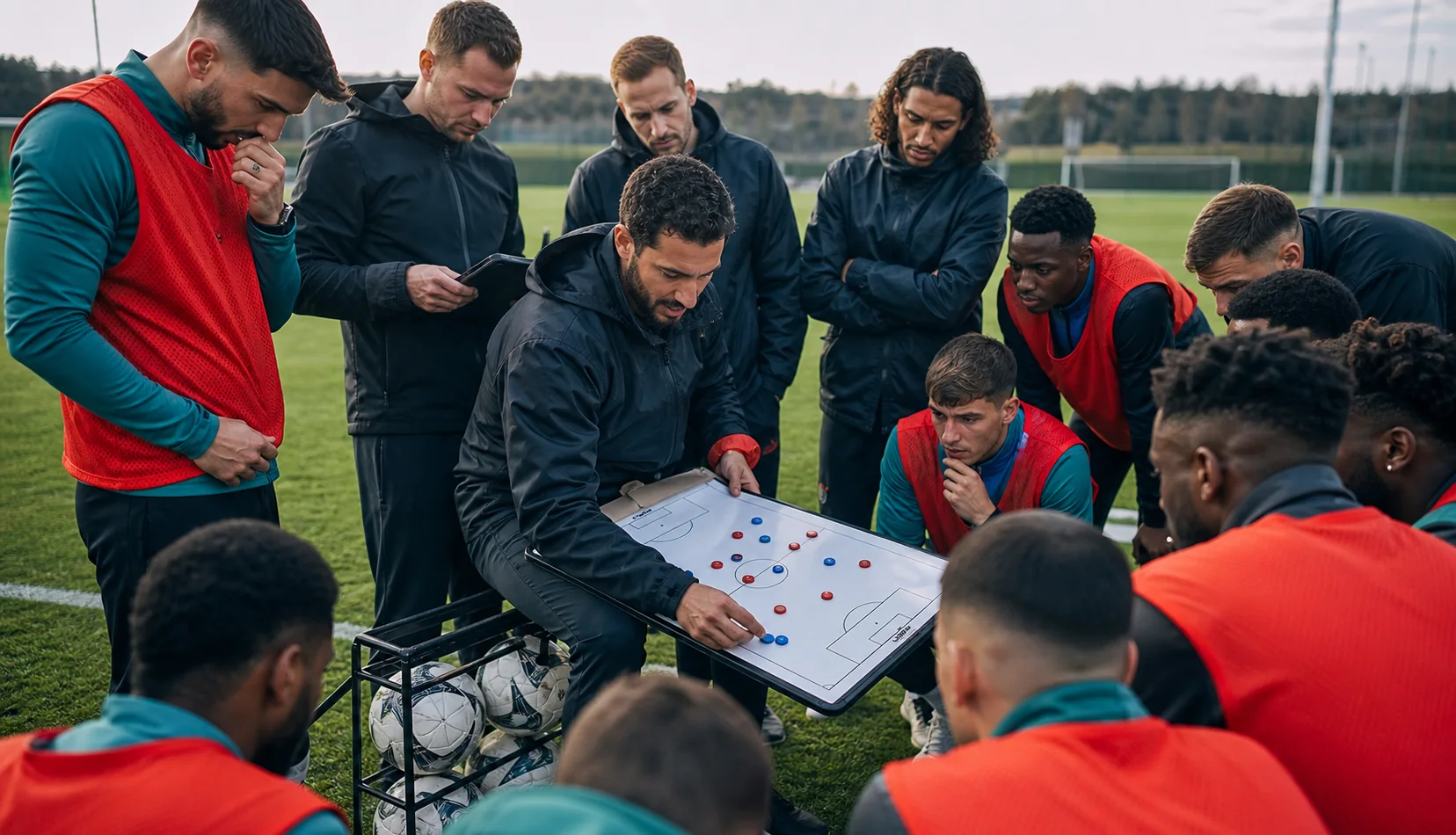
The daily performance huddle is a decision meeting, not a reporting ritual. Its job is to align the people who can change today’s training: head coach, assistant, performance lead, medical representative where appropriate, analyst, and operations lead. Start with the non-negotiables—the next competitive demand, venue constraints, travel, and current practice objective—then move to exceptions that may require an adjustment. Limit the group to people who own decisions or hold essential information. A crowded room often converts a ten-minute huddle into a status update with no clear outcome. Staff should record the adjustment, observe the next meaningful exposure, and revise the plan if the evidence changes.
Use a fixed agenda visible to everyone: what changed overnight, what was delivered yesterday, what matters today, who needs a conversation, and what decision is now final. Bring only information tied to those questions. A training load graphic, short coach note, athlete check-in theme, weather forecast, or venue update can each be useful, but only if someone can explain its implication. Staff should state uncertainty directly: missing data, a late fixture confirmation, or a player report that needs private follow-up. Honesty about limits prevents a polished dashboard from overruling common sense.
Start with the session objective before discussing individuals. If today is a tactical rehearsal, the team may preserve that purpose while modifying a high-cost drill or an individual’s role. If it is a development day, there may be more room to redistribute exposure. This sequence protects the sport coach’s intent while giving performance staff a defined place to contribute. It also discourages a habit in which every unusual number automatically drives the agenda. Context first, then individual adjustment, is usually more coherent than a list of flags with no shared training problem.
Decisions should be stated in operational language. “Monitor closely” is not enough; “the player completes the unit walkthrough, skips the repeated sprint block, and checks in privately afterward” has an owner and a boundary. Record only the action, rationale, owner, and review point. Avoid detailed personal information in a broad meeting note. If a health or safeguarding concern arises, take it to the appropriate restricted pathway rather than turning the huddle into a case conference. Clear notes reduce contradictory messages when athletes speak to different staff during the day. A brief note on context and outcome makes the next coaching decision easier, more transparent, and less dependent on memory.
Set a strict time limit and protect it. Most huddles can finish in eight to twelve minutes if complex individual issues move offline. Use a parking list for items that need analysis or planning later, such as a recurring training mismatch or a venue issue for next week. The facilitator should stop retrospective debate unless it changes today’s choice. A good huddle is not the place to prove who was right about yesterday. It is the place to ensure the group now acts from one current plan, with known contingencies if conditions change again.
Privacy and psychological safety are operational requirements. Athlete self-reports, personal circumstances, and detailed movement or clinical information should be discussed only to the level necessary for the people present. Staff must not use a huddle to signal authority by sharing sensitive detail. Athletes should know that their information may inform planning but will be handled through defined access routes. Likewise, assistants need permission to raise a concern without being dismissed for disrupting the schedule. Better decisions depend on staff surfacing uncertainty early, not protecting appearances. This creates a practical feedback loop: decision, delivery, observation, and a proportionate adjustment for the following session.
Evaluate the huddle through its outputs. At the end of each week, audit a small sample of decisions: was the action communicated, delivered, and revisited at the stated time? Did the meeting catch avoidable operational conflicts? Did it routinely defer the same issue without resolving it? Remove inputs that never change a decision and improve the data or communication that does. The best daily huddle becomes almost invisible to athletes because the day runs clearly. Its value is not more discussion; it is fewer surprises and more coherent coaching. The staff can then distinguish a useful adaptation from a temporary workaround and communicate the next step clearly.