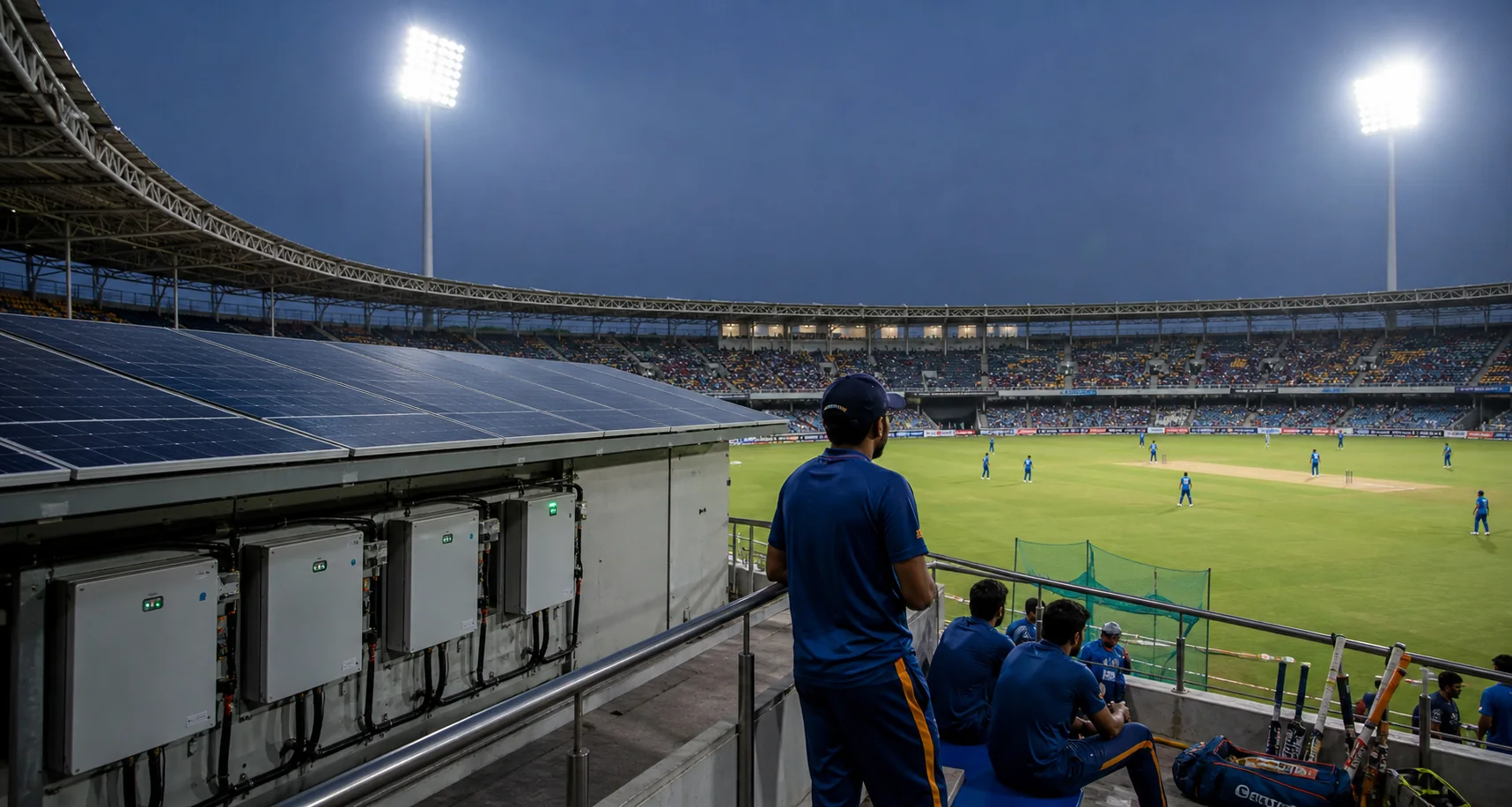
An energy microgrid should be evaluated as an event-continuity system, not only a sustainability feature. At a stadium, lighting, safety systems, communications, refrigeration, broadcast, pumps, and office loads do not have the same consequence when supply changes. In an Indian venue context, start by identifying the critical loads and local electrical conditions before choosing generation or storage equipment. The venue should make this choice deliberately rather than inheriting it from a default setting. It is a decision about people, process, and physical space as much as a decision about equipment. The resulting plan should be simple enough for an event supervisor to apply without opening a technical manual.
Build a load hierarchy with operators, not only engineers. Classify life-safety and emergency communications first, then identify event-essential services and deferrable loads. Record the starting currents, control dependencies, and restart order for major equipment. A theoretical backup capacity is misleading if a chilled-water pump, broadcast rack, or access control system cannot be restarted in the sequence the event requires. Frontline staff need a short instruction that remains usable when communication is imperfect. Document the normal workflow and the exception workflow; both need an owner. That discipline keeps investment choices connected to a credible event-day workflow.
Generation and storage trade-offs should be transparent. Solar production may align differently with a daytime event than an evening fixture; batteries can support short transitions but have finite energy; and backup generation has fuel, noise, and maintenance constraints. Model several event profiles, include weather and load uncertainty, and decide what level of service the venue will preserve during each contingency. Prefer a small intervention made early to a dramatic change made after options have narrowed. Field checks should challenge the model whenever the live environment has changed. It also gives the team a practical basis for changing the approach after a debrief.
Metering must be granular enough to inform action but not so elaborate that no one maintains it. Separate major systems and temporary event loads where feasible, then reconcile meter readings with operating logs. Investigate unusual demand with maintenance teams before treating every peak as a behavioural failure. A practical energy programme relies on trustworthy baselines, not decorative dashboards. Use evidence with humility: sensors, records, and observations each describe only part of the scene. Protect the route for people who need more time, space, or assistance to act on the instruction. The point is a clear operational choice rather than a more elaborate technical description.
Safety and approval pathways must be built into the project schedule. Electrical isolation, fire protection, access to battery areas, contractor controls, emergency response, and local permitting all require careful coordination. Give security and event operations a clear map of restricted equipment areas, including what changes during a power event and who is authorised to enter. Access should be proportionate to the task, with logs that support review without creating busywork. Limit collection and visibility of personal information to what the task genuinely requires. This keeps the arrangement understandable to the people who must act on it.
Test islanding, transfer, and restart under controlled conditions that resemble an event. Observe the actual response of ticketing, network gear, lighting controls, lifts, kitchens, and screen systems. Record not only whether power remained available but whether staff understood the change and whether customer-facing services recovered in a sensible order. An exercise should include at least one failed assumption, so recovery is genuinely practised. Rehearse the degraded mode before a crowded event makes experimentation unsafe. The same record can support a fair review when a decision is questioned later. Any partner involved should understand both its technical role and its authority boundary.
Governance after commissioning matters as much as the capital project. Assign an energy owner, maintain a seasonal operating plan, verify warranties and service access, and review event energy traces alongside reliability incidents. The aim is a resilient venue that understands its load choices. It is not an automatic promise of lower cost or uninterrupted service under every circumstance. The mature outcome is a service the venue can explain, operate, and improve with confidence. Continual improvement depends on honest feedback from users, crews, and supervisors. That makes the next event safer to run and the system easier to maintain.