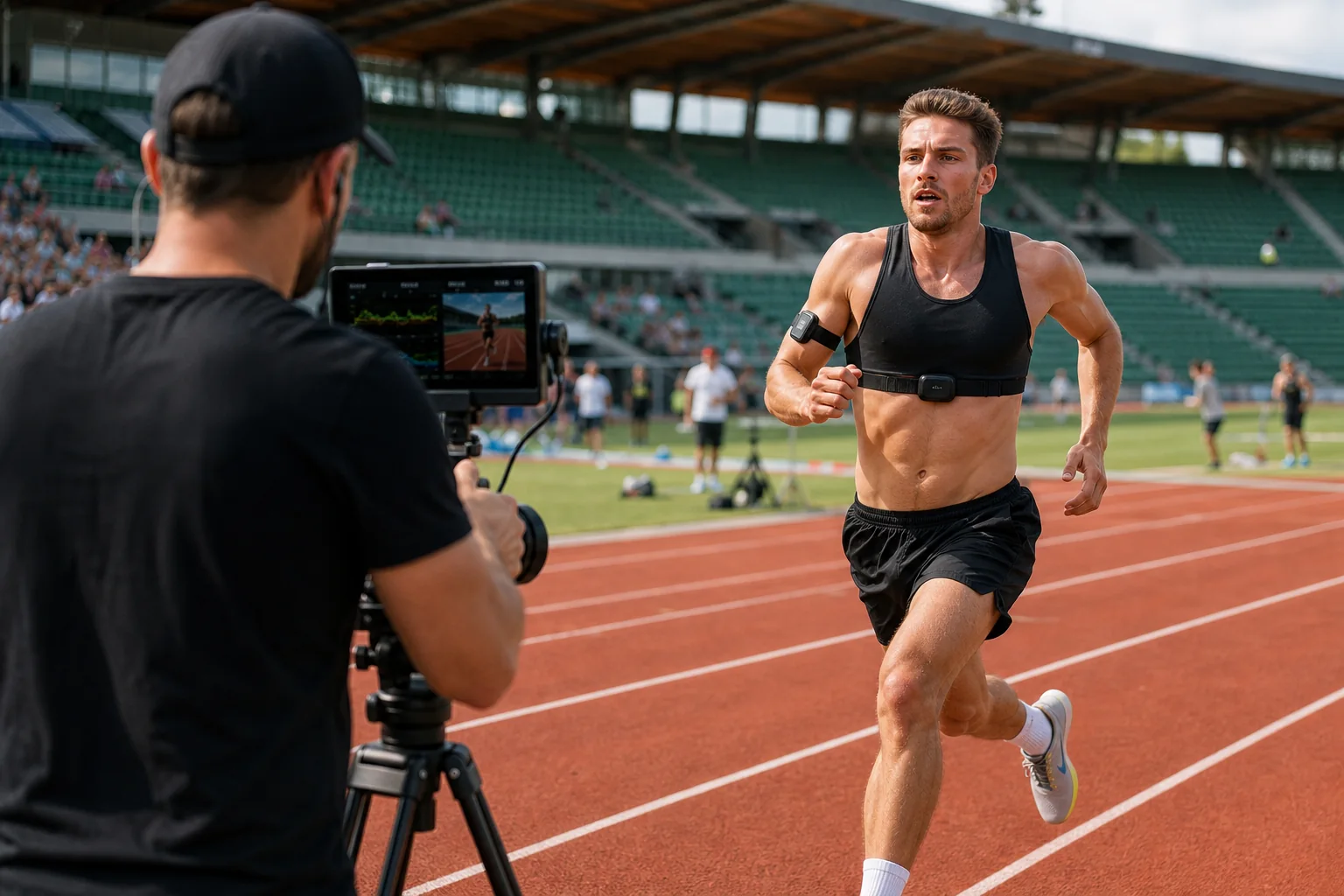
At a field site, Sensor fusion for sports analysis has to survive the conditions that staff actually face. The live question is which relationships across sources are sufficiently aligned to inform review, and which should remain separate because their uncertainty compounds. In a programme combining video-derived positions, permitted wearable measurements, and human-tagged events across training and competition settings in India, begin with observation: walk the space, speak to the operators, and list the parts of the day that vary. This ground truth prevents a plan from assuming stable power, views, attendance, staffing, or participant expectations. It also reveals where a small intervention could make an immediate difference.
To evaluate progress, use time-alignment error on test events, spatial discrepancy against known references, percentage of fused records with complete lineage, and error change when one source is absent. Compare like with like and retain enough context to interpret a change. For example, an intervention that appears to improve flow or coverage might instead reflect a different timetable, crowd mix, opponent, or lighting condition. Measurement earns trust when it is paired with a practical account of what changed and what remained outside the observer’s view. In practice, record this step in the shared operational log so that the next reviewer can see the context, owner, and unresolved question without reconstructing it from memory.
Choose signals that are available and defensible. For this work, they are source clocks, coordinate systems, sampling rates, device status, confidence flags, event definitions, and synchronisation offsets. Use them to establish one reference timeline, map every source into documented coordinates, and propagate uncertainty instead of snapping unlike measurements together. Keep a note of what is directly observed, what is estimated, and what has been supplied by another system or person. A simple source ledger gives later reviewers a way to challenge a conclusion without treating every issue as a conflict. It also helps a programme learn which collection work is worth repeating.
The first setup should favour reproducibility over sophistication. Take setup photos, use stable naming conventions, and give each role a short checklist. Avoid dependencies that a local operator cannot reset or explain. If the site needs a more advanced component, pair it with a manual alternative that keeps the core review process moving. A resilient field design anticipates weather, schedule changes, temporary structures, and ordinary human error. In practice, record this step in the shared operational log so that the next reviewer can see the context, owner, and unresolved question without reconstructing it from memory.
The engineer begins with a synchronization test event and stores the offset estimate with the session. Analysts inspect a small alignment panel before using fused views, compare selected sequences against raw video, and mark sources missing or degraded. Derived tables retain source lineage so a coach can move from a composite view back to each underlying signal. Include a brief end-of-day debrief that captures what staff noticed outside the instruments. Those comments often explain an anomaly better than a retrospective guess. Keep corrective actions small and assigned; a list of observations without ownership becomes institutional memory that disappears with the next shift.
Field limits deserve their own operating response: different sampling rates create interpolation choices, device clocks drift, event tags can be late, and combining two uncertain signals may increase confidence-looking detail without improving truth Use only authorised sensors, minimise athlete-linked data, document access and retention, and avoid blending sources for purposes participants were not told about. Ensure staff understand that fusion does not equal validation. Say in advance what will be turned off, escalated, or reviewed when those limits appear. This is particularly important where participants may have less power to question a programme or where the capture environment includes people who are not central to the sporting activity.
For the next fixture or cycle, Fuse sources only for questions that require the relationship, such as sequence review, and retain separate displays for individual-source decisions. Prefer an explicit gap over an invented coordinate. Write the adjustment onto the site card and test it with the people expected to perform it. Scale only when the routine is workable under normal staffing. The lasting asset is not the first visualization; it is a local process that produces useful, bounded evidence again and again. In practice, record this step in the shared operational log so that the next reviewer can see the context, owner, and unresolved question without reconstructing it from memory.