What the 23 September report actually adds
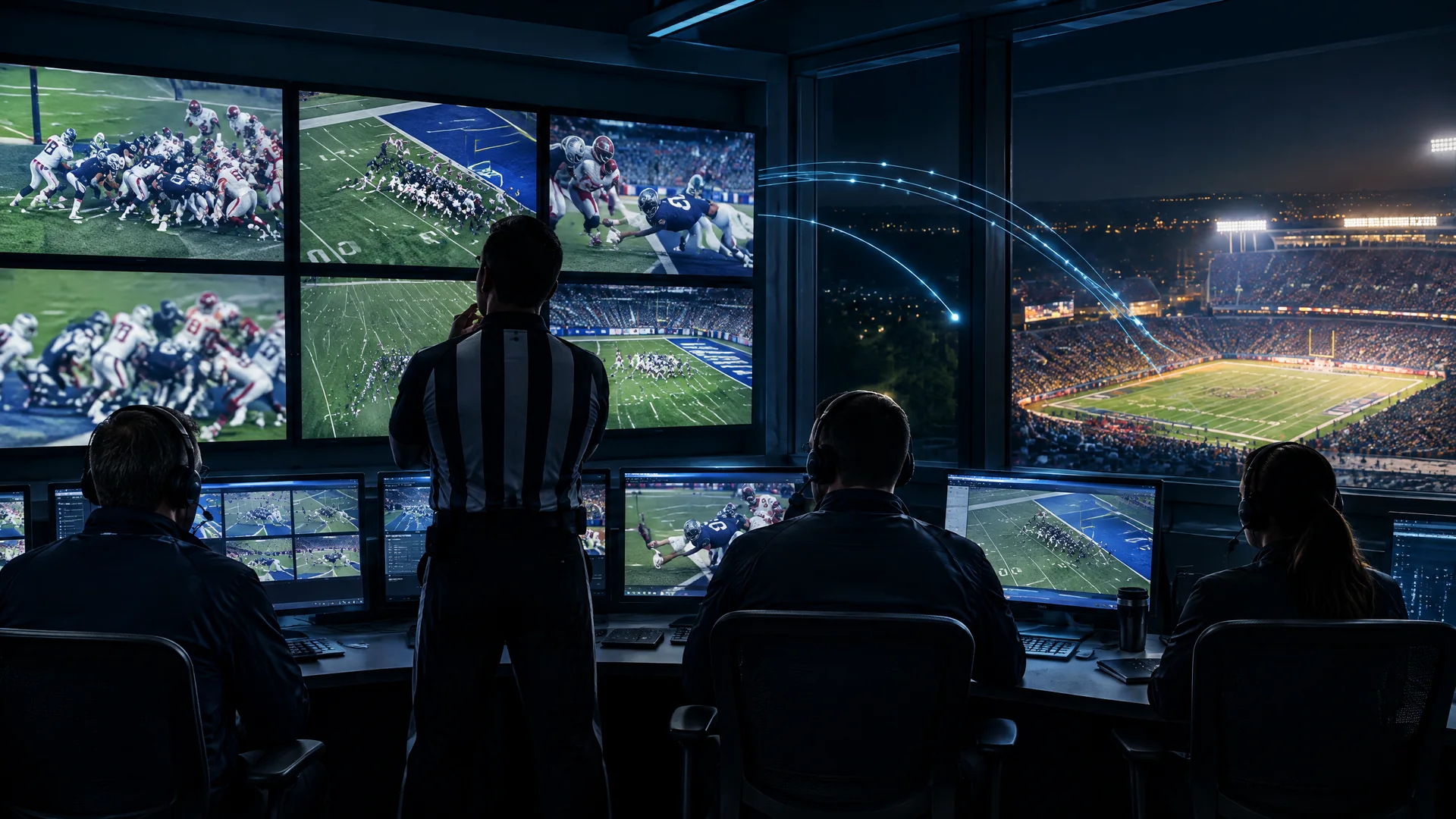
Mountain West’s centralized replay operations centre in Las Vegas is not a new 23 September launch. The conference and its replay supplier had already announced that the 600-square-foot facility opened on 29 August with seven replay stations, access to broadcast and coaching feeds, direct communications and game archives. The material development inside the reporting window is a more detailed early-operations account. It says the review room can now display twelve inputs at once, compared with nine under the previous arrangement, keeps goal-line feeds separate, supports work shared with Conference USA and changes the hours imposed by late games in Hawaii. This chronology matters because it separates installed capability from subsequent operating evidence and keeps supplier claims about better accuracy or speed outside the confirmed record.
From nine views to twelve inputs
The reported increase from nine to twelve simultaneous inputs expands what the replay team can place on its review surface. Broadcast feeds, coaching views and dedicated goal-line pictures can provide different evidence about the same incident, but an additional view does not automatically resolve the decision. Operators still have to know which feed is synchronized, whether every relevant moment is available and which angle addresses the rule being reviewed. That is the same distinction explored in SportyTechs’ guide to auditable replay for officiating incidents: collection is only the first part of an accountable review. A twelve-input wall can reduce the need to replace one picture with another, yet the public record does not show whether it shortened a review, changed an overturn rate or prevented a missed angle.
Separate goal-line feeds change the review surface
The early-operations report says goal-line feeds are now available separately instead of being combined into a quad view. Separate feeds can make each camera picture larger and easier to select, while a quad view can help operators compare several pictures at once. Neither presentation is inherently correct for every incident. The useful question is whether the reviewer can identify the relevant frame, verify timing and understand the limits of the camera position. SportyTechs’ article on why camera calibration is the first analytics decision explains why an apparently precise image can still carry geometric limits. The Mountain West record identifies the presentation change, but it supplies no calibration documents, synchronization test, camera-availability log or decision-quality comparison.
Las Vegas changes the people-and-hours model
Before this centre opened, the collaborative replay process operated from the supplier’s headquarters in Pittsburgh. Moving support west changes the time-zone relationship with Mountain West venues. The specialist report gives Hawaii home games as the clearest example: a late local kickoff could keep an eastern support team working deep into the night, whereas Las Vegas reduces that offset. This is a real operating consequence, but it is not evidence of a staffing saving or a health outcome. The record does not disclose shift length, headcount, fatigue reporting, overtime, turnover or review quality by hour. The defensible conclusion is narrower: location alters when a centralized team works, so leagues evaluating remote review need to treat time zones, handovers and sustained attention as part of system design rather than as background scheduling.
Shared operations require separation as well as capacity
The report also says the facility supports replay work for Conference USA. Sharing a room and technical platform can improve utilisation, but the public material does not explain how the conferences divide access, staff, credentials, archives or escalation authority. Those are not reasons to assume a problem; they are controls that make shared operations inspectable. Separate competition profiles, logged operator access, clearly assigned decision owners and documented incident hand-offs help prevent one league’s work from becoming ambiguous inside another league’s operating environment. The broader stadium operating-system framework applies here because a control room is not only a collection of screens. It is a set of roles, permissions and decisions that must remain clear when multiple organizations use the same infrastructure.
Communications and archives support human accountability
Mountain West’s earlier records describe direct communications among stadium replay officials, the centralized team and officiating leadership, along with archives from conference football games. The later report adds operating context but does not displace the final human decision. A useful replay chain therefore needs more than a video wall: it needs a named person responsible for the ruling, a record of which angles were available, a way to capture communication and a route for post-game review. SportyTechs’ work on human review for semi-automated offside and computer vision in match officiating makes the same boundary explicit. Technology can organize evidence, but rule application, escalation and accountability remain human responsibilities unless a competition publishes a different governed process.
What remains unmeasured
The early account establishes a centre in use and identifies meaningful workflow changes. It does not publish review duration, overturn rate, error rate, feed availability, camera synchronization, outages, security controls, staffing levels or training outcomes. It also gives no incident record showing how the room responds when a stadium feed, communications path or workstation becomes unavailable. Those missing measures set the threshold for a later update. A post-season audit could compare review times without equating speed with correctness, disclose feed and system availability, document training and escalation, and explain how disputed incidents were reconstructed from logs. Until such evidence exists, the significant development is the operating model: twelve visible inputs, separate goal-line feeds, western time-zone alignment and shared use, all bounded by the need for traceable human review.